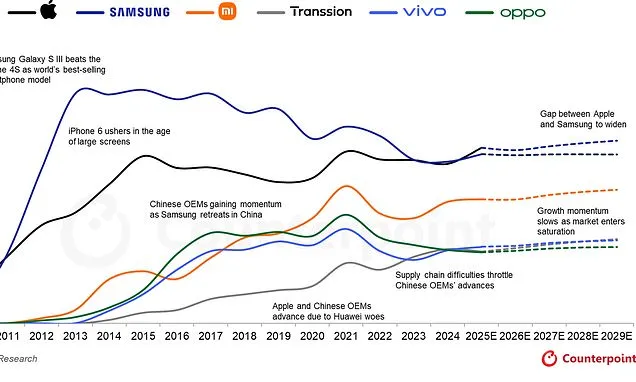
Apple is set to surpass Samsung to become the world's top phone maker for the first time in 14 years, experts reveal.
Apple will ship around 243 million phones this year compared with 235 million for Samsung, according to Counterpoint Research.
This equates to 19.4 per cent of the global smartphone market for Apple compared with 18.7 per cent for Korean rival Samsung.
It puts the multi-trillion-dollar company above its Asian rivals for the first time since 2011.
What's more, Apple will maintain the global top spot until 2029 - and possibly even beyond, according to the experts.
Yang Wang, analyst at Counterpoint Research, pointed to the success of the iPhone 17 released in September which is having 'bumper' holiday season sales.
'In addition, we are seeing record demand coming from emerging markets like India, Middle East and Southeast Asia,' he told the Daily Mail.
'Apple has been actively working with channel partners to penetrate deeper in domestic markets, or setting up retail outlets directly.'
Apple is set to surpass Samsung in shipments for the first time in 14 years by the end of the year. Other smartphone brands ranking behind the two giants are China-based - Xiaomi, Vivo, Transsion and Oppo.
Apple will ship around 243 million phones this year compared with 235 million for Samsung, according to Counterpoint Research.
'Added to the fact that the US dollar has depreciated during the course of the year, that has meant that consumers overseas have found a little bit more purchasing power and can afford an aspirational upgrade.'
Sales of the iPhone 17 series in the US during the first four weeks after launch were 12 per cent higher than those of the iPhone 16 series (excluding the 'budget' iPhone 16e).
In China, sales of the iPhone 17 series during the same period were 18 per cent higher than its predecessor, even though the iPhone Air was not part of the initial launch.
Meanwhile, in Japan, sales for the iPhone 17 series during the first four weeks were seven per cent higher than those for the previous generation.
Mr Wang also pointed to a certain demographic of iPhone users who don't rush out to buy the newest iPhone model every year but are now choosing to upgrade.
'Beyond the highly positive market reception for the iPhone 17 series, the key driver behind the upgraded shipment outlook lies in the replacement cycle reaching its inflection point,' he said.
'Consumers who purchased smartphones during the Covid-19 boom are now entering their upgrade phase.'
Apple also benefited from lower-than-expected tariff impacts globally and a truce in the US-China trade and tech war. President Donald Trump's trade tariffs threatened to put hefty charges on goods imported from other countries - including China where most iPhones are made.
Global smartphone shipments are expected to increase by 3.3 per cent year-on-year in 2025, mainly driven by strong performances from Apple.
Top five smartphone firms by shipments
- Apple (US) - 19.4% global share
- Samsung (South Korea) - 18.7%
- Xiaomi (China) - 13.7%
- Vivo (China) - 8.4%
- Transsion (China) - 7.9%
- Oppo (China) - 7.8%
With strong momentum building for the iPhone 17 series across key regions, iPhone shipments will grow 10 per cent year-on-year in 2025, while Samsung is expected to see a 'decent' five per cent shipment growth.
In contrast, mixed fortunes are projected for the top four Chinese manufacturers - Xiaomi, Vivo, Transsion and Oppo.
The experts point to domestic market weakness, supply chain 'jitters' and increasing competition throttling further growth for these Chinese companies.
'These companies are shifting toward higher price segments, investing in premium devices, AI capabilities and foldables to boost profitability and reduce reliance on the crowded low-end market,' the research firm said in a statement.
'Supply chain uncertainties, however, continue to pose constraints on expansion.'
Global smartphone shipments are expected to increase by 3.3 per cent year-on-year in 2025, mainly driven by strong performances from Apple.
In the next few years, Apple is likely to increase its dominance as some hotly-anticipated iPhone products finally get a release.
It is on track to launch the iPhone 17e - the successor to the iPhone 16e and the second model in the lower-priced 'e' series - in the first half of 2026.
The company is also expected to release its first foldable iPhone by the end of next year, likely a book-shaped device with a large internal screen.
Meanwhile, a smaller iPhone 'flip' with a horizonal crease across the screen is expected by late 2027.
The team at Counterpoint Research also forecast a 'major iPhone design revamp' in 2027 to mark the 20th anniversary of the iPhone.
Respected US leaker Mark Gurman has already said this special device will have a curved glass screen.
Further improvements to Apple Intelligence, the company's suite of AI tools, will also fuel more sales by persuading people to upgrade to the newest device.
It's been nearly two decades since Apple released its first ever iPhone
The device that redefined mobile phones helped make Apple one of the most valuable companies in the world.
Apple's original iPhone model sold a whopping 2.2 billion units after just a year of sales; now—18 years later—the Cupertino firm still looks unstoppable.
The first iPhone was announced by Steve Jobs in January 2007 and released in the US on June 29 that year. Its release in other countries—including the UK—came in November.
The co-founder described it as 'an iPod, a phone and an internet communicator', stressing from the start that it wasn't like any other phone at the time.
Jobs was not wrong when he said the company 'is going to reinvent the phone' with the device, which boasted a 3.5-inch diagonal screen, 16GB of storage and a 2-megapixel camera among its specs.
The 3.5-inch diagonal screen was considerably larger than other smartphones at the time (which Jobs said actually were 'not so smart').
In 2007, rival phones including BlackBerry, Nokia E62 and Moto Q had a set of buttons that took up about half front device.
For first iPhone, Apple decided to replace physical buttons with virtual buttons within user interface because they could be changed depending on software being used at any one time.
Although other touchscreen products had come before, iPhone was revolutionary because user could interact with it using finger rather than stylus.
Jobs memorably condemned rival tech companies who chose to design stylus for their tablets when introducing first iPhone (bitter rival Samsung is still today releasing phones with styluses).
'Who wants a stylus?' Jobs said. 'You have to get them, put them away, you lose them. Yuck! Nobody wants a stylus. So let's not use a stylus.'
Apple products, he said, were designed to work with 'best pointing device in world' - human finger.
Cameras
The original iPhone only had a single camera - 2-megapixels, located on the back of the device. At the time, one camera on the back of a phone was fairly common.
But it couldn't record video - something that is taken for granted now.
Video capability wouldn't come to Apple's phones until the iPhone 3GS in 2009.
Connectivity
Jobs introduced the first iPhone as a 'breakthrough internet communications device' with desktop-class email, web browsing, searching and maps.
But the device could only connect to Wi-Fi and 2G - the second-generation cellular network standard dating back to the 1990s.
Even though the first commercial 3G networks were introduced in mid-2001, iPhone notably lacked a 3G connection capability for fast internet access.
3G came to iPhones the following year with the iPhone 2, first released in July 2008.
Apps
Intriguingly, Steve Jobs was originally opposed to the idea of allowing third-party development on iOS, the firm's proprietary software, which also debuted in June 2007 with the first iPhone.
In other words, Jobs didn't want the iPhone to have apps that users could buy from outside developers; every app would be something his firm had created.
So when the iPhone first launched it had no App Store and only came with preinstalled apps like Weather, Notes, Calendar and Photos.
However, Jobs finally relented on the proviso that third-party apps met strict standards and were all tested and approved by Apple.
The App Store launched in 2008 and has since been at the heart of creating a large number of hugely successful mobile app businesses including Angry Birds, Uber and Deliveroo.
Price
With the era of the iPhone, shelling out several hundred dollars for a mobile device has become fairly normal.
But 15 years ago, the first iPhone was slammed for being far too expensive for the average consumer.
2007's iPhone was available with either 4GB of storage for $499 or 8GB of storage for $599, on a two-year contract with AT&T.
In contrast, iPhone 17 starts at $799 - while Pro models push past $1,000.