'Riding St George', 'pully-hawly', 'clicket' and 'blanket hornpipe' - you'd be forgiven for thinking these whimsical terms from the 1800s were the names of frivolous party games or domestic hobbies.
They were all, in fact, euphemisms for a very different kind of recreation, namely sex, a subject that has demanded verbal tiptoeing for centuries and that has inspired each generation to invent ways of giving a vigorous nod and a wink without crossing the line.
But now, it seems, a chunk of this lexicon, even from recent history, is slowly slipping away.
According to a survey, today's young have never heard of such phrases as 'hanky-panky', 'how's your father', or 'rumpy-pumpy'.
Instead, they choose to go full frontal with such descriptions as 'smash', 'hook up', and 'get with'.
The shifts in our squeamishness over time have always been fascinating.
Take swearing, which in the Middle Ages rested mainly on religious profanity.
'Gorblimey' (God blind me), 'drat' (God rot), and 'strewth' (God's truth) were all ways of avoiding the use of God's name in vain.
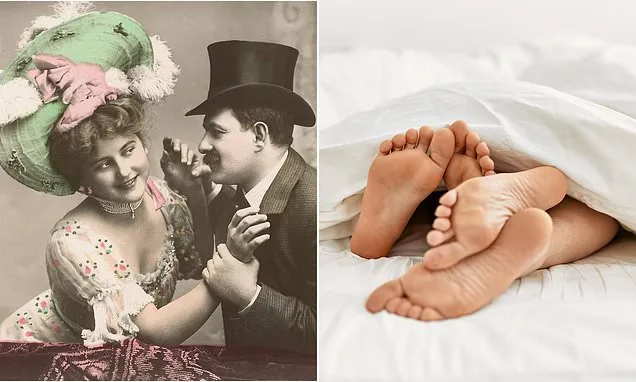
A vintage photograph from the 1890s shows a man attempting to steal a kiss from a woman.
Body parts, on the other hand - or what those parts got up to - were fair game.
Shakespeare, master of innuendo as well as verse, revelled in dirty jokes.
He even gave us what might be the first 'your mum' joke on record in Titus Andronicus, when Chiron tells Aaron: 'Thou hast undone our mother.' Quick as a flash, Aaron answers 'Villain, I have done thy mother.'
A few centuries later, the world had changed, and our taboos with it. Bawdiness didn't disappear, but it went underground. Some of the subjects requiring fig leaves might surprise you.
For the Victorians, who called chicken breast 'white meat' and famously wrapped cloths around piano legs lest the sight of them suggest the human version, the word 'trousers' was considered unutterable in polite company.
Clearly these garments housed the unthinkable.
Enter such synonyms as 'inexpressibles', 'sit-upons', and 'unmentionables'.
You can imagine a Victorian gent scratching his head and asking: 'Where on Earth have I put my round-me-houses?'
As for sex, a brief riffle through a historical dictionary provides plenty of examples of strait-laced synonyms: 'business', 'correspondence', 'arriving at the end of the sentimental journey', and, of course, 'intercourse', which originally meant simply 'social communication'.
'Making love', from the 17th century, is still hanging on, but only by its fingertips.
Dive into a thesaurus of slang, on the other hand, and it's clear these were always going to be too po-faced for some.
Those same Victorians, for all their prudishness, delighted in coded banter for sex, and there's no denying it's fun.
'Hot cockles' was one favourite, as was 'tipping one's nag the gallop', 'catching an oyster', and the wonderful 'fandango de pokum'.
Best of all, surely, is 'firkytoodling' - described simply as 'vigorous kissing and cuddling'.
You can sense the delight in all of them, part of a parlour game where everyone knew what was being said but no one was offended.
A few decades later, music hall and comedy were adding to the sexual repertoire with such phrases as 'how's your father', a nonsensical catchphrase made popular by the performer Harry Tate, who used it innocently enough as an escape route whenever his character was unable to think of an appropriate response.
It took another 50 years for 'how's your father' to settle happily beneath the sheets.
'Hanky panky' also started off very differently, as a riff on 'hocus pocus', the verbal flourish of magicians.
Sleight of hand eventually suggested sleight of a whole lot more... As for 'rumpy-pumpy' - a phrase that needs no further explanation - we can thank Blackadder for its popularity.
The expression appears there many times, notably King Richard's rallying cry: 'Blood! Death! War! Rumpy-pumpy!'
But if the days of 'rumpy-pumpy' and its ilk are numbered, we should hardly be surprised.
Each carries an echo of Carry On films, where 'ooh Matron' moments abound and 'taking her up the chip shop' left no one in doubt what was on the menu.
When such references are lost, their language often vanishes with them. Often for good reason.
According to a survey, today's young have never heard of such phrases as 'hanky-panky', 'how's your father', or 'rumpy-pumpy'
It would be hard not to respect our children and grandchildren for jettisoning such misogynistic phrases as 'getting your leg over'.
Besides, new generations will always have their own codes to mark out members of the tribe.
'Netflix and chill' had its own sense of mischief, but it is making way for verbs so unflinching they might have made even Shakespeare’s eyes water. As always, context is key.
Firkytoodling has always required careful navigation. Keep that in mind the next time you consider dropping your unmentionables.