A strange fog envelops the town, sowing fear and chaos. The monster is loose.
Season 1, Episode 8: 'Winter Fire'
A good Pennywise murder has several key components. It has to be disgusting, first of all. It has to be blackly funny, displaying the sense of humor of an insult comic or edgelord podcaster who goes way too far. Finally, there' has to be a little showbiz: Its primary persona is that of a performer, after all.
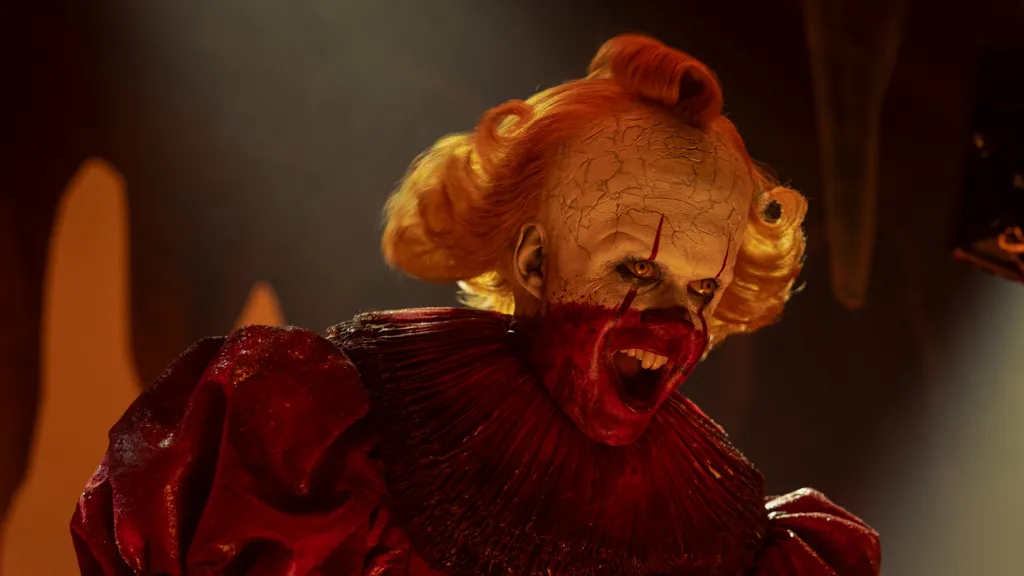
This is why the berserk scene that kicks off the season finale of "It: Welcome to Derry" works so well. After the destruction of one of the ancient pillars that contains It, a freezing mist envelops Derry. The titular creature calls the children of the town to a school assembly. There, It reveals itself in Pennywise form, Its white clown costume now the crimson color of the blood in which It hibernates.
It works the kids' principal like a puppet before poking out his eyes, tearing of his head and punting it like a football. (Our heroes later find it lying outside.) It parts a red curtain straight out of David Lynch's Black Lodge to reveal a convincing theatrical simulacrum of Hell behind It.
As the children scream and try to flee, as the sound grows more hellish and cacophonous, Pennywise the Dancing Clown sings, then opens up Its head to reveal the infernal orange glow of Its deadlights. This black magic renders the children catatonic and elevates them into the air, where they float away behind the clown as It leads them, Pied Piper-style, to the city limits.
How's that for an opening?
Written by Jason Fuchs and directed by Andy Muschietti, the season finale of "It: Welcome to Derry" consists largely of a prolonged final battle for the fate of the children, the town and the free world. Leroy, Charlotte, Dick, Rose, Taniel, Ronnie, Marge, Lilly and Will (who spends some time in Its deadlights) struggle to save the children and seal It within the confines of Derry.
But under the orders of Gen. Shaw, the military attacks, wounding Leroy and killing Taniel. Dick is able to psychically trap It within the memories of Bob Gray, the circus performer It consumed and absorbed, for only so long before It uncovers the ruse and escapes. Too bad for Gen. Shaw, who had picked this moment to taunt the thousand-toothed monstrosity, which froze in place when Dick whammied it. Once the whammy is broken, It is free to gobble up Shaw, who dies issuing commands to the creature as if he were talking to a drunken private.
So it's up to the children, as it always is in this story. As Pennywise skips through the snow toward them like the hap-hap-happiest child predator on this plane of existence, Marge, Lilly, Ronnie and Will implant the mystical dagger into the ground beneath a dead tree that marks the uttermost outskirts of Derry.
They manage with the help of Leroy and Rose, who presumably are able to injure the creature because of their fearlessness and faith respectively, and with that of their friend Rich, who appears as a ghost to flip It the bird and lend a hand to drive the dagger down. Not even transforming into a giant, bat-winged bird of prey can save It from being blasted back into hibernation.
After that, it's all over but the grieving and the leaving. The adults and kids attend Rich's funeral, where Dick -- whose visions of the dead are now under control thanks to a psychedelic tea Rose served to him -- tells Rich's parents that the boy is still with them. Ronnie and her fugitive dad, Hank, head out of town. Will and his family take over Rose's farm, and her duty to keep It contained. Will writes letters to Ronnie in hopes that they will help her remember him while Derry’s mysterious power works to make her forget.
There's one more resident of Derry we haven't mentioned. Ingrid Kersh winds up back in Juniper Hill, where she remains until the 1980s. In a flash forward that ends the episode, Sophia Lillis reprises her role from the "It" films as Beverly Marsh, who encounters an aged Mrs. Kersh after her own mother's suicide in the asylum. "No one who dies in Derry ever really dies," Ingrid informs the girl, grinning from ear to ear.
Yet many mysteries remain unresolved, and it is unclear if those answers are intentionally absent or being hand-waved away. For example, what becomes of all the kids who suddenly find themselves in the middle of a frozen river after being hypnotized and paraded across town by the terrifying clown from their school assembly? Do they remember any of it? Do their presumably concerned parents?
What about the military ramifications? Gen. Shaw is dead, along with his big project of capturing an extradimensional entity to use against Freedom Riders and beatniks. What's the fallout from this catastrophe, and why are key players like Dick and Leroy allowed to simply walk away?
Dick, of "The Shining" fame, even has a groaner of a line about how he doesn't anticipate getting into trouble at his new job ... in a hotel. As for Leroy, I don't think I would be quite so relaxed about buying a family farm in the hunting grounds for a cannibalistic Clarabell, for that matter.
Not all of it works on the level of genre storytelling, either. The adults' exposition regarding what needs to be done with the dagger feels canned and forced. So does the dagger's inexplicably negative psychic energy, which briefly transforms Lilly into a Gollum-esque figure obsessed with the show's answer to the One Ring. These feel like first-draft ideas.
I'm intrigued, however, by the questions that are clearly intended to remain open. Marge is right to note that Its ability to experience all of time simultaneously is a major revelation, and not just because it affects her and her loved ones directly, in the past, present and future alike. Ever the chatterbox, Pennywise tells Margie she is destined to give birth to Richie Tozier, one of the "It" films' heroes (played by Finn Wolfhard and Bill Hader), who in turn is destined to cause Its death.
But because Its relationship to reality is nonlinear, It suggests that Its "death" might in fact be a new "birth." This introduces the possibility that the timeline established in the two "It" films, including the events of those films themselves, could be altered or even erased by Pennywise's space-time shenanigans. If you've seen those movies, which range in quality from spooky to, frankly, stupid, that would be ... well, to borrow a phrase from Stephen King's "The Stand," no great loss.
This fluid approach to the movies' continuity is part of what makes this show such a surprise. "It: Welcome to Derry" feels like a mulligan for Muschietti, who directed them. The first film's haunted-hayride vibe; the second's nonsensical plot and warmed-over quip-heavy dialogue: All of that has been jettisoned. In their place stands a season-long testament to the power of cruelty in art.
From start to finish, "Welcome to Derry" has relentlessly probed fears that plague our childhood and our adulthood. Children are tormented with their worst nightmares. Adults are taunted for their most painful failures and confronted with their most terrible memories.
At the center of it all lurks an orange lunatic who feeds on fear and suffering, empowered by a government apparatus working to spread that fear and suffering from sea to shining sea. As such, Pennywise is a monster for our degraded age.