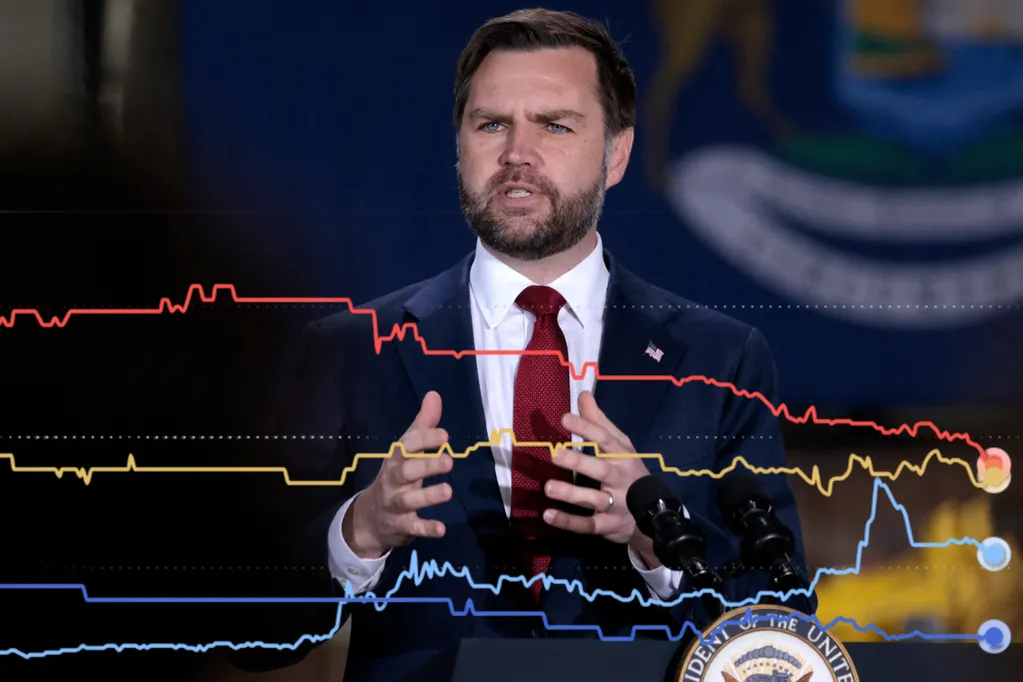
That advantage has eroded as geopolitical turmoil and shifting voter sentiment reshape the early 2028 landscape.
Prediction markets are signaling a notable downturn for Vance's 2028 chances, with Polymarket saying in a post on X on Wednesday: "BREAKING: JD Vance's 2028 odds crash to an all-time low of 18 percent."
At the time of writing, Polymarket's live odds page showed Vance at 18 percent, down from 22.4 percent on February 28, the day war broke out between the United States, Israel and Iran.
That marks the lowest point for Vance since this particular market launched.
The shift has not happened in isolation, with California Governor Gavin Newsom close behind on 17 percent, while Secretary of State Marco Rubio sat at 11 percent after briefly rising to 16.9 percent in the aftermath of the conflict before sliding back again.
Polymarket's "Presidential Election Winner 2028" market has drawn heavy interest, with more than $455 million traded overall.
Vance alone accounted for nearly $8.9 million in volume, compared with about $6.5 million for Newsom and just over $5.1 million for Rubio.
New York Democratic Representative Alexandria Ocasio‑Cortez trailed the leading contenders at roughly 5 percent, though her market attracted more than $10 million in trading, highlighting the level of speculation across the field.
Kalshi, another major U.S.-regulated prediction market, tells a similar story.
Vance's implied chances were listed at 19.2 percent at the time of writing, close to what the platform shows as his all‑time low, which was 17.3 percent on March 11.
That figure is down from 22.9 percent on February 28, continuing a steady decline over the past month.
On Kalshi, Newsom stood at 18.3 percent, narrowing the gap further, while Rubio registered 14.3 percent.
Trading volume on Kalshi's 2028 U.S. presidential winner market topped $23.8 million, reinforcing the sense that investor sentiment has cooled on Vance while warming slightly toward his Democratic rival.
Traditional betting markets are also moving.
Star Sports now lists Newsom as the favorite to become the next U.S. president, pricing him at 7/2, down from 4/1.
Vance, once the clear market leader, has slipped to 4/1, marking the first time since Trump took office in 2024 that he has been overtaken at the top of the odds.
Rubio trails the two leaders at 7/1, while Ocasio‑Cortez is priced at 16/1.
The shift is significant not only for Vance's standing but also because it marks the first time since August 2024 that a Democrat has been favored to win the presidency.
William Kedjanyi, a political betting analyst at Star Sports, said the movement reflects a combination of polling trends and broader political headwinds.
He pointed to growing criticism of U.S. involvement in the Middle East and noted that Newsom currently leads Vance in head‑to‑head polling averages, adding to the sense that momentum has changed.
Despite the slide, Vance remains the favorite to secure the Republican nomination, priced at 11/8, ahead of Rubio at 5/2.
On the Democratic side, Newsom leads the nomination market, with Ocasio‑Cortez a distant second.
Star Sports also lists Democrats as 4/6 favorites to win the White House in 2028 compared with 5/4 for Republicans, underscoring how far expectations have shifted since Vance's early dominance.
Prediction markets allow traders to buy and sell contracts tied to the outcome of future events, such as elections.
Prices fluctuate based on demand, with higher prices implying a greater perceived chance of an outcome occurring.
Supporters argue these markets can aggregate information quickly and reflect real‑time sentiment, sometimes reacting faster than polls.
Critics caution that they can be volatile, influenced by large trades or short‑term news events, and should not be treated as forecasts.
Traditional betting odds, while similar, are set by bookmakers who may adjust prices to balance risk as much as to reflect political reality.
William Kedjanyi, political betting analyst at Star Sports, said: "The current governor of California has shortened from 4/1, marking the first time a Democrat has been favorite to be the next POTUS [president of the United States] since [former Vice President] Kamala Harris in August of 2024, and the move comes amid a backdrop of growing criticism of the Trump-led U.S. involvement in the Middle East.
"Newsom leads second favorite JD Vance in an average of head-to-head polls by 4.6 percent, and as the Democrats attempt to wrestle back control of the House of Representatives in November's midterm elections, they are 4/6 favorites to return to the White House in 2028."
Speaking about a 2028 run, California Governor Gavin Newsom told Politico: "It's fate that will determine that. It's not me. It's the people who will determine that...Family first. Period. Full stop.
"And number two, you have to meet the moment.
"And that moment presents itself in the context of Trump and Trumpism and the world we're living in and all the just anxiety around what he's unleashed in terms of the unknown and chaos.
"Who knows where we'll be in six weeks, let alone six months, let alone in two years. And so it will reveal itself."
Vice President JD Vance told USA Today in August last year: "Yes, terrible tragedies happen, but I feel very confident the president of the United States is in good shape, is going to serve out the remainder of his term and do great things for the American people.
"And if, God forbid, there's a terrible tragedy, I can't think of better on-the-job training than what I've gotten over the last 200 days."