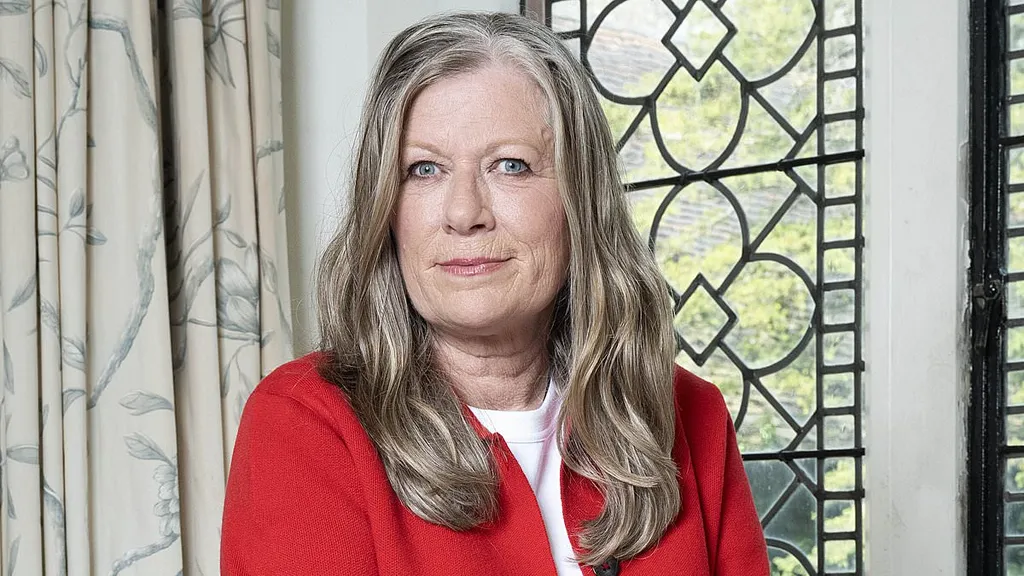
Wendy Duffy bowed out of life in the way she always insisted she would: with a smile, happy to be off. 'Onwards and upwards. Ta-ra, Flower,' she told me in the last conversation we had before she left her Swiss hotel and checked into the assisted suicide clinic from which there would be no return. Just hours later I got confirmation that she was dead.
The Lady Gaga and Bruno Mars song Die With A Smile - her choice - had played her out of this world. I am told that she asked for it to be turned up to full volume as she was fading away. Which was very Wendy.
'I'm going out with a bit of bang, aren't I?' she told me during our designated 'goodbye' call on Thursday night.
She had been blown away by the reaction to this newspaper's interview with her, which ran that day, and had felt the tsunami of affection for her even from sterile Switzerland.
The 56-year-old was aware that she was leaving us as debate over the Assisted Dying Bill was reaching its end in the House of Lords, and that her story had been a hugely important one. Controversial, too.
Wendy was touched that so many people supported her, even if they disagreed fundamentally with what she was doing.
'Wouldn't it be a boring world if we all agreed?' she said.
She was in what can only be described as buoyant form as we spoke, just before 11pm on Thursday. She messaged to say she had to charge her mobile phone first. 'It's been red-hot. I've had to charge it four times today. Everyone has been phoning to say goodbye, all my brothers and sisters, nephews, friends. You wouldn't believe it.'
I would, Wendy. I really would.
She'd eaten her last proper dinner - a veggie falafel burger - had enjoyed a long shower and was going to do a bit of meditation, then 'pack'.
That wasn't going to take long. She'd taken only a small case to Switzerland. When a foreign national dies at the 'suicide clinic' Pegasos, their belongings cannot be returned to the family and everything is donated to an animal charity. Wendy wanted to 'leave it neat' for them.
'There isn't much. The case. Some clothes. They might be able to sell my ear buds, and my phone. I'm going to reset it, take it back to factory settings.'
The car was booked to pick her up from her hotel at 9am, and she wanted to be prompt. This was not a lady who liked to mess anyone around. I don't know for sure, but I'll wager that she made her bed before checking out.
Will you be having breakfast before you go, I asked.
'Oh yes,' she assured me, laughing about how even an appointment with death would not stop her getting her money's worth from the buffet breakfast.
'It's a lovely hotel, this,' she marvelled, rejecting my clutching-at-straws suggestion that if the hotel was so nice, she could just stay a bit longer.
It was the most British death, while at the same time being the least British death. It felt all wrong to me but entirely right to Wendy. 'Let me go,' she said. As if I could stop her. For 40 minutes we chatted, before her final words to me: 'Onwards and upwards. Ta-ra, Flower.'
'Flower' was a new one. In the three months I had known Wendy, she'd always managed to surprise me with the sheer range of her breezy terms of endearment, all delivered in a thick Brummie accent.
'Sweetheart' was a favourite. 'Mate' or 'Matey' came at the end of every other sentence. 'Blossom' popped out occasionally.
I'd gone into this 'journey' with Wendy, incredulous at first, certainly tentative. This couldn't be for real, could it? A perfectly healthy British woman, just a year older than I am, who had been given the green light to die in a Swiss clinic and who wanted to explain why before she went.
Before I even called her there were concerned conversations with colleagues on this newspaper. She must be, we all agreed, disturbed, fragile, weird.
I prepared to tiptoe carefully on that first testing-the-waters phone call.
'Did you think I'd be nuts, Matey?' she said during it. 'I assure you I'm not. I have full mental capacity.'
It was a subject we would return to several times over more telephone chats and then an in-depth, in-person interview.
It would go like this: she'd assure me she was entirely sane; I'd say something like: 'Psychiatric wards are full of people who think they are entirely sane, Wendy,'; she would laugh and say: 'Well, I am, Sweetheart.'
The thing is there was nothing, ever, to suggest that she wasn't entirely sane. This was a bright, clever, warm woman, just one who was utterly broken by the loss of her only child. Her beloved Marcus was only 23 when he died in a freak accident, choking on a halved cherry tomato in a sandwich she'd prepared for him.
She had already attempted suicide since his death. She was 'doing this' - by grisly means if it came to it. But she'd rather have her 'gentle death' in Switzerland, and since that opportunity existed for her, why the hell not?
And hadn't all the psychiatrists already confirmed that Wendy was indeed of sound mind?
What I had to remember, she told me repeatedly, was that by the time I met her she'd been planning her death for a year. 'I've got my head around it. It's what I want, and I'm going to get it.'
Last month, after several long phone conversations, we did our big interview. She turned up in a taxi at a nice country hotel to meet me and photographer Murray Sanders. There were sandwiches and coffee. She had us in stitches at times; tears at others.
Murray has dealt with all manner of difficult stories in his 45-year career. He has reported from war zones, covered murders, photographed difficult celebrities and Prime Ministers. He stays calm in the face of, well, anything.
But he had never met a Wendy. He was choked enough on that day simply unable to comprehend how someone who had so much to live for—her vibrancy there in clear proof on his camera—could be so determined to die.
Wendy said that it was 'better this way' to go through the clinic as she would not be 'leaving a mess behind'
By the time I spoke to Wendy on Thursday she'd already had her 'goodbye' call with Murray. They'd done, she told me, 'that thing of saying "You put the phone down. No, you do first."' He had insisted she must end the call because he couldn't.
Once I'd ended my final call with her I paced up and down my own kitchen and called Murray. He had been driving at the time Wendy called him and had pulled over to a lay-by. He was still sitting in the car shedding a tear.
I share this with Murray’s permission—even if, as he puts it, it ‘makes him look soft’—because it illustrates a wider point. Wendy went to her death calmly, coherently, almost serenely. She coped better with it, frankly, than anyone else did.
But this, I fear, is the thing about assisted dying. Without sounding too brutal, it is easy for the person who wants to exit; less so for everyone else around them.
I think we saw this with the huge reaction to Wendy’s story. I have been fielding calls all week—not just from TV stations and journalists but from readers, friends, my own family.
Just minutes after Wendy’s story went online I was contacted by a lady called Katja Faber, another bereaved mum I had interviewed some years ago. Katja’s son Alex Morgan had been murdered in the most awful circumstances at a Swiss chalet. He was 23 when he died—the same age as Wendy’s son Marcus. She told me her heart had gone out to Wendy and she wanted to help.
She was in Zurich. Did Wendy want her to go to the clinic and sit with her as she died so that she wasn't alone? No judgment, she assured me. No attempt to change her mind.
I asked Wendy secretly hoping that this could happen and that Katja could change her mind. Wendy was so touched.
But she declined. ‘I wouldn’t put anyone through that,’ she says. Similarly she’d told her siblings not to even consider making a last-minute dash to Switzerland.
And what of Wendy’s family? I thought of them often on that last night wondering what they were doing thinking feeling.
‘I’m glad they have each other,’ Wendy said insisting she felt like a ‘weight was taken’ off her shoulders once she had told them she was in Switzerland and while shocked they did not try to stop her. ‘They know me,’ she repeated.’They know this is what I want.’
Whatever Murray and I were feeling on that last night would have been multiplied a hundred-fold more by Wendy’s family who knew her and loved her.
This is the thing. The pacing around the kitchen watching the clock wondering if you’d done enough will be familiar ground for any family who discover their loved one is in Switzerland about to end their life.
If this is happening to one British person a week at Pegasos alone—which the founder tells me is the case—that leaves a lot of families feeling helpless powerless and utterly distraught. The law cannot help here. This was something Wendy and I talked about several times including the night before she died. ‘It’s better this way because I’m not leaving a mess behind,’ she said.
You are,Wendy,I said.It’s just a different type of mess.
‘I know I have to put my family through pain to alleviate my pain.I know that’s selfish,’she admitted.'But it’s my life.'
There were so many moments where the ‘what ifs’ seemed to drown out her words.What if Marcus hadn’t choked on that tomato?What if she’d had better bereavement support earlier?
There was a chilling moment when she was singing the praises of the Pegasos staff.
‘I’d tell you if they were toerags,honest,sweetheart,but they’ve been so helpful and so lovely.They’ve been much better than the NHS.When someone loses a child or relative there needs to be more support.The NHS can’t cope with what it’s got,it really can’t.’
Not that she blames the NHS.‘I’m not blaming them.I’m not blaming anyone.My decision.Mine only.’
I got word that Wendy had gone at lunchtime yesterday.She hadn’t gone through with the threat to take a bottle of Champagne into the room with her.(She told me the procedure was booked for early in the day,’too early for even me to start drinking’.)
I was reminded of something she said on that last night of life justifying for the nth time why she wanted to go.‘Before Marcus died,I’d always been that bubbly bottle of pop,you know the one where you take the top off and it fizzes everywhere.
‘But my sparkle went the day I lost Markie.It really did.’
It didn’t,Wendy.The rest of us saw it;you just could not.