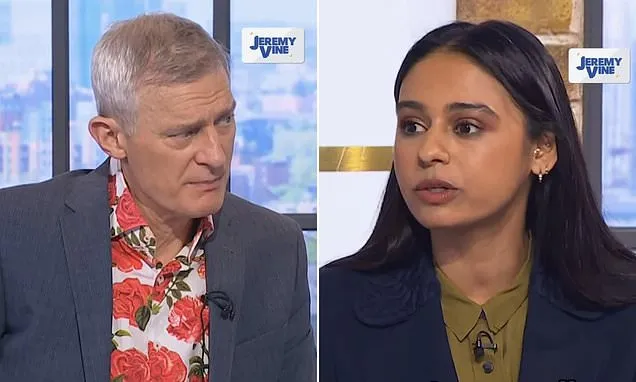
Jeremy Vine viewers were left up in arms after the broadcaster was joined by two contributors for a 'totally ridiculous' debate about an upcoming ITV period drama.
Last week, it was revealed that ITV were planning a new period drama exploring whether Queen Elizabeth I was transgender - with insiders warning it would be 'guaranteed to anger viewers'.
It was reported that transgender actresses were being considered for the role of the Virgin Queen in the series that had been dubbed Majesty, with casting directors admitting they were 'particularly keen' to hire a transgender leading lady.
Jeremy, 60, was joined documentary maker Nelufar Hedayat and political commentator Peter Barnes to discuss the news, as they debated the 'anger' over the TV series drama.
Opening up the debate, Jeremy began: 'Queen Elizabeth herself may have been biologically male?' to which Nelufar, 38, responded: 'Yes, or certainly a hermaphrodite. There are a lot of sexes in between male and female.
'The thing is, the casting directors have come out and they've just basically said we would prefer, quote, "we are particularly keen", they said, to hear from people who are transgender for this role.
Jeremy hit back: 'But they don't say Julias Caeser was a woman?' before drawing comparisons between the new drama and 2024 film Conclave, in which the newly elected Pope (Cardinal Benitez) is intersex.
Peter chimed in: 'Queen Elizabeth I's story is about being the Virgin Queen, about being the powerful female leader and now they're recasting that as they wouldn't probably do with certain people in certain communities.'
He concluded by fuming that the move felt like a 'double standard'.
Sharing the clip to social media, fans were quick to interact with the segment from Jeremy Vine, with many hitting out about 'historical inaccuracy'.
One penned: 'I just want to get off this planet,' as another wrote: 'Portraying a real historical figure in any other way they the truth is historical inaccurate and should not be allowed.
'It's just teaching the younger generations wrong information and is totally ridiculous.'
'This is absolutely ridiculous,' a third chimed in, while a fourth penned: 'It's so disrespectful.'
Others stepped in to defend Nelufar and the show's curators, adding: 'How many films/plays/performances have there been about the Tudors...
View this post on Instagram
'How many times have those films ever portrayed anything but heteronormative casting! Getting mad about gender identity and roles in film misses the point of art and culture as a whole and shows how limited you are.'
A second penned: 'They are stories... just stories to explore humanity and being. The history of young men playing women and later women playing men's roles is nothing new. Imagine the discussion and out rage the first time a woman played a woman...'
It comes after it was revealed that ITV were said to be planning a new period drama exploring whether Queen Elizabeth I was transgender - with insiders warning it's 'guaranteed to anger viewers'.
Bosses have been looking for 'actors who identify as transgender women' to play the role of the Tudor royal in the series, which will be set in the court of her father, King Henry VIII, according to reports.
The Sun reported that the drama is set to explore a 'profound secret', which some have argued is to do with the queen's gender.
Elizabeth was known as the Virgin Queen as she had no children, and ruling from 1558 to 1603 was also associated with traits of a male monarch.
When the Spanish Armada failed to invade in 1588, Elizabeth was documented telling her courtiers: 'I know I have the body of a weak and feeble woman, but I have the heart and stomach of a king.'
History fans have long speculated about Elizabeth, with some suggesting she had male pseudo-hermaphroditism, known as testicular feminisation - which causes a female external appearance but no uterus or ovaries.
ITV is said to be planning a new period drama exploring whether Queen Elizabeth I was transgender - with insiders warning it's 'guaranteed to anger viewers'
Others have debated the Bisley Boy myth, which states Princess Elizabeth died when she was young and was replaced with a boy with red hair.
Historians have widely considered the theory to be false, and more likely to be rooted in folklore and misogyny given her successful rule as an unmarried woman.
An insider told the publication: 'Most historians dismiss the claims as misogyny motivated by the idea no woman could be as strong or capable without actually being a man.
'But it's a theory which captures the imagination and appears to answer a lot of other questions around the unique queen.
'Though it's almost guaranteed to anger many viewers, who view her as one of the greatest women in British history.'
The six-part series, given the working title Majesty, is said to have been first announced in 2024, with filming expected to take place in summer to make its debut on screen in 2027.
The Sun detailed how writers described the series as 'a contemporary-feeling alternate history about how three outsiders try to stay alive while hiding a secret that, if discovered, would rock England to its foundations'.
Mail Online have approached ITV for comment.
It's not the first time the life of Queen Elizabeth I has been dramatised - and in 2017, Lily Cole was transformed into the infamous Tudor queen for a Channel 5 series.
The docu-drama series fused historical fact with sumptuous reconstructions of the key events - and had no shortage of good-looking people either.
Following the broadcaster's acclaimed Henry VIII And His Six Wives series, it looked at Elizabeth I, focusing on the many enemies who wanted her dead during her life.
Presented by Dr Suzannah Lipscomb, the stunning Oxford-educated Tudor expert, and Cambridge-educated historian Dan Jones, it starred former supermodel Lily, another Cambridge alumnus, as the Virgin Queen.
'History TV is littered with terrible dramatic reconstructions,' said historian Dan.
'What's great about our series is we're as serious about the drama as we are about the history.
'Aspects of these stories are better related through drama such as people's connections, their disagreements and their foibles.
'When we heard Lily had agreed to be Elizabeth we had to pinch ourselves. It's an amazing coup and shows people are beginning to take this type of show seriously.'
In the three-part series, Lily played Elizabeth from the age of 20 when she narrowly escaped execution for treason by her half-sister Mary I until, at the age of 53, she signs the death warrant of her cousin Mary, Queen of Scots.
Lily, who gained a double first in history of art while modelling, has remained a history buff and did lots of research for the role.
'Her life was so peculiar, having so many family members try to kill her,' she said.
'A hell of a lot of things happened, and the conflict on the continent was intense. But the impression I got was that she always tried to bring unity to the country.
'I tried to think about her from her perspective. I don’t think she would have thought of herself as a feminist but I do think she felt capable, smart, sure of her own merits and anxious not to be put into a submissive position just because she was a woman.'
The drama followed how Elizabeth was fighting battles all her life.
'People think of her as this great Gloriana who reigned successfully because we have hindsight,' Suzannah added.
'We know she saw off the Armada and reigned for 45 years, but when you go back to the beginning you see that even before she became queen she was under threat.'
Elizabeth's first battle began when her father Henry VIII had her mother Anne Boleyn executed on charges of adultery and conspiracy.
'It’s not a great start in life when Daddy lops Mummy’s head off before you’ve reached the age of three,' Dan explained.
'The marriage was annulled and Elizabeth was declared illegitimate. She was isolated and had a traumatic upbringing.'
The show also moved on to Thomas Seymour, who married Henry VIII’s last wife, Catherine Parr, after Henry’s death.
She was Elizabeth’s mentor and Seymour was known to be over-affectionate towards Elizabeth, then a young teenager, regularly visiting her bedroom at night.
When Catherine died in 1548 he plotted to marry Elizabeth and seize the throne from her younger half-brother Edward VI, who’d acceded aged nine. In 1549 Seymour was arrested for treason and beheaded; Elizabeth escaped with her life.
When Edward died in 1553 and Elizabeth’s Catholic half-sister Mary Tudor became queen, the Protestant princess became a focus for English Protestants rebelling against Mary’s bloody rule with her Spanish husband Prince Philip.
Lily confronting her older self in one of the scenes in the new historic drama
'Elizabeth was put under house arrest for a year,' said Suzannah.'There’s this idea that Mary and Philip were simply unhappy with Elizabeth, but we show it was far more serious than that. There are begging letters from Elizabeth to her sister asking for her life to be spared.'
In 1558, when Elizabeth became queen after Mary’s death, she turned down a marriage offer from her brother-in-law, now King Philip II of Spain, and made an enemy for life.
The show looks at the Armada in 1588 from Elizabeth’s point of view as she waited for news. As it happened, luck was on her side.
'The Armada was to pick up the Duke of Parma and his troops from the Netherlands, go to London and kill Elizabeth,' said Suzannah.'But the troops weren’t ready so they had to wait. Then they were affected by bad weather. We use a reconstruction here to show her tension as she waits.
'But even after the Armada Philip tried to invade throughout the 1590s. And when he died his son Philip III tried to invade through Ireland.'
Then there was her cousin, Mary, Queen of Scots, considered the legitimate sovereign of England by many English Catholics.
Even though Elizabeth had her incarcerated for 18 years, she became the figurehead for several Catholic rebellions until Elizabeth reluctantly signed her death warrant in 1587.
'She was aware Mary was a real danger,' Dan added.'Accounts from her ministers make it clear she didn’t intend the warrant to be used. She was furious when Mary was killed.'
Even before she died in 1603 Elizabeth was fighting off coups, including one by her favourite the Earl of Essex. He raised troops against her in London, but they deserted him and he was arrested and beheaded.
'Once again she was genuinely under threat,' Dan explained.'This is the Elizabeth people don’t know.
'She was seriously under threat at least a dozen times. We hope it will fascinate people because the Elizabethan age really is the start of the modern age.'
Jeremy Vine airs weekdays from 9:15am on Channel 5.