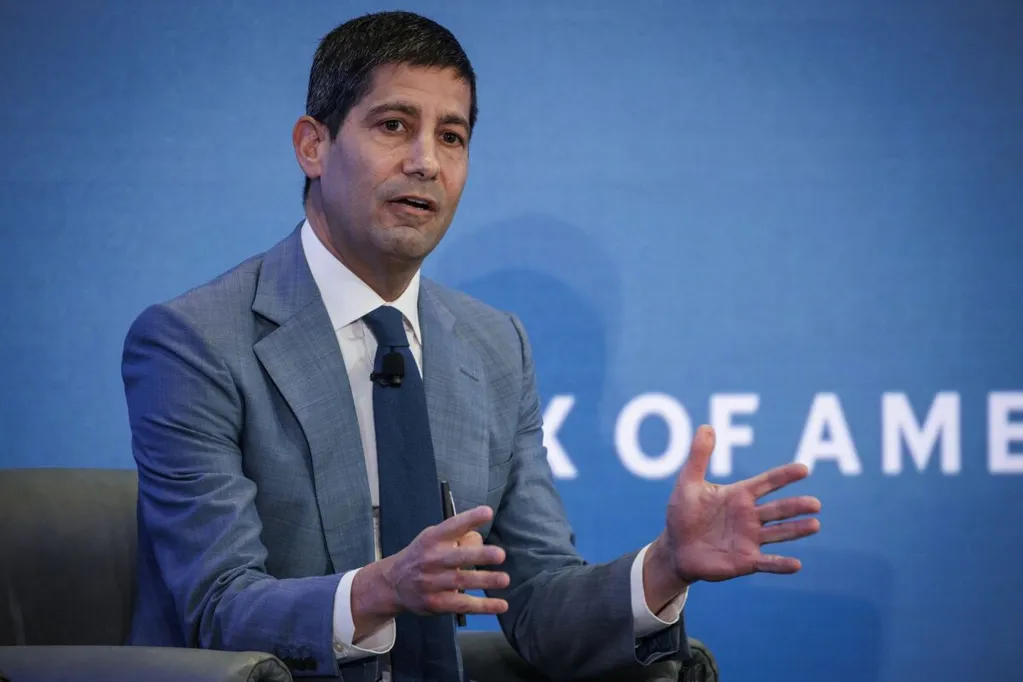
The latest Bureau of Labor Statistics report showed that the unemployment rate slipped to 4.3% in January, from a prior 4.4%, as US payrolls expanded at twice the rate that economists had been expecting. While that's great news for workers, it will make life a lot more challenging for Kevin Warsh, President Donald Trump's pick to become the next chair of the Federal Reserve.
Trump wants his nominee to slash interest rates, but Warsh's Fed colleagues are likely to balk if the labor market continues to hold up this well, creating the conditions for a volatile first year on the job, starting in May. Although outgoing Chair Jerome Powell has faced similar pressure, Warsh will be seen in markets as an unproven and less predictable newbie at the powerful central bank.
With Wednesday's data in hand, the unemployment rate -- the most important all-in labor market statistic -- looks to be settling in around current levels. It's now been in the vicinity of 4.3%, plus or minus 0.1 percentage point, for most of the past year. A key exception was the short-lived jump in November, which now looks like a fleeting distortion created by the government shutdown that ended that month.
Prior to Wednesday, concerns about the labor market had offered the clearest path to easier monetary policy, and an ebbing in those risks could foreclose on the possibility of additional cuts in 2026. The core personal consumption expenditures deflator -- a preferred inflation gauge among members of the Fed's rate-setting committee -- probably ended 2025 at around 3%, a full percentage point above the central bank's 2% target, where it's been more or less since early 2024 (more on that later). And the Federal Reserve Bank of Atlanta's GDPNow tracker suggests that the economy may have expanded at a very strong 3.7% annualized pace in the fourth quarter.
In other words, there's a case to be made that monetary policy has achieved a sort of "neutral" setting. On the surface at least, interest rates aren't doing much to push unemployment higher, nor are they bringing inflation demonstrably lower. A few policymakers have already acknowledged in their economic projections that the neutral setting for policy could be right around the current levels of 3.5%-3.75%. And although they're still in the minority, with other policymakers offering guesstimates closer to 3%, the confluence of data suggests that the "higher neutral rate" crowd may have a point worth entertaining.
Certainly, the inflation problem probably isn't quite as bad as meets the eye. Among other things, the Trump administration's tariff policies are probably adding around half a percentage point to reported inflation, and economic orthodoxy would suggest that Fed policy "look through" those one-off price-level shifts. (Economists will reevaluate that widely held belief on Friday when the BLS releases the January consumer price index. Some observers are bracing for high numbers as firms may have used the start of the year to push through another round of tariff-related price increases).
What's more, the labor market isn't without its blemishes. Of the 172,000 jobs added to private nonfarm payrolls in January, 124,000 came from health care and social assistance -- noncyclical corners of the labor market that aren't exactly the hallmarks of an economic boom. In most sectors, it's still basically the case that companies are neither hiring nor firing very much, meaning that existing workers feel more or less fine, though new labor market entrants are facing a hard outlook and job losers are remaining unemployed for longer.
And with tariffs weighing on profit margins and artificial intelligence starting to threaten some business models, labor market watchers will have to keep a close eye on layoff announcements to see if payrolls take an unexpected turn for the worse.
For now, I mainly take Wednesday’s positive report at face value. Payrolls saw their strongest growth in more than a year, in spite of a large drop in federal government jobs. The number of people working “part time for economic reasons” (i.e., those who wanted to work full time but might have had hours reduced by managers) declined sharply after a couple of disconcerting reports.
Labor market resilience is never a bad thing for the American people. But Trump has been banging the drum for rate cuts since the start of his presidency. No sooner had he announced Warsh’s nomination than he was cracking jokes about suing him if he doesn’t cut rates. On Wednesday, he celebrated the positive jobs numbers in a post on Truth Social, and yet confusingly seemed to imply that they provided justification for lower rates (which is either ignorant or willfully deceptive). Here’s his full post:
Just in: GREAT JOBS NUMBERS, FAR GREATER THAN EXPECTED! The United States of America should be paying MUCH LESS on its Borrowings (BONDS!). We are again the strongest Country in the World, and should therefore be paying the LOWEST INTEREST RATE, by far. This would be an INTEREST COST SAVINGS OF AT LEAST ONE TRILLION DOLLARS PER YEAR - BALANCED BUDGET, PLUS. WOW! The Golden Age of America is upon us!!! President DJT
Needless to say, the Fed’s job is not to help facilitate the federal government’s deficit spending. Such a mandate would be a one-way street to an enduring inflation problem.
For his part, Warsh understands this and may well steer policy based on his reading of the economic reality. Still, he’ll have to contend with relentless pressure from the president who is putting him in the job. Assuming he is confirmed, Warsh is going to have to use the data in hand to make a coherent monetary policy case to the 11 other voters on the Fed’s rate-setting committee. And with the current constellation of facts, he’ll have a hard time convincing them that the economy has an urgent need for many more rate cuts -- or, possibly, any at all.