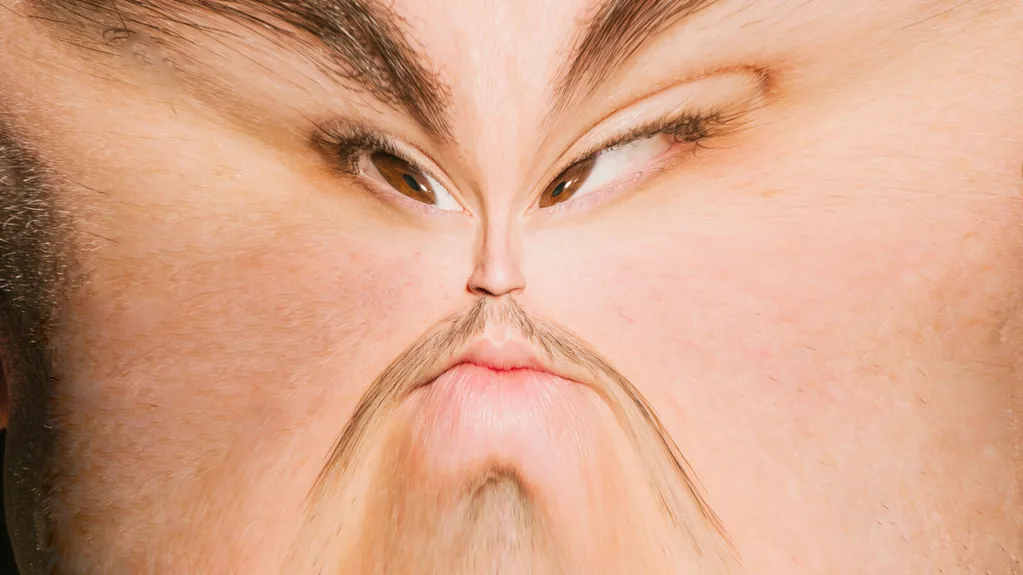
The world has gone crazy for tools and tricks that slim the visage. Is vanity to blame -- or something weirder?
If you are a person who has a face, and happen to have ever spent three nanoseconds thinking about said face, then at some point you have come across a certain word -- in conversations or the morass of the internet or texts from your mother -- that feels mysterious, witchy and true. That word is "bloated."
"Bloated" can and does happen to anyone. It describes the condition of cheeks or temples or jaws somehow being ... bigger, rounder, fuller, puffier-feeling, than they ought to be. This unhappy balloonishness can be caused by anything from tooth cavities to kidney disease. But also by mojitos, a salty midnight snack, any number of allergens: pollen, wheat, Siberian huskies. Sometimes, it goes away on its own. Many other times, it does not, and that, in a nutshell, is why we have a gazillion-dollar beauty industrial complex.
Once upon a time, people just walked around with bloated faces and didn't know it. But now the world is afflicted with the curse of knowledge, and there are remedies galore to slim, sharpen and "snatch" -- jade rollers, microcurrent devices, Kim Kardashian's viral chin bandage. Every day in New York City, I pass two storefronts named FaceGym and the Tox, both of which offer depuffing sessions via tools that appear designed for grooming horses or hosing down tractor-trailers. I would like to tell you that I have never paid money to either of these businesses, but unfortunately this magazine is fact-checked.
Earlier this year, while visiting a good friend in Tokyo, I learned of something called kogao kyousei -- an even more exacting procedure that translates marvelously to "small-face correction," and promises to squish away bloat so dramatically that practicing clinics describe it as "scalpel-free cosmetic surgery."
"Do you enjoy it?" I said.
"It works," my friend said, kind of forbiddingly.
Three nanoseconds later, I'd booked an hourlong appointment.
What does it feel like to get "small-faced"? In short: You lie on a table, and someone rolls her sleeves up and slaps your face. Repeatedly. Then she punches it. A lot. Then she pushes her fingers into your flesh as if you were dough in need of kneading, which is more or less the concept. Occasionally she pounds you with an actual wooden mallet. Is this painful, you ask me? Have you ever been hit point-blank in the mouth with tennis balls, I ask you?
The horse-grooming tools were one thing -- but my Japanese face corrector at one point grasped my ears in her fists and tugged so hard I really thought they might come off, Mr. Potato Head-style. What it sounded like was Rat-a-tat-tat-tat shwooopf.
During all of this pummeling, the question that bubbled to mind was, of course, why I had signed on for any of this. In the West, small-face correction is, in addition to being a bit less brutal, known by a less charming name: lymphatic drainage. Lymph is the fluid that circulates across the body to pipe out bacteria and waste, and essentially all forms of face-slimming massage work by pushing lymph toward nodes around the head -- "flushing things out," as some put it. Drainage massage is a real medical treatment for conditions like lymphedema. But it has made the leap into mainstream wellness territory, if the rabid Google search interest in recent years is anything to go by.
Pooowt. Pooowt. Floooooph-POP.
As my face smusher stood up and leaned her entire weight on my skull, I thought about the curious language. "Correction" and "drainage" and "flush" and "debloat" point not to good health or good looks but to waste, repair and disposal -- more the work of a plumber than an aesthetician. So what could it be that we're so eager to get rid of, so desperate to purge out from deep inside ourselves? Possible answers don't seem far from reach: ultraprocessed foods, carbon emissions, microplastics, the ubiquitous news about microplastics; on any given day, you'd be hard-pressed to find a facet of modern life that hasn't been said to be poisoning us, just a little.
Then the beating was over, and it was time to get up from the table.
For a moment, I pictured my face now so much smaller that I no longer had a face at all. Which was quite a nice thought: to be just a pure being -- drifting, unidentifiable, free like a nimbus cloud. A lovely thing at a time of profile photos and facial-recognition technology and that constant accident of trying to swipe a notification on your phone and instead opening the front-facing camera.
Annoyingly, a mirror told me I did still have a face. It had not disappeared, slunk out to oblivion. Yet it was also not entirely my face. From my original face, a stranger’s hands had chiseled and chipped out an interesting sculpture, familiar but fresh, even the eyes and mouth somehow more awake-seeming.
And this felt like the true allure of face-debloating treatments around the world: You get to find out that inside your existing face was always a more pristine, ideal face -- lurking, begging to come out, if only you would let it. Look at your face when it sheds the stress, the screen time, the office air-conditioning, the DoorDash deliveries! See the real thing.
On the plane back from Tokyo to New York, I learned there is no shortage of gurus online teaching D.I.Y. facial plumbing: anastasiabeautyfascia (2.7 million followers), Face Yoga Method (740,000), the acupuncturist Alex Hui (320,000). At home, I pressed my fingers into the prescribed points and watched the swelling almost magically lessen. Remarkable, the way a face can be changed by external conditions -- like dehydration and the cabin pressure of a 14-hour flight -- and then have these effects undone by manual labor, by a few minutes of wrenching and wincing.
And I found that the satisfaction was actually even greater when I was the one inflicting my own punishment: Here is what I've brought upon myself, and here it is in my control to undo.