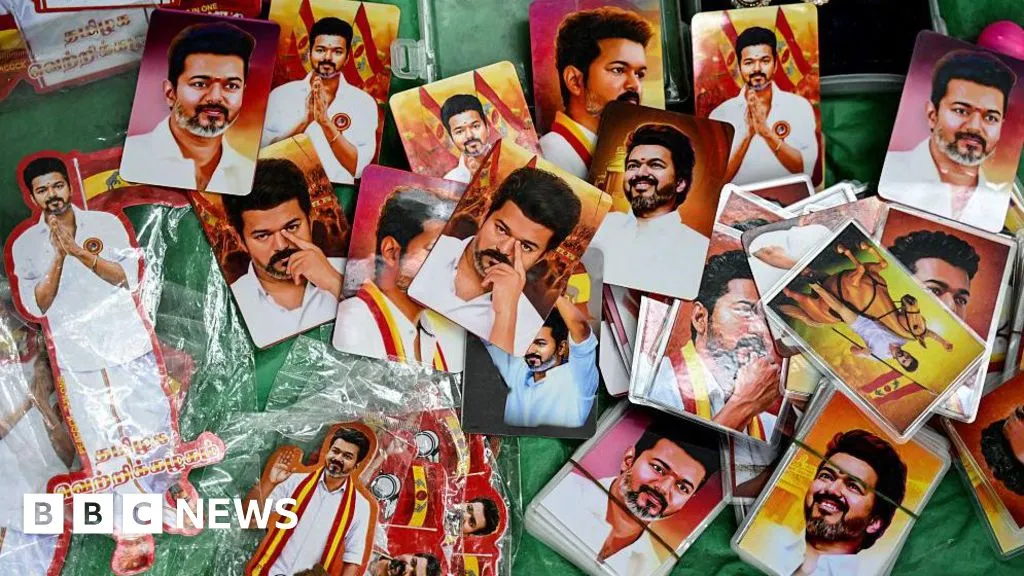
Film star-turned-politician C Joseph Vijay is on the cusp of history in Tamil Nadu state.
On Monday, his political party Tamilaga Vettri Kazhagam (TVK) defied all naysayers to almost sweep the state election, marking a break in the established political order.
Vijay's spectacular rise is being compared with that of matinee idol MG Ramachandran, who broke away from the established Dravida Munnetra Kazahagam (DMK) to form his own party and become chief minister in 1977.
But even as Vijay's victory has delighted fans and supporters, he has hurdles to cross to reach the top post. To form a government in the 234-member Tamil Nadu assembly, a party needs 118 seats. Vijay's Tamilaga Vettri Kazhagam (TVK) has won 108 - leaving him 10 seats short of a majority.
That means over the next few days, Vijay will need to change from crowd-puller to coalition-builder, negotiating with smaller parties and independent legislators to cross the threshold and stake a claim to power.
Even then, his performance marks a striking political moment in a state that has, for decades, chosen between two established regional parties - the DMK and its rival the All India Anna Dravida Munnetra Kazhagam (AIADMK).
"Vijay carries a different kind of verve," says social scientist Shiv Visvanathan. "He offers a sense of fun, confidence and an aura of competence rooted in individuality and that gives him a different kind of power."
In the weeks since voting took place, Vijay has been carefully crafting his public image - not on screen, but by visiting prominent temples and churches.
Images of these visits have flooded TV screens and mobile phones. In a state where modern politics was shaped by rationalist thought and the Self-Respect Movement - which envisioned a society where marginalised castes would have equal rights - the visible turn to faith feels deliberate.
Tamil Nadu has long been attuned to political theatrics, where cinema and power often blur into one continuum. From Ramachandran to his successor J Jayalalithaa, film stars have entered politics and gone on to lead the state.
Vijay steps into that lineage, but at a different political moment.
Analysts say he is entering a landscape still dominated by the DMK and the AIADMK - a duopoly that mostly appears stable on paper, yet shows signs of fatigue on the ground. That, they argue, is opening space for new political experiments - and for figures like Vijay to test how far star power can translate into durable political authority.
"Vijay's timing as a politician is immaculate," says Visvanathan. "He arrives at a moment when established leaders are seen as jaded. He represents youth - and a new interplay of memory and messaging in how voters imagine their leaders."
Vijay's road to political triumph has not been that smooth.
He suffered a serious setback last year after dozens of people were killed in a crush at his party's rally. But despite criticism over his immediate reaction, voters seem to have forgiven him.
His film Jana Nayagan (People's Leader), which was set to be released in January, was meant to be Vijay's final outing on screen after he announced he was moving to full-time politics. But the film ran into trouble with India's film classification board, with makers even moving court to get it released. It's still not clear when Jananayagan will hit cinemas.
Vijay formally launched his party TVK only in 2024. Yet his political decisions stretch back much longer.
As early as 2009, he began reorganising fan clubs into the Vijay Makkal Iyakkam - a welfare network that worked at the neighbourhood level, offering relief, education support and local assistance.
By 2011, it was already testing its political reach by backing an AIADMK alliance, checking whether fandom could translate into votes.
Over the next decade, Vijay's film events took on an increasingly political tone as he spoke to younger audiences about exam stress, unemployment and corruption, and later criticised the controversial Citizenship Amendment Act in 2019.
When he eventually stepped away from acting after nearly 70 films to enter politics full-time, the message was clear: this was not an extension of stardom, but its deliberate conversion into political capital.
Tamil Nadu's voters have long understood the language of charisma. What makes Vijay distinct is the scale and spread of the base he is attempting to build.
The shift towards Vijay is most pronounced among younger voters and women, according to pollster Pradeep Gupta of Axis My India.
Voters aged 18-39 - roughly 42% of Tamil Nadu's electorate - show particularly strong support, especially first-time voters.
Women, too, appear to have moved towards his party in significant numbers, with support cutting across caste lines, including among the state's Scheduled Castes (SCs) and Other Backward Classes (OBCs).
Political strategist Prashant Kishor puts it more simply: "He's the new hope for Tamil Nadu."
For now, that appeal is defined less by detailed policy and more by the promise of change.
TM Krishna, prominent Indian vocalist, author and social activist, says: "Elections are about stirring imagination. This is not a verdict against Dravidian politics. It is something else. Vijay offers a new imagination."
In Tamil Nadu, Dravidian politics - led by the DMK and AIADMK - which is rooted in social justice and welfare, has dominated for decades. It has also delivered: the state recorded 11.2% growth in 2024-25, with solid manufacturing gains and some of India's strongest social indicators.
Yet performance has not dulled the appetite for change. Stability, analysts say, can breed its own restlessness - particularly among younger voters less invested in legacy narratives and more drawn to renewal.
That helps explain the contrast with other superstars like Rajinikanth who also dabbled with politics but stopped short. Even Kamal Hassan, who launched a political party, has not been able to create an impact on the ground.
Vijay has cast the Bharatiya Janata Party (BJP) as his ideological adversary, and the incumbent DMK as his immediate political rival - a positioning that reflects Tamil Nadu's long resistance to the BJP's expansion rooted in language politics and a strong regional identity as well as a promise of freshness.
But not everyone is convinced. Author and analyst Nilakantan RS points to the thinness of TVK's policies.
"There is an absence of any original position on real issues," he says. "Virality has become the currency of his actions."
He reads Vijay's temple visits and public gestures as calibrated moves aimed at specific audiences - raising the risk of a politics driven more by image than administrative depth.
And yet, the pull is rooted in familiarity.
Tamil Nadu does not merely admire its film stars - it invests in them, often seeing in them a more immediate and personal form of justice.
It remains one of India's most stable and well-performing states. Yet beneath that stability, a younger electorate is increasingly restless.
"This election is to herald change," Vijay said while campaigning.
His supporters echo that sentiment more bluntly. "People are tired of both major parties. They want change. They see TVK as that change," says party spokesperson Felix Gerald.