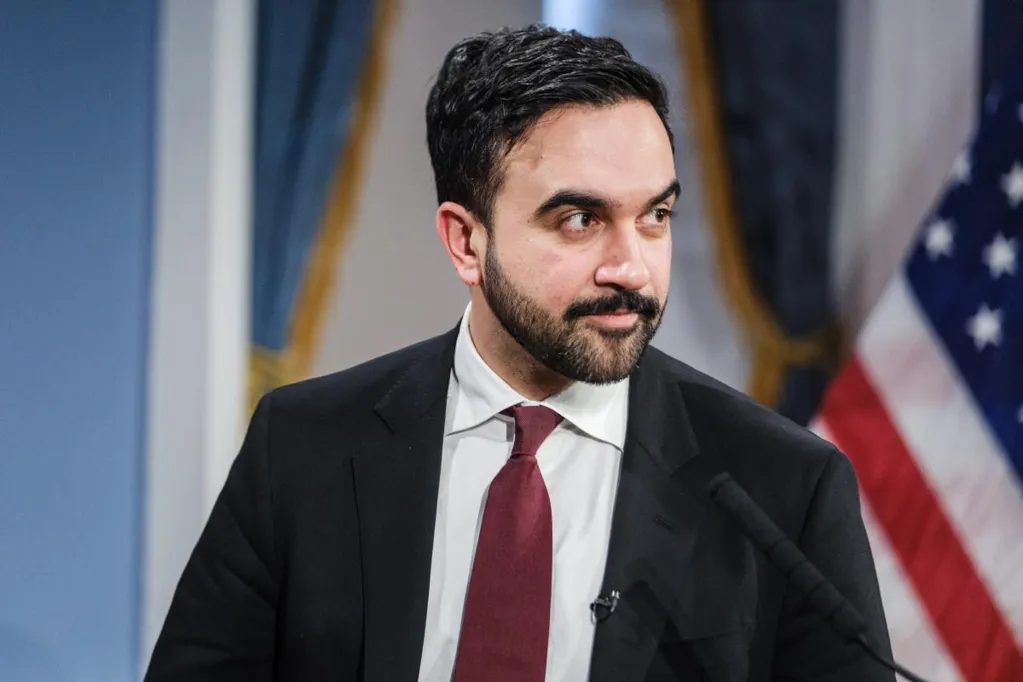
On the eve of Mayor Zohran Mamdani's first preliminary budget rollout, Gov. Kathy Hochul handed him what amounted to a $1.5 billion gift card, courtesy of state taxpayers.
On Tuesday, the mayor thanked the governor for the promised new state aid -- by handing her a ticking political bomb.
Despite the added money, Mamdani said, the city faces a "historic" $5.4 billion budget gap -- which can only be closed by proceeding along what the mayor characterized as two "paths."
Path one, he said, would be for the state to give the city authority to "raise [income] taxes on the ultra-wealthy and the most profitable corporations" -- a step Hochul has refused to take.
Path two: "Balance the budget on the backs of working people" with a 9.5% increase in the city property tax.
This would be New York City's first property tax hike in 23 years, and its second largest in at least 45 years.
And its impact wouldn't be limited to working people; it would undermine the commercial market and push into bankruptcy more of the city's struggling rent-regulated apartment owners.
Mamdani flatly ruled out an obvious third path for the city: reducing spending in his mammoth $127 billion proposed budget.
An obvious starting point would be with something for which Hochul richly deserves blame: the 2022 state law mandating smaller class sizes, even as school enrollment plummets.
Repealing that law and updating the school-aid formula could save well over $1 billion a year.
Total spending in Mamdani's first budget would be billions of dollars higher than Mayor Eric Adams' last estimate, reflecting in large part the new mayor's promise to more accurately reflect rising expenses his predecessor chronically sought to fudge or underbudget.
But in another departure from Adams' approach -- and, indeed, from the deliberate revenue low-balling of every mayor since Rudy Giuliani -- Mamdani's economic outlook is also anything but less conservative.
Despite a projected slowdown in New York's already sluggish job growth, Mamdani's budget assumes the city's economy will grow faster than the national GDP over the next four years.
His total tax projections are billions of dollars above the levels projected by the city's independent fiscal monitors.
This kind of optimism leaves little room for error -- even as Mamdani projects a hefty budget gap of $6.6 billion the year after next, and total shortfalls of $20 billion from fiscal 2028 through fiscal 2030.
Indeed, even if he squeezes a soak-the-rich tax hike out of Hochul -- and even assuming a continued Wall Street boom -- Mamdani will be in the hole again a year from now.
Speaking of gifts, the budget also includes a big favor to the city's powerful labor unions.
In a 2018 deal with then-Mayor Bill de Blasio, union leaders agreed to find $1 billion in savings to replenish an off-budget Health Insurance Stabilization Fund for city workers.
But the savings never materialized, and the fund is insolvent.
Mamdani now has moved the health-care obligation onto the budget, at a combined cost of $2 billion in spending obligations this year and next.
This will be partially offset by a recent labor-management agreement to move city workers to a less expensive health-insurance plan -- which will, nonetheless, continue to offer coverage free of co-pays, an expensive deal unavailable to most private workers and state-government employees.
Meanwhile, Hochul has reason to seethe over the mayor's unsubtle message to city voters in a statewide election year: If your property taxes go up, it's Hochul's fault.
True, the governor's road to re-election looks much smoother than just a few weeks ago, when Lt.-Gov Altonio Delgado was threatening to challenge her in a Democratic primary.
In a two-way general election, polls show the governor with a sizable lead over her Republican-Conservative opponent, Nassau County Executive Bruce Blakeman.
But there remains a cloud on the governor's political horizon, in the form of Mamdani's close allies in the Working Families Party.
The same week Democrats renominated Hochul, the WFP handed its gubernatorial nod to a no-name placeholder, preserving that party's option of producing a better-known challenger to undermine Hochul's support on the left.
And as it happened, hours before unveiling his budget Tuesday, Mamdani announced his appointment of a WFP party leader as the city's commissioner of international affairs.
Next week, hordes of left-wing activists and union members will descend on the state Capitol to lobby for Mamdani's soak-the-rich tax agenda.
In what's shaping up as an epic state budget battle, Mamdani may have won the news cycle.
To guard against further erosion in a statewide tax base already over-dependent on millionaire earners based in the city, Hochul needs a strategy for winning the war.