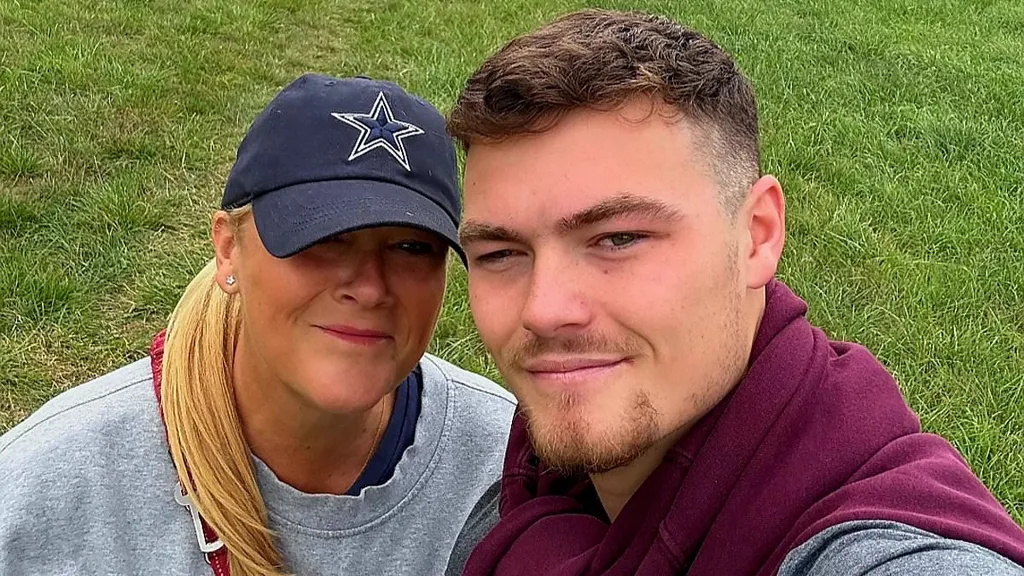
A mother is mourning the death of her 21-year-old son after he died of a brain tumour which had been initially dismissed as vertigo.
James Mann, a fit-and-healthy police officer and qualified personal trainer from Bedfordshire, complained of feeling 'imbalanced' after returning home from a holiday in Greece last June.
At first, James thought his ears had not 'cleared' from the flight home and waited around two days before going to see his GP.
His doctor told him that he believed that the tiny crystals in his ear had been dislodged before providing him with exercises to tilt his head.
Within weeks, however, James's dizziness had rapidly intensified to the point that he was now vomiting.
He returned to see his doctor four times before being diagnosed with vertigo - a sensation that causes people to feel like they are spinning - in August, and was signed off work.
As his condition continued to deteriorate, James went back to his GP in September, but was yet again sent home after being told that he was still suffering with vertigo.
However, James's mother Dianne this time spoke with the doctor to express her 'grave concerns' that her son's symptoms had been 'getting worse'.
Dianne said: 'It was an acceleration of the same symptoms - his dizziness was affected, and he was struggling to walk without touching either the walls or furniture to steady himself.
Dianne Mann is mourning the death of her 21-year-old son James after he died of a brain tumour which had been intially diagnosed as vertigo
'He also had to stop driving. He was a busy, driven, 21-year-old who loved his work and was having the best life so he was really frustrated.
'None of us could understand how someone who was the picture of health, a qualified personal trainer, who loved his sport and was the epitome of strength, could suddenly be like this.
'It seemed a bit crazy that nothing seemed to be able to be done for something that is extraordinarily debilitating for him, out of thin air.'
Growing frustrated with her son's GP, Dianne pushed for James to get another appointment the following day and to be referred for an urgent MRI scan.
Though it was labelled as 'urgent', Dianne was told that it could take up to four weeks for James to get the scan at Bedford Hospital.
Instead of waiting, she called the hospital every day to check for cancellations before securing her son an earlier appointment on November 10, 2025.
Dianne said: 'This is when our world just collapsed.'
Immediately after the scan, the radiographer told James and Dianne that they were 'quite worried about' a mass that they had found on his brain.
The 21-year-old was immediately passed to the neurology team at Addenbrooke's Hospital, where he underwent emergency surgery there on November 13 to relieve the 'life-threatening' pressure.
They fitted an external drain and removed around 70 per cent of the tumour - due to its position - but his brain was not draining correctly and he developed an infection. This set his recovery back.
James and his family were then told he had a high-grade, progressive tumour, which they now know was H3K27 midline glioma.
The prognosis for the aggressive tumour - which sits in the brainstem, thalamus midbrain or spinal cord of the brain - is typically less than a year.
James underwent further surgery to repair a wound on his head, before another procedure in the first week of December to insert a shunt.
However, he suffered a seizure and was plunged into a medically induced coma for five days before waking up.
Dianne said: 'In true James style he decided 'Right, I've had enough of this, I'm coming off this' and he tried to sit up and pull the tube out of his mouth.'
Though initially allowed to leave intensive care and come off life support, the medics looking after James said he was 'too unwell' for typical treatment that would target the tumour.
He was sent home last December and Dianne said they never left each other.
'I was with him everyday either sleeping on the chair or on the floor,' she added.
'The first few weeks at home were challenging for him - he was mobile, albeit unsteady.'
A week after the New Year, James’s medical team said he appeared more ‘settled’ following the surgeries and could be considered for radiotherapy to shrink the remaining tumour.
But the family received heartbreaking news around a week later.
Dianne said: ‘The oncologist said ‘I’m really sorry, the tumour has grown back in its entirety from where 70 per cent was taken away’.
‘In the space of three and a half to four weeks, the tumour had completely grown back and looked like it had travelled to other places in the brain.
‘It was at that point that he was given a handful of weeks to three months to live.’
When James returned home, he immediately turned to his loved ones, including his siblings Ben, 26, and Kate, 24.
'He navigated and crafted conversations with them, for them to somehow have a blueprint of how to live and cope without him,' Dianne added.
James’s condition ‘quickly declined’ and ‘all of a sudden’ they were told he had less than 24 hours to live.
He died nine hours later, on January 30.
'We did what we've done as a family forever - we were together the whole time, and he died at home with us,' Dianne said.
'If love alone could have saved James, he would have lived forever,' she added.
The much-loved young man's funeral was held on March 4, 2026, with around 150 people attending - including his police colleagues from Hertfordshire Constabulary.
Dianne explained: 'It was a testament to how much people clearly loved him - friends old and new were there; teachers; police colleagues - that was beautiful and excruciating in equal measure.'
After the funeral, the family held a 'celebration of life party' at a golf club where James used to work, with hundreds of photos from birth to age 21 all around the room, as well as a film that his sister made capturing James' whole life, made from family video clips.
Dianne and her family are now focusing on organising memorial events in James' honour and fundraising for the Brain Tumour Charity, as they know 'that's what James would do' if anyone he knew passed away in similar circumstances.
'We want to help fund vital research and clinical trials into aggressive brain tumours - so that one day, families facing this nightmare are given real options, real hope and real chances,' Dianne explained.
'A saying my mum had that I passed down to my children was 'Things are always going to go wrong in life, but we have to always try and get some good out of the bad'.
'So that's what we're doing; we're honouring that family belief in the best way possible; which is to try and keep James alive in the only way we can now.'