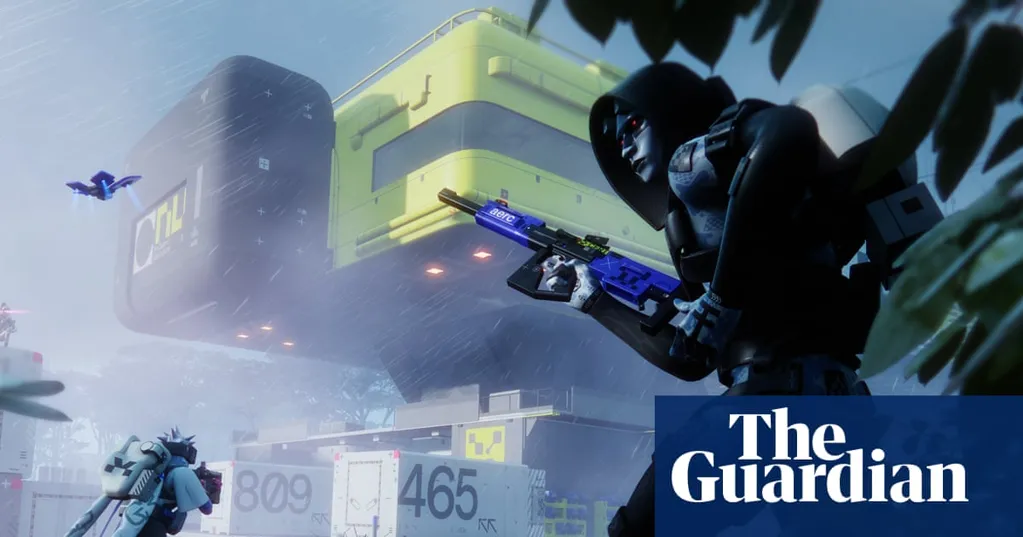
A lot is riding on the success of the latest multiplayer online shooter from Halo creator Bungie, a DayGlo spectacular that whisks players to a far-off planet mired in an endless battle for resources.
In rare quiet moments playing Marathon, you may find yourself overcome by the iridiscently pretty planet Tau Ceti IV. This fictional world seems to radiate a chemical glow: powdery pink skies and lurid green vegetation fill the screen alongside supermassive architecture emblazoned with ultra-stylish, neon graphic design. Yet enjoy the scenery for a split second too long and you might catch a bullet, causing your character to bleed an icky blue substance. In such moments, the camera locks - meaning you must stare down at their unceremonious expiry. Marathon's considerable beauty is matched only by its clinical brutality.
The road to Marathon's release has been long and contentious. This extraction shooter - so-called because you must do as much shooting and looting as you can in a given level before making an escape - was first shown off in 2022 with a ravishing trailer (below). Among many startling images, it showed tiny robotic bugs, a little like silkworms, weaving a synthetic body into existence. The game, made by Halo and Destiny creator Bungie, looked weird in a way that blockbuster shooters rarely do, causing excitable stirrings among both shooter stalwarts and art-game aficionados.
But then the mood soured: Marathon became mired in an artwork-theft scandal, and to make matters worse, the feedback to an alpha play test in April 2025 was so bad that the game, originally due out last September, was delayed indefinitely. In the intervening months, another extraction shooter called Arc Raiders was released to acclaim and gigantic sales.
So Marathon arrives with much to prove, not least because it is the first new game Bungie has released since it was acquired by Sony for $3.6bn in 2022. The studio's owners are also under pressure, having sunk further hundreds of millions, if not billions, into an online multiplayer pivot which has yielded just a single hit, Helldivers 2, amid a string of cancelled games and one eye-wateringly expensive flop.
Marathon - with its thrilling, kinetic gunplay, tantalising sci-fi and encouraging initial player feedback - may yet buck this trend for Sony. You play as a Runner whose consciousness has been uploaded into an artificial body. With this body-swapping premise, Runners technically escape death, yet you would be hard-pushed to call their particular type of immortality desirable. These gun-toting bio-cybernetic beings are contract-chasing freelancers, locked into an endless purgatorial fight on Tau Ceti IV - grist for the mill in the cosmic wilderness.
Here's how a recent run of mine went down: I dropped into Dire Marsh, a wet, gaseous level that more than lives up to its miserable name. My crew and I made a beeline for a maintenance area, tasked with finding a mysterious metal rod. While searching, we fought successive deployments of the game's mech enemies; I was downed, then revived. We continued our rod hunt for a full five minutes before giving up, wholly exasperated. When we headed to an exit, lo and behold, some other Runners had arrived with the same idea. A brief, heart-racing gunfight played out during which I mostly cowered behind a door. Then, at precisely the moment another human player stabbed me in the chest thus ending my run for good, they shouted "Mr Silly" down the microphone. Mr Silly - whoever and wherever you are - you can go to hell.
Marathon's gameplay loop is relentless and frequently demoralising, certainly more so than its extraction shooter rival Arc Raiders. The genius of Arc Raiders lies in how it facilitates different, broader tones of drama, particularly during encounters with other humans. In that game, all players are audible to one another once they get within a certain range, so negotiations can occur before combat, or even during it. It is not only marksmanship or gear that decides an outcome but generosity of spirit and the ability to talk smoothly. De-escalation is as viable a tactic as armed violence.
Marathon, so far, is less dynamic and by extension less interesting. Verbal discussions are always secondary to brute force. It seems as though no one wishes to cooperate; everyone is in it for themselves. I think the speculative dystopian concept encourages this fierce competitiveness. If you're new to the extraction shooter genre, the question is whether you'll become fatigued with such a dog-eat-dog experience.
But after 15 hours, I'm finding Bungie's latest compelling precisely because it is so ruthless. Like the social deduction game Among Us did during the paranoid pandemic years, it mirrors the times that produced it. We live in a mean-spirited, cut-throat era in which too many world events feel driven by pernicious self-interest. Here then is a game that seems to give players a way to work through this cynical state of affairs. Either you are the one pulling the trigger - bang! - or you're bleeding out with a mouthful of dirt.