I've spent roughly twelve hours in the Marathon playtest so far, and it has been surreal to finally get hands-on with Bungie's return to one of their oldest worlds. Before diving into the action, I think it is important to look back at the franchise's roots; Marathon began as a Macintosh exclusive in the mid 90s and helped establish foundations that modern shooters with a narrative still rely on. MandaloreGaming has an excellent retrospective on the original trilogy; it informed a lot of my understanding of the series and highlighted just how ahead of its time Marathon truly was. The original game was one of two titles released on the same day that featured dual-wielding gunplay; it was also the first FPS to implement mouse controls, which placed it years ahead of its contemporaries.
Alongside the playtest, I also received my Collector's Edition (currently backordered), which helped frame this new entry within Bungie's long lineage. I have spent years immersed in their work; everything from the unique feel of their gunplay to the dense worldbuilding has set a high bar to clear; and I have been eager to see whether this new take on Marathon feels like a proper evolution of Bungie's 90s roots. Thankfully, the playtest shows tremendous promise.
The most fun I had came from the tense moments after clearing a sector without encountering anyone; extracting becomes nerve-wracking precisely because silence does not imply safety. Proximity chat adds another layer of stress since every interaction is loaded with uncertainty; not once did any communication I had with other players form alliances, not even uneasy or temporary ones.
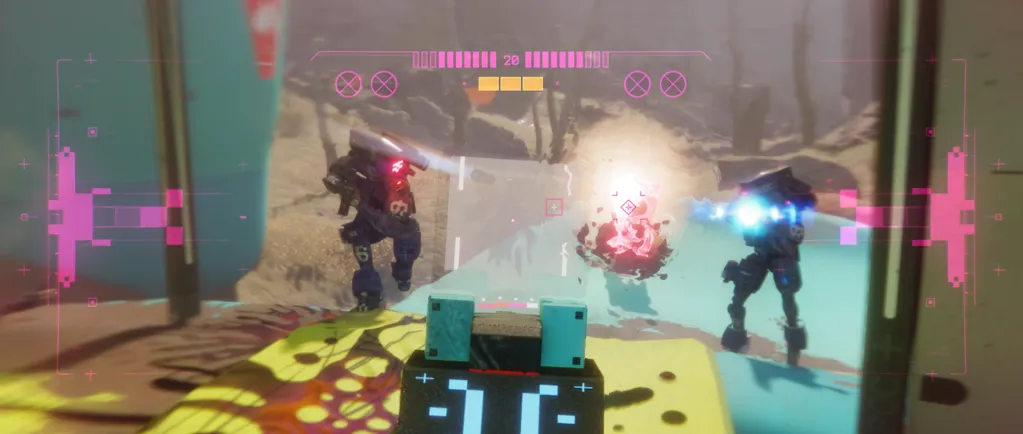
Each match is extremely busy thanks to the presence of UESC bots. They populate the map almost overwhelmingly; any scuffle with them immediately alerts other Runners to your position. Someone is always nearby waiting to capitalize on the chaos and take your spoils. I had more than a few matches where the UESC downed me outright; they are not simple mobs, and several quests directly tie into defeating them. This gives every encounter weight; noise and time are resources you spend carefully.
Visually, the game runs incredibly smooth, edges are clean with high readability; and the map is easy to parse at a glance. In fact, it might be a bit too readable since spotting other players is surprisingly easy. The adrenaline is high in every open space. Story fragments appear between missions as you level each faction; the worldbuilding creates a sense of a larger narrative and metagame waiting to unfold. I also found myself pulling my knife out far more often than expected; ammo is scarce outside of what you bring into the match, and relying on teammates to drop ammo boxes becomes essential during longer runs. One important tip to know is that instead of stamina, you're exhausting heat that makes your shell inactive after a bit. If you stand still or stand in water; your shell will cool off quicker.
So far, this modern Marathon is a thoughtful reinvention rather than just a random game with the name slapped on it; there is DNA from the classic trilogy (especially with the story we experienced so far) to feel familiar, yet the structure and pacing belong entirely to this new extraction format.
A lot of the gameplay experience will be shaped by what faction you end up doing missions for. With a diverse number of rewards and things to buy from each faction's store, Marathon wants you to explore your options and level up a variety of them to suit your playstyle.
One of the more interesting factions is Arachne; a death cult focused entirely on aggression and player elimination. If you crave PVP, unlocking Arachne is going to be your go-to since most of their contracts revolve around hunting rival Runners.
There is also CyberAcme; the main corporation behind the cybernetic infrastructure that enables consciousness transfers into Shells. Their contracts focus on Runner diagnostics and upgrades, which makes them appealing for players who enjoy improving long-term survivability.
NuCaloric stands out as an agricultural megacorp tied to sustaining humanity's basic needs. Their contracts emphasize exploration and resource gathering, and the narrative elements revolve around recovering lost colonial data.
Traxus sits at the top of the corporate food chain. Many of the missions had me recovering rare weapons and mods; the corporation's wealth and influence clearly seep into its objectives.
MIDA is a political movement turned radical organization. Their contracts emphasize explosives and the elimination of key targets; destruction is the core of their identity.
Sekiguchi Genetics focuses on the biological side of Runner Shells; they created the Weaveform technology that shapes the body you inhabit. Their missions emphasize endurance, survival, and biological experimentation.
The seven Shells offer a wide range of playstyles; although Thief was unplayable during the stress test, the rest provided a great sense of mechanical diversity.
The Destroyer is built for frontline combat. Its primary ability, Search and Destroy, launches heat-seeking rockets, while the tactical ability, Riot Barricade, deploys a wall of energy that blocks damage. Its traits include a mid-air lateral dash and a tactical sprint that grants faster movement at the cost of higher heat consumption.
The Assassin excels at stealth. The primary ability is Smoke Screen, which creates a trail of smoke fields. The Shadow Dive trait removes fall damage and creates a smoke screen on landing, while Shroud grants invisibility after exiting a smoke cloud.
The Recon Shell serves as the intel specialist. Its primary ability, Echo Pulse, highlights hostiles through walls. The Tracker Drone acts as a hostile seeking bot that rushes targets and explodes. Recon's traits are built around situational awareness; the Interrogation trait warns you when you are pinged and reveals a crew's location after a finisher. The Stalker Protocol trait highlights an enemy with a lingering holographic trail after their shield breaks.
Vandal is mobility-focused. Its prime ability, Amplify, boosts movement speed and reduces heat generation while improving weapon handling. The tactical ability, Disrupt Cannon, fires an energy projectile that damages and knocks back Runners. Vandal’s traits include a second jump for accessing flanks or hard-to-reach areas and a heat reduction passive that minimizes heat buildup during sprinting or sliding.
Triage is the primary healer. Its Med Drone provides a steady stream of health and shields. The tactical ability, Capacitive Gauntlets, can damage enemies or revive allies from a distance using an electrical burst. Its traits revolve around recovery and sustain, making it an essential support choice.
Rook is the free loadout Shell. This is a low-risk, solo-only frame designed for scavenging. Its prime ability, Recuperation, starts a health regeneration effect that continues until interrupted by damage. Signal Mask is the tactical ability that allows Rook to blend in with UESC forces. Rook joins matches already in progress; you risk nothing from your vault; but you cannot progress contracts while using this frame. It exists primarily to expand your inventory.
Thief was not available during the stress test; as soon as we have access to the poster child of the game, we will update these impressions.
It is also worth mentioning that Marathon is a PlayStation Studios title releasing simultaneously on PS5, Xbox, and PC; the playtest ran tremendously well on PS5 Pro in particular. The game likely utilizes some form of PSSR to achieve its high clarity, especially in the reflective surfaces scattered around Tau Ceti IV. Water reflections appear almost perfectly one-to-one with the environment; the sharpness and stability of these visuals make the experience feel grounded and responsive. The combination of smooth performance and clean reconstruction gives the PS5 Pro version a level of visual polish that stands out even among modern extraction shooters.