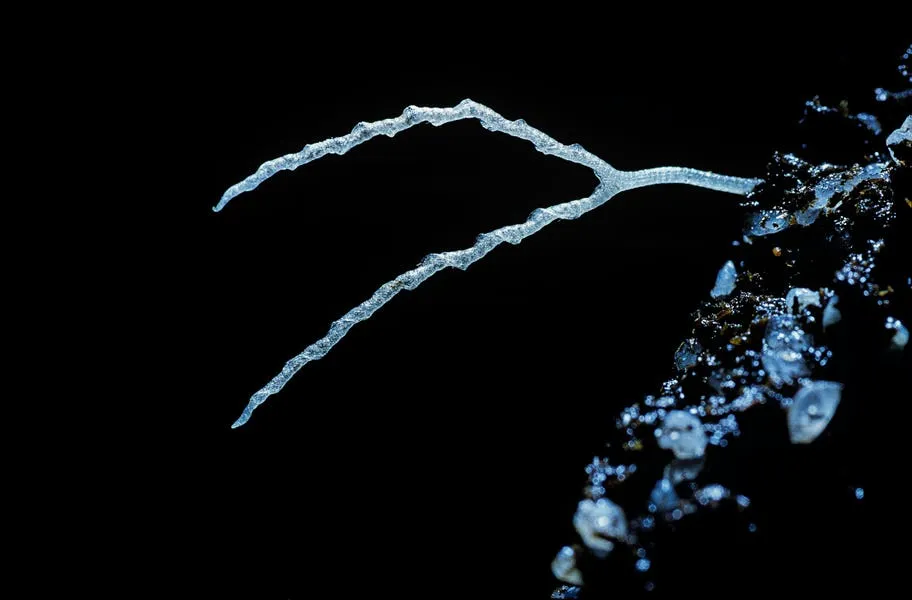
When most people try to picture a carnivorous plant, their minds conjure images of dramatic leaf-jaws snapping shut, or sticky pads that gleam with dew. However, there's one group of plants that relies on a radically different strategy: rather than ambushing insects above ground, they feed on them in the soil below the surface.
This would be Genlisea, or "corkscrew" plants -- a carnivorous genus of herbs that use underground traps to capture microscopic prey. And unlike Venus flytraps or pitcher plants, Genlisea's traps are hidden, tubular and engineered to exploit the physics of microscopic movement. Here's how they're redefining what it means to be a "meat-eating" plant.
Genlisea belongs to the carnivorous plant family Lentibulariaceae, which also includes bladderworts (Utricularia) and butterworts (Pinguicula). These plants thrive in nutrient-poor, waterlogged soils.
Here, nitrogen and phosphorus are scarce, and normal photosynthesis alone doesn't cut it. So, in order to supplement their diets, Genlisea has evolved highly specialized subterranean leaf structures known as rhizophylls, which serve as prey traps deep underground.
Above ground, corkscrew plants produce small green leaves and delicate flowers. However, unbeknownst to onlookers, hidden just beneath the surface are the plant's star attractions: long, narrow, corkscrew-shaped "eel traps." These traps resemble tiny spiral tubes or lobster-pot funnels that lure and imprison microscopic soil organisms.
What sets Genlisea apart from other carnivorous plants is that its traps are passive, subterranean and physics-driven; they don't rely on rapid movements or sticky surfaces like other plants do.
According to a 2024 study published in PNAS, the corkscrew shape of Genlisea traps exploits principles of active matter physics -- that is, the motion of self-propelled organisms like bacteria. It does so to create a directional flux of prey into the plant's digestive vesicle, even without fluid currents or chemical lures.
In simpler terms, inside each of its traps, there are inward-pointing hairs that act like one-way doors. As soon as a microscopic prey enters, seeking nutrients or moisture, the geometry and hair arrangement make escape nearly impossible. In turn, prey are forced to gradually move deeper into the tube toward the plant's digestive chamber.
This passive design of the trap's structure accounts for the random motion of soil microbes, which effectively increases the likelihood that they end up inside the digestive chamber, where they're eventually broken down and absorbed.
This mechanism is fundamentally different from the predator-prey interaction we typically see in plants with snap traps or pitchers. Specifically, rather than needing to chase prey with movement or lures, Genlisea's architecture, in and of itself, is what subtly steers microscopic organisms inward. Think of it like a microscopic corkscrew funnel: very easy to enter, but almost impossible to get back out of.
Once inside, prey organisms -- including bacteria, protozoans like ciliates and amoebae and even tiny soil mites -- are subjected to conditions with very low oxygen. This is most likely what contributes to their death and subsequent digestion.
Although it might seem odd for a plant to hunt underground, for Genlisea it's both a smart and necessary adaptation to a harsh habitat. Typically, corkscrew plants can be found in wet, acidic soils, which are often devoid of the nutrients essential for their survival. So, instead of waiting around for insects to forage above ground, Genlisea taps into the abundance of microbes that live with it in the soil. Few plants exploit this resource so directly.
However, this strategy also brings Genlisea into direct competition with other underground carnivorous plants. Bladderworts (Utricularia) also use subterranean traps, but they employ active suction mechanisms to draw in aquatic prey. In contrast, Genlisea's traps rely almost entirely on passive geometry and microscopic movement patterns.
Interestingly, Genlisea houses diverse microbial communities that play roles in prey breakdown. A 2024 survey of bacteria and fungi associated with Genlisea hispidula traps found highly distinctive bacterial communities living inside different parts of the plant's architecture. In other words, complex interactions likely occur between the plant and its resident microbes -- the microbes may help break down captured prey, or even compete with the plant for nutrients.
There are roughly 30 known species of Genlisea, all of which are distributed mainly across tropical and subtropical regions of Africa, Central and South America. Their habitats range from waterlogged savannas to acidic bogs.
Some species, like Genlisea hispidula and Genlisea filiformis, have been studied more extensively than others, which has revealed differences in trap anatomy, microbial associations, and prey preferences. Ongoing research continues to uncover variations in Genlisea's trap structure and function across species.
Even within this genus, there's more diversity than meets the eye. So, despite decades' worth of research, there are still many questions that remain regarding Genlisea's carnivory. Botanists are interested in:
Recent research leveraging imaging technologies and fluid dynamics continues to push our understanding of how these subterranean hunters work, and what their strategies reveal about life on the edge of nutrient scarcity.
Genlisea may be small and unseen, but its hunting strategy is one of the most unusual in all of the plant world. By exploiting physics and microscopic motion underground, it has mastered a form of carnivory that blurs the line between plant and animal predator.