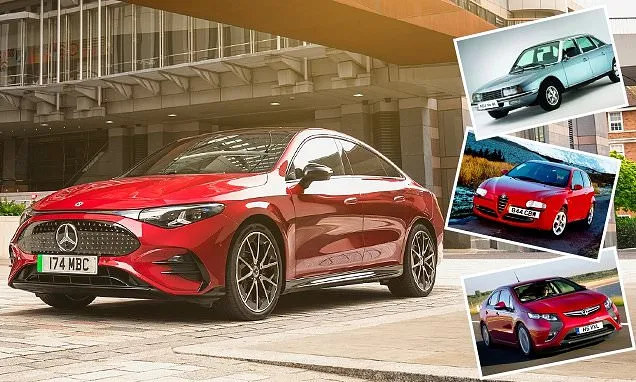
A £45,000 electric Mercedes-Benz that can cover almost 500 miles between charges has picked up the first major car award of the year.
The European Car of the Year gong - which was first dished out in 1964 - was handed to the new CLA saloon last week, marking the third consecutive year an EV has taken top honours in spite of slowing battery car sales across European markets, including the UK.
The award was announced at the Brussels Motor Show on Friday, where the CLA saw off competition from six other finalists to take the overall victory.
This was based on votes submitted by 59 independent motoring journalists from 23 European nations.
The Mercedes family car received a total of 320 points form jurors, beating the Skoda Elroq SUV into second place with 220 points. The Kia EV4 received 208 points to complete an all-EV podium.
The electric Mercedes CLA has just taken one of the biggest automotive awards of the year, with the family EV with a 492-mile range claiming the European Car of the Year 2026 gong.
It's the first time in more than 50 years that Mercedes has taken home the trophy, with the last being the 1974 450SE S-Class.
But while the German car maker hailed it a 'proud moment' for its 'game changing' EV, the list of previous winners proves that the European Car of the Year title is by no means a guarantee for sales success - in fact, it has been something of a poisoned chalice for some cars in the past.
The new CLA four-door coupe - in its longest-range variant - offers up to 492 miles between charges, making it one of the longest distance EVs currently on sales in Britain.
With an 85kWh battery, the CLA returns more than 5 miles per kWh and can add around 200 miles of range from a 10-minute charge, so around the time it takes to fill the tank of a petrol car.
And it is the compact saloon's impressive capabilities that have landed it the 2026 European Car of the Year prize in the eyes of motoring hacks who have driven every motor in showrooms currently and due to arrive in the coming months.
The CLA has been on sale since the middle of last year with a price tag starting from £45,615 and has been dubbed the 'smartest, most flexible' Mercedes yet.
The CLA uses Mercedes-Benz Operating System (MB.OS) and has been its Mercedes-Benz User Experience has been developed with Google and Microsoft to deliver the best AI
This is partly thanks to the all-new Mercedes-Benz Operating System (MB.OS) - an AI-enhanced supercomputer connected to the Mercedes-Benz Intelligent Cloud, which will receive regular over-the-air updates to allow owners to communicate and make adjustments on the move with consummate ease.
Mercedes bosses claim that initial orders for the new CLA have exceeded their expectations. In fact, its order bank is already filled until well into the second half of the year.
'The new CLA was named Car of the Year 2026 - a proud moment for Mercedes‑Benz,' explained Ola Källenius, chairman of the board of management of Mercedes‑Benz Group AG.
'Jurors from across Europe have confirmed what our customers have been telling us:the CLA is a game-changer, delivering outstanding efficiency and effortless intelligence.'
Other cars in the running for the 2026 European Car of the Year trophy included the Citroën C5 Aircross, Dacia Bigster, Fiat Grande Panda and Renault 4.
European Car of the Year winners that were flops or contentious choices...
While the European Car of the Year moniker might be considered a pointer towards a hit seller, in the 62 years of the award there have been a few dubious winners - many of which have gone on to flop.
The NSU Ro 80 was the fifth European Car of the Year winner in 1968, with jurors falling for the German car's innovative rotary engine.
However, severe warranty costs due to engine reliability problems saw it hit huge financial difficulty and the company was bought out by Audi just one year after the R0 80's crown.
Among the winners to have flopped is the 1968 victor, the NSU Ro 80. Jurors loved its rotary engine, but that would be its downfall, with major reliability and warranty issues plunging the German brand into a financial crisis.
The Chrysler Horizon - known as the Talbot Horizon in the UK - is another former European Car of the Year winner.
Another example of this is the Chrysler Horizon, the ECOTY winner for 1979.
While it had grand plans to become Chrysler's first 'world car' and a direct rival to the VW Golf, it failed to live up to the reputation and few recall it at all today, let alone remember it as a standout model.
And while some 150,000 were produced in the UK between 1980 and 1985, registrations data shows there's just one left on the road in Britain today.
Other contentious winners from years past include the hugely unpopular Fiat Brava and Bravo models taking the title in 1996, and the Alfa Romeo 147 - arguably one of the least reliable motors of the modern era - winning the gong in 2021.
In the mid-1990s, the Fiat Bravo (left) and Brava (right) took the European Car of the Year crown. Both would go on to become sales flops
The Alfa Romeo 147 was the European Car of the Year in 2001. The family hatchback suffered a terrible reliability track record
In 2012, the Vauxhall Ampera and Chevrolet Volt - sister 'range extender' cars - took the crown.
However, both vehicles sold in small volumes across Europe, with range extender technology quickly superseded by conventional self-charging hybrids and plug-in hybrids.
The year 2019 saw Jaguar's I-Pace secure the top honour - the first time an EV had won the coveted prize.
But the I-Pace sales have been somewhat disappointing and it became one of the fastest-depreciating cars on the road in recent years, with owners suffering massive value loss within 12 months of buying one new.
Even last year's winner, the Renault 5 E-Tech EV, raised eyebrows when it was awarded the title despite Euro NCAP only giving it a four out of five-star rating in crash tests.
That said, the 5 was among the best-selling electric cars among private buyers, with the small French electric vehicle proving relatively popular.
The 2012 winner was the Vauxhall Ampera range extender. Despite suggestions the drivetrain could be a stepping stone to EVs, manufacturers ditched the technology in favour of more conventional hybrids
In 2019, the Jaguar I-Pace was crowned the first electric European Car of the Year. But it went on to become one of the fastest depreciating cars in showrooms
There was even a level of contention regarding last year's European Car of the Year, the electric Renault 5 E-Tech. This is because it only managed a 4 out of 5-star Euro NCAP crash test rating