Boston-based Tulip announced today it has raised $120 million in a Series D funding round led by Mitsubishi Electric, at a valuation of $1.3 billion. Natan Linder, Tulip's CEO, says he and others at MIT launched the startup to address technology constraints plaguing the world's factories: "While much of the industry pursued automation to replace workers, we focused on a different idea -- productivity improves when software amplifies human expertise on the frontline." This insight led the company to focus on developing and deploying a new category of software that embeds AI in frontline operations.
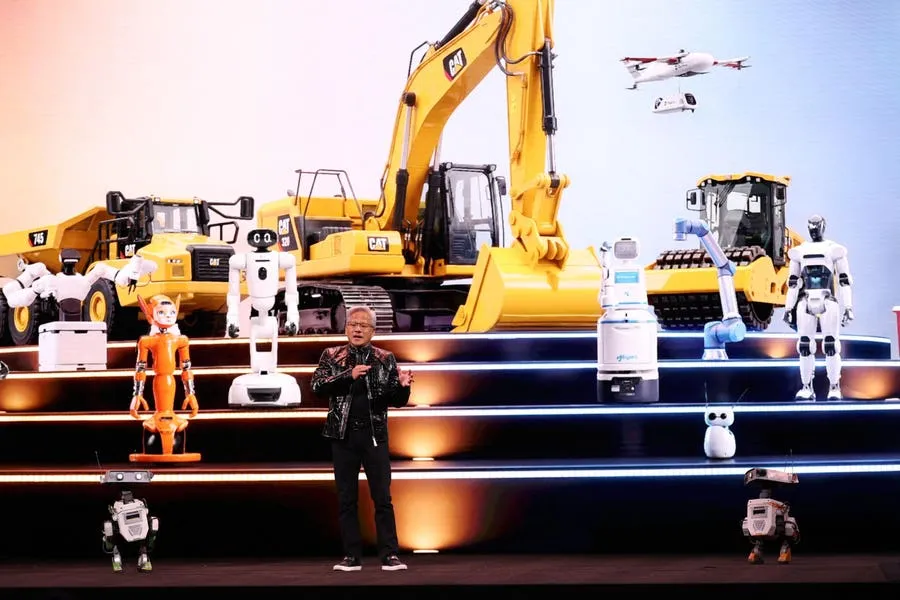
Earlier this month, at CES 2026, Nvidia's CEO Jensen Huang described a new industrial revolution based on Physical AI or machines interacting with the real world; Digital Twins or digital simulations of factories to test and optimize systems before real-world deployment; and Agentic AI or systems that can reason and take action, transforming workflows and productivity by managing complex tasks.
Last October, when talk of the coming crash of the "AI Bubble" has reached a crescendo, I wrote Don't Automate, Innovate: "AI startups that will thrive and survive the coming AI bubble crash, if there is one, are those that will develop innovative ways -- activities, processes, organization of work -- in which people work with AI to be more productive, creative, and efficient."
This is what Tulip has done since its inception a decade ago. In 2025, it supported the activities of 60,000 frontline workers across 1,000 customer sites in 45 countries. One of these customers, Reframe Systems, is revolutionizing home construction by treating homebuilding as a precision manufacturing process, creating high-performance, prefabricated homes that are faster to build, easier to customize, and more sustainable than those built through conventional methods.
Tulip's frontline operations platform provided the flexibility and depth Reframe required to digitize their factory floor, integrate complex workflows, and bridge the gap between digital design and physical production. This digital transformation of Reframe manufacturing processes not only changes how homes are built but also who can build them. Clear, visual, and interactive digital instructions allow new and apprentice-level workers to quickly become proficient without requiring years of specialized training. Operators can flag items for rework and access reference materials directly within the Tulip apps, helping ensure accountability and quality at every step. Using the Tulip apps, operators connect physical items on the factory floor with their digital counterparts, creating a living, responsive environment where data and action are constantly aligned.
As a result, while traditional house building can take 6-18 months, Reframe can accomplish this in just 3-4 months of factory production followed by 1 month of on-site assembly. A Total Economic Impact study by Forrester of Tulip's use by four organizations found an ROI of 448% over three years. The study found, for example, improved efficiencies of 15% for direct labor and 50% for indirect labor, and a 70% reduction in defects.
Agentic AI, employee self-service and empowerment, automated knowledge capture, composable and hybrid architectures, low-code and no-code platforms, "copilots" for the factory floor, mobile-first super apps, and convergence of physical and digital are all key components of the new manufacturing. Tulip has been doing this for a while, and it is poised to capture a significant slice of the emerging industrial revolution, insisting on AI as augmented intelligence or worker augmentation, not automation or replacement.