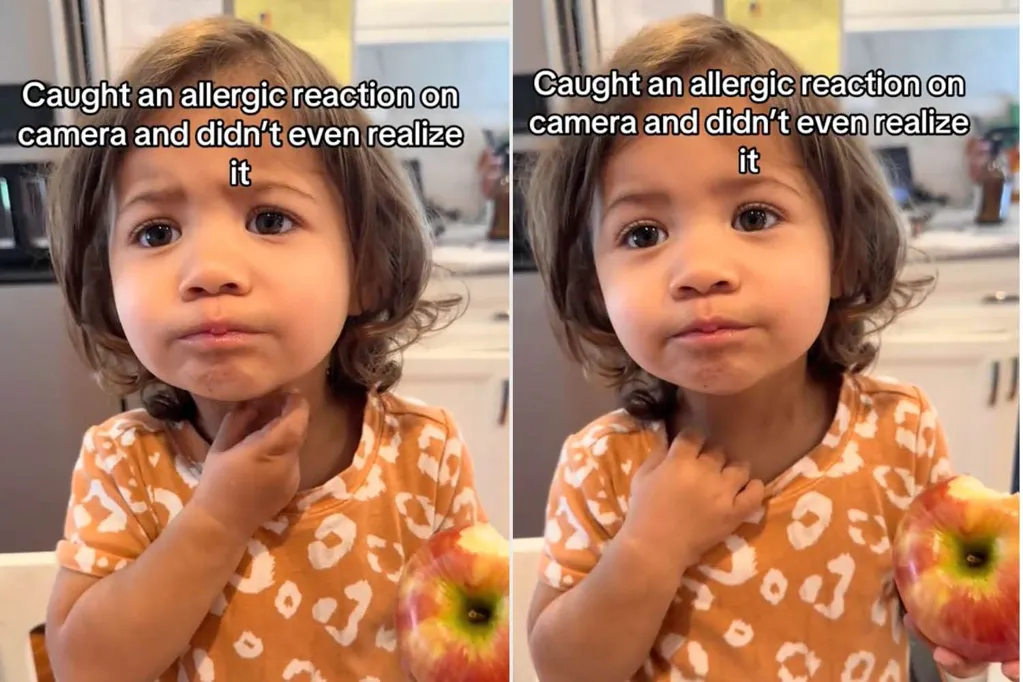
The viral video prompted a deeper conversation about how easily allergies can be missed and how families adapt over time.
One mom's video is only a few seconds long, but it captures a moment that still stops viewers in their tracks: a toddler mid-bite, mid-celebration, and unknowingly in the earliest stages of an allergic reaction.
Simmy Larkin, a 33-year-old stay-at-home mom from Langhorne, Pa., never intended to document anything more than her daughter's excitement about an upcoming birthday. "If you saw the apple in the video, you saw that a significant portion had been bitten off, and that was her very first time biting into an apple," Larkin shared exclusively with PEOPLE.
Just days earlier, her daughter had watched cousins bite directly into apples, something Larkin had never let her do before. With her second birthday eight days away, the family was counting down as they often did, asking Alexa how many days were left and capturing the joy that followed.
Larkin remembers pulling out her phone because her daughter's excitement felt like something worth saving. Instead of the smile she expected, her daughter began scratching her neck and asking to be picked up, behavior that initially didn't set off alarms.
"She has eczema, so that’s nothing out of the ordinary, and that’s why it kind of took me a little bit to catch on," Larkin explains. It wasn’t until she picked her daughter up and saw her from a different angle that the truth became clear.
From that new lighting, the hives were suddenly visible, spreading across her daughter's skin. "As soon as I picked her up, I saw the hives, and I was like, oh, she's having an allergic reaction," Larkin says.
Because food allergies were already part of their daily life, Larkin knew exactly what to do next. She gave her daughter Zyrtec, and the reaction subsided without escalating further.
At the time, Larkin didn't realize apples were the trigger, let alone something as specific as the peel. Like many parents watching the video later, she initially assumed the reaction could have been caused by something else in the environment.
"She has broken out into random hives before, and I did not have any explanation why," Larkin says. Later testing revealed allergies to dogs and dust, things that had been affecting her daughter without the family fully understanding the cause.
The family dog, for instance, had unknowingly been a trigger. "Whenever he licks her, she breaks out in hives, and we didn't know that,"Larkin says, explaining why the apple peel didn't immediately register as the problem.
It wasn't until a second reaction, this time off camera, that the pattern became impossible to ignore. After giving her daughter another apple with the peel on, the same symptoms appeared, prompting Larkin to contact her allergist.
"That second time is when I realized that, oh, she must be allergic to the apple peel," she says. From there, more testing followed, and the list of allergens continued to grow. Now her daughter's list of allergens now contains common foods like steak and eggs.
Beef was one of the earliest and most surprising discoveries. "I've never heard of anyone ever being allergic to steak, so that situation was like, wow, she's got a rare allergy," Larkin says.
The apple peel diagnosis only deepened her awareness of how unpredictable allergies can be. "I've never even heard of an apple peel allergy; that's why I didn't catch on the first time," she adds.
Since sharing the video on TikTok, Larkin has heard from countless viewers with similar stories. Many told her they developed the same allergy later in life after years of eating apples without any issues.
"A lot of people commented and said they grew up eating apple peels and then as adults they started to react," Larkin says. Reading those stories only reinforced how vigilant she now feels she has to be.
Today, that vigilance shapes nearly every part of their routine. Meals are adjusted, ingredients are swapped and familiar foods are approached with caution.
"We substitute ground turkey for a lot of beef recipes even though I don't like the taste of it," Larkin says,laughing. She adds that the family now eats far less red meat overall,something she views as a small silver lining.
Social situations require even more planning. At birthday parties or cookouts,Larkin often brings her daughter's food rather than risk cross-contamination on shared grills.
At school,the differences are especially emotional.“I feel bad knowing that she can’t have cupcakes,”Larkin says,explaining how her daughter’s teacher keeps candy bars on hand so she still gets a treat during celebrations.
Despite her own worries,Larkin believes her daughter has adapted better than she has.“I don’t think she feels as bad as I feel for her,”she says,noting that her daughter often turns down allergy-friendly substitutes anyway.
Over time,Larkin has learned that reactions don’t always come from food.A blanket at a play space once caused hives,later traced back to dust,another confirmed allergy.
“It’s like,wow;now I know that something in the blanket could have caused it,”Larkin says.Moments like that have taught her that reactions can come from anywhere;not just the kitchen.
Her daughter carries an EpiPen,though it hasn’t been needed yet.“She has to show two symptoms,and when she just has hives—that’s only one,”Larkin explains of their emergency plan.
Beyond the immediate reactions,eczema has become another daily challenge.Larkin says they are still learning how much her daughter’s allergies contribute to flare-ups that affect her comfort and sleep.
Recently,her daughter began a new treatment to help manage the condition.“We haven’t really seen any improvements yet,but they say it takes several weeks,”Larkin says,hopeful but realistic.
For Larkin,sharing the viral video wasn’t about fear but awareness.She hopes parents and caregivers come away understanding how subtle allergic reactions can be.
“Be more mindful of giving kids things and ask their parents,”she says,recalling moments from daycare that could have gone very differently if allergies had been involved.
Even something as common as Goldfish crackers can carry risks,she notes.“It could have impacts on kid’s health and type of reaction they have,”Larkin says.