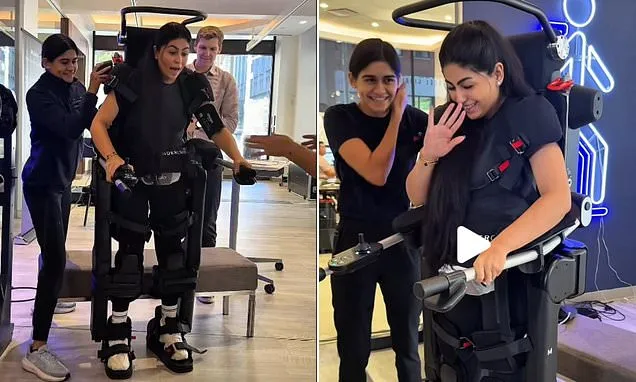
Emotional footage of a woman taking her first steps in more than a decade thanks to a revolutionary exoskeleton has captured the hearts of millions.
Jessica Tawil has been unable to move her legs or lower body since she was involved in a massive car crash in New Jersey, USA, aged just 16.
The smash, which occurred in November 2014, left Ms Tawil with a devastating injury to her spine and means she needs to use a wheelchair every day.
Now a T6 paraplegic - meaning she is paralysed from the lower body downwards - the 27-year-old documents the challenges she faces with her devastating disability on TikTok, where she has gained more than three million followers.
And though she may never naturally walk again, Ms Tawil has been been able to use wearable exoskeletons, powered technology also known as exosuits, which allow paraplegics to walk.
In a video that has since amassed more than 350million views, Ms Tawil captures the moment she takes her first steps since the crash.
As the device lifts her to her feet, she gasps in disbelief: 'Oh my God... ok, ok, ok.'
Moments later and overwhelmed with emotion, she pauses and through tears, says: 'I'm sorry. Just give me a second.'
But as she regains composure and continues forward, a smile breaks through as she reassures herself: 'Ok, not bad. Not bad.'
At the time of writing the clip has racked up more than 15million likes and 140,000 comments, with viewers rushing to leave emotional messages.
Reflecting on the moment in her post, Ms Tawil wrote: 'I never thought I'd get to relive a moment like this again.
'What started as something terrifying turned out to be the experience of a lifetime.
'For the first time in ten years, I saw 16-year-old Jess again - so much of her still alive within me, yet shaped by everything I've lived through since. Different, yes - but stronger, softer, and more grateful than ever.'
Scientists and engineers have collaborated for years to advance exoskeleton technology, with the hope that it could be transformative for people with paraplegia.
The devices are typically constructed from materials such as metal and carbon fibre and are equipped with motion sensors that track the user's movements.
For individuals who cannot move their legs, exoskeletons interpret the user's intent through their upper-body motion. For example, leaning forward or shifting the hips can signal the device to initiate a step.
Some models, such as the one used by Ms Tawil, also feature wrist-mounted controllers that allow users to direct movement. Others include buttons that enable the user to command the device.
Researchers have highlighted a range of physical and psychological benefits associated with their use.
In the Journal of Personalized Medicine, published in 2022, authors said: 'The benefits of walking with an exoskeleton include strengthening impaired muscles, walking speed and efficiency, and secondary conditions after a (spinal cord injury), such as spasticity, bone density, lean body mass, muscle tone, pain, and changes in cardiovascular and bladder and bowel functions.
'Improvements in mood and mental state and overall impact on quality of life have also been reported.'
For Ms Tawil, it gives her a chance to reclaim the part of her life that she lost in 2014.
Previously recalling the night of the car crash, Ms Tawil claimed she was spending the evening at a friend's house when men she did not know arrived with drugs and alcohol.
In her TikTok videos, she alleges that she was kidnapped by them before being taken to an abandoned road and having her requests to go home repeatedly ignored.
Ms Tawil regularly answers questions on her TikTok about life after becoming paraplegic
'When we got to this road, the driver stopped the car and put his foot on the gas and brake at the same time, doing a burnout with his wheels,' she told BuzzFeed previously.
'He lost control of the car and crashed into a tree.'
Ms Tawil suffered whiplash, a head injury that exposed her skull, and a spinal cord injury as a result of the impact.
'Paramedics said that I lost the equivalence of a 'Coca-Cola bottle of blood' out of my head, and didn't think I'd make it if they drove me to the hospital,' she recalled.
'So they drove me to a nearby soccer field where a helicopter airlifted me to the ICU.'
After recovering enough to leave the intensive care unit, Ms Tawil spent seven months in rehab and is now back at home, where she is permanently wheelchair-bound.
Much of her life has now changed.
When she goes to sleep at night, Ms Tawil uses her hands to position her lower body to push up out of her wheelchair and into bed.
She does not toss, turn or shift her position in the night. The position she falls asleep in is exactly how she will remain when she wakes up.
To get into a car, Ms Tawil has to carefully open the door and position her wheelchair next to the front seat. She uses a plank of wood as a bridge from her chair to the seat in the car.
Ms Tawil said she has to be careful moving her body because she cannot feel pain from the waist down, meaning she may not know if she has injured herself.
She, like many other T6 paraplegics, suffers with episodes of autonomic dysreflexia every day—a potentially fatal spike of blood pressure triggered by not going to the toilet.
She describes it as her body 'attacking' her 'because it is in complete confusion.'
Ms Tawil also answers viewer questions on TikTok
Ms Tawil also answers viewer questions on TikTok, though the most common ones appear to be about sex and if she could ever become a mother.
'If I engage in intercourse, I can not feel anything externally, I cannot feel anything internally,' she said.
However, the car accident did not affect Ms Tawil’s menstrual cycle and doctors have told her that she can still conceive a child.
If she does become a parent, she will not need any pain medication during childbirth as she won’t be able to feel it.
Ms Tawil told BuzzFeed that she feels it is important to share her story and her struggles to educate others.
'Not many people know too much about paraplegics and their capabilities, so I wanted to be that light to inform, educate, and even entertain people,' she said.
'I want people to know what it's like to be paralysed... so that they can be a little bit more appreciative of what they have and remain humble.'
She added: 'A lot of people are discriminatory toward paraplegics and wheelchair users... this would give them a small taste of what it's like.'