By NICK PISA, SENIOR REPORTER and JAKE HOLDEN, UK NEWS REPORTER
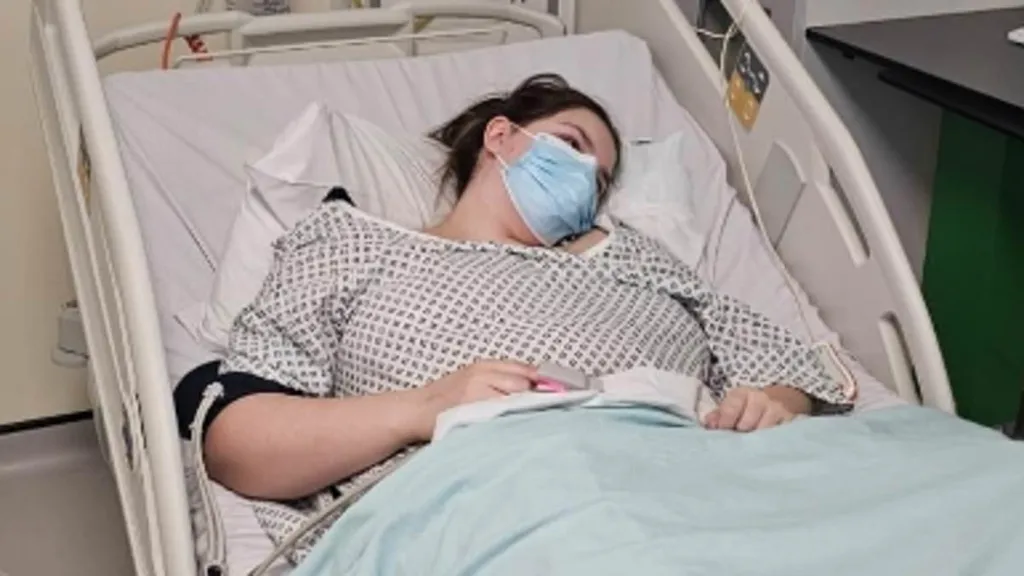
Laying in a hospital bed, looking weak and attached to wires, this is one of the teenage meningitis victims - as her anguished mother told how she feared she was going to die.
Casey Marlow, 19, was rushed to hospital a few days after her and her friends spent the evening at a nightclub thought to be at the centre of the deadly outbreak to celebrate her birthday.
Two young people, a Year 13 pupil and student at the University of Kent, have died in the devastating outbreak, while 11 people have been left seriously ill.
Meningitis can be spread through close contact, and microbiology experts today confirmed that the outbreak in Kent is of the serious bacterial form of the disease.
Infectious disease experts believe the outbreak at the University of Kent is 'unusual' and may be linked to a 'new strain with different behaviours' - where vaccination rates among students are 73 per cent.
Casey's frantic mother Emma Marlow, 38, spoke to the Daily Mail from her daughter's bedside in an isolation ward at the William Harvey hospital in Ashford, Kent, and gave permission for the dramatic picture to be used.
In the photo, Casey appeared weak and exhausted after being diagnosed with meningitis.
Speaking exclusively to the Daily Mail, Mrs Marlow, a custody detention officer, from Ashford in Kent, told how Casey began to feel ill a few days after the night out and her condition quick deteriorated.
She said: 'Casey went to the nightclub on Friday 6 March and a few days later said she had a sore throat, but at first we didn't think anything of it.
'Then on Saturday she pulled up outside my house and called me said she felt awful, she had a raging temperature, a stiff neck and a terrible headache.
'She looked really pale and we just went to the hospital where she has been ever since. She's in isolation but she's getting a bit of colour back and is getting a lot of mummy care.'
Casey Marlow, 19, was rushed to hospital a few days after her and her friends spent the evening at a nightclub thought to be at the centre of the deadly outbreak of meningitis
Casey’s mother Emma Marlow, 38, said her daughter should make a full recovery with antibiotics
Casey, who works at a local Five Guys, told her mum she had ‘felt rough’ during the week after her nightclub visit but put it down to a ‘lurgy’.
Mrs Marlow added: ‘We just didn’t think it was anything serious, just one of those bugs that goes around.
‘She said she had no energy and just felt so exhausted but the Saturday she was taken in she had such a raging temperature and looked awful.
‘You just don’t think something like this will happen to you or one of your family.’
Mrs Marlow revealed that Casey, who should make a full recovery with antibiotics, was at the Club Chemistry in Canterbury with another girl and two boys.
She said: ‘We just hope they all pull through. It’s awful for those who have lost children.
‘I would just say to people be aware and even if you aren’t sure just get yourself checked out if you live in the area and don’t feel well.
‘Casey was lucky, she was with her boyfriend in the car, and they drove straight to the hospital where she was immediately seen to. She was put on antibiotics and had a lumbar puncture and had been looking really pale but she’s got some colour back now.
‘Before she went in she said she had been feeling rough, but we just didn’t think it was something as awful as meningitis, you never do.
‘Just before she called to say she didn’t feel well she said she had been on a walk and her legs ached; the symptoms are so similar to other illnesses that you just don’t think it could be something as serious as meningitis.’
Casey was taken to the hospital by her boyfriend Brandon Williams after her symptoms continued to get worse
Students queue at the University of Kent in Canterbury today amid the meningitis outbreak
Students queuing for antibiotics outside a University of Kent building in Canterbury today
Meningitis alert: What are the symptoms and can it be treated?
- What is meningitis and what causes it??
Meningitis is an infection of the protective membranes that surround the brain and spinal cord. It is usually caused by a bacterial or viral infection. Bacterial meningitis is rarer but more serious than viral meningitis.
It can affect anyone but is more common in babies, children, teenagers and young adults.
Meningitis can be very serious if not treated quickly, and can lead to life-threatening sepsis and permanent damage to the brain or nerves. - What are the symptoms?
Symptoms of meningitis and sepsis can include a high temperature, cold hands and feet, vomiting, confusion, muscle and joint pain, pale, mottled or blotchy skin, spots or a rash, a headache, a stiff neck, aversion to bright lights, being very sleepy and seizures.
Symptoms can appear in any order and some may not appear at all. - Why are young people at risk?
According to Meningitis Now, one in four 15 to 19-year-olds carry meningococcal bacteria in the back of their throats, compared to one in ten of the UK population.
People can carry this harmlessly without becoming unwell, but it can be passed from person to person by coughing, sneezing and kissing.
Increased social interaction in this age group means the bacteria can be passed on more easily.
In universities, students can be more vulnerable because of living in more 'cramped' housing or halls of residence. Young people also come together from all over the world to live, study and socialise. - What causes these outbreaks and how serious are they?
Outbreaks can happen when a particular meningococcal strain enters a community where people are mixing closely.
Universities which include halls of residence, parties, and large social groups can help the bacteria to spread more easily.
But the risk to the general public in Kent is low, with people at the highest risk usually close contacts of cases. - How is meningitis treated?
Hospital treatment is recommended by the NHS for all cases of bacterial meningitis.
Treatments include antibiotics and fluids administered directly into a vein; oxygen if there are breathing difficulties; and in some cases steroid medication to prevent swelling around the brain.
Patients may need to stay in hospital for a few days or weeks.
In cases of mild meningitis, patients may be sent home if tests confirm it is viral; which usually gets better on its own. Most patients start to feel better within seven to ten days.
But severe viral meningitis may also be treated in hospital. - What action is being taken to stop the spread in Kent?
Close contacts of the University of Kent students affected will be given antibiotics.
On Sunday, the UKHSA said specialists were interviewing affected individuals and their families to 'help identify all close contacts and arrange antibiotics to limit spread'.
The agency had also worked with the University of Kent to provide advice letters to all 16,000 students; providing information on recent cases; the signs and symptoms of the illness; how to obtain antibiotics; and what to do if they felt unwell. - Are there vaccines available for meningitis?
There are two vaccines for meningitis.
The MenACWY vaccine is a single dose jab that protects against four strains of meningococcal bacteria.
It is offered to teenagers in school and is also available to those entering university, up to the age of 25.
Experts say that this jab is 'highly effective at protecting against invasive disease'.
But Andrew Preston, a professor of microbial pathogenicity at University of Bath, said that uptake among teenagers was about 73%.
'So there are a lot of unvaccinated students given the size of the student cohort,' he said.
Elsewhere, there are the MenB , 6-in-1 , pneumococcal and MMRV vaccines for babies and children. - What should you do if you think you have meningitis?
The NHS recommends that people call 999 for an ambulance or go to their nearest A&E.
People are advised to trust their instincts , as someone with meningitis or sepsis can get a lot worse very quickly .
'I would just say to anyone who has been in the Canterbury area to be aware and if they don't feel well get themselves checked out.
'I'm just going to stay with her and make sure she gets better as quickly as possible , bless her but she's still feeling weak and exhausted.'
Mrs Marlow added: 'I've had the UK Health Security Agency on , and they wanted to know who else Casey was with that night so they could be traced and checked .
'They have been helpful and have been sending me lots of information but what I'm worried about is that if this was known about why there were no warnings , if I had known I wouldn't have let her go to Canterbury that night.'
It comes as hundreds of masked university students queued for antibiotics at University of Kent in Canterbury today following the deaths of one student at the university and a sixth-former named Juliette at Queen Elizabeth's Grammar School in nearby Faversham.
Two teenage brothers have become terrified after they attended a party which was hosted by a friend who is now in hospital with meningitis.
Matthew McDonagh, 16, and his brother Luca , 17 , were at a party in Whitstable , Kent , on Saturday with one person who has now been diagnosed with the infection .
Luca , who is in Year 13 , has said that no one in his year group at Simon Langton Grammar School is allowed to go in for lessons .
He and his brother , also at same school , were told to come to University of Kent to receive precautionary antibiotic .
Matthew told the Press Association: ‘It’s quite scary. Like, just like, I can’t believe it. It’s just insane. Yeah , it’s actually happening since Covid . I thought this literally never happened again , and then I’m in like , a massive queue .
‘It’s completely unbelievable. I never thought this would happen again.’
They were both queuing at the university to collect antibiotics.
More than 30,000 students and staff at the campus have been alerted by the UK Health Security Agency (UKHSA), warning them to stay vigilant against symptoms. The university has now postponed some in-person exams and moved others online.
The invasive outbreak is believed to be linked to a social event at a nightclub in Canterbury, which some of those affected had recently attended. The UKHSA is now arranging antibiotics for some students in the Canterbury area following the outbreak.