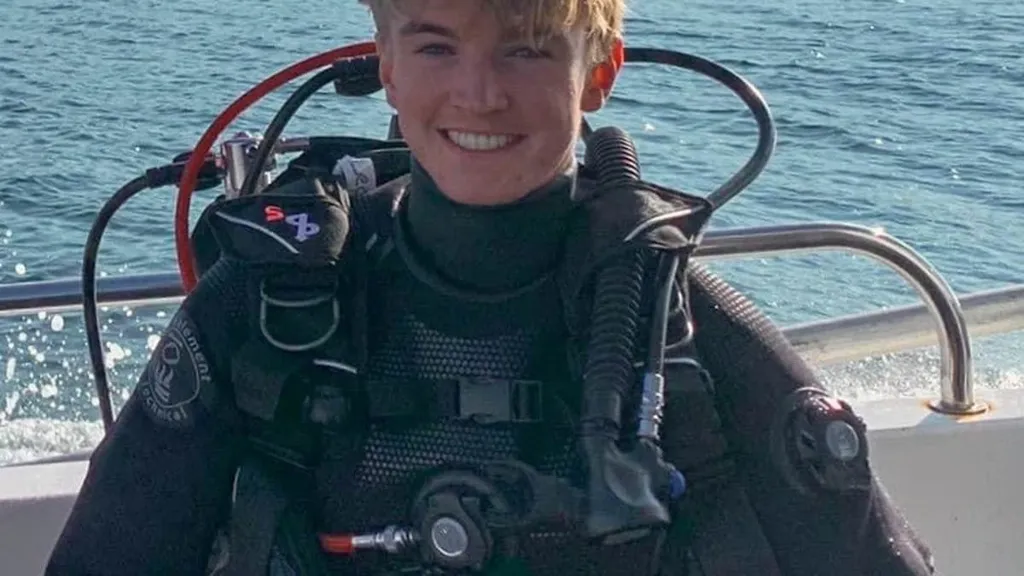
Every mother remembers the first time they hold their newborn baby in their arms - gratifyingly few are alive for their funerals and the subsequent emotional nightmare of the admin that follows.
On February 3 2023, 19-year-old Leo Johnson took his life while at university, leaving his mother Jane, his sister Ella and father shattered, heartbroken and confused - and six years on, they are determined to change things for the next unfortunate family.
Hours before taking his life, 19-year-old Leo Johnson sent his mother Jane a photo of the calm blue Devon sea. He had just been cold water swimming.
'The last few days have been really good,' read the accompanying text. It would be the last message Jane would ever receive from her son. A few hours later, he had thrown himself under a train.
Leo had been suffering from what he'd told his parents was mild depression at university. In reality - he was drowning.
Tragically, on top of their overwhelming grief, Leo's family had another burden heaped upon them - the 'practical chaos' of closing his every account, from banking to bonds and social media.
The admin nightmare that followed her son's death is the reason Jane Johnson wants people to consider the consequences when the worst happens. It is the reason she urges everyone to sign up to Legacy Hub.
Her heart filled with hope that her son was winning the battle with the demons that had been haunting him. He looked like he had finally found his happy place.
On February 03 2023, 19-year-old Leo Johnson took his life while at university
His mother Jane and sister Ella were left shattered by Leo's death and the admin nightmare that followed
But nothing could prepare Jane, 55, for the knock on the door just hours later. The police officer's words will stay with her forever.
Leo came from a close and loving family in Stourbridge West Midlands. He and his sister Ella, now 21, had an especially tight bond, and grew even closer after their parents divorced in 2015.
Jane said: 'He was an amazing boy growing up. He was bright, adventurous, but also sensitive. He could be reserved at times, but he would always give things a go.
'He grew up surrounded by love, not just from his immediate family, but from a wide network of friends, cousins, aunts and uncles and grandparents.
'We had such a wonderfully close wider family. I often felt genuinely lucky to be raising two children in such a lively and supportive environment.'
Leo was known to internalise his emotions more than sister Ella. 'Maybe this was an early clue to how he might later cope with life's pressures,' muses Jane.
'When his dad and I divorced, Leo continued living between both our homes. He seemed happy like that.
'He handled school well, he loved diving, and his A level subjects of geography, geology and physics reflected his enquiring mind and fascination with science.
Like many teenagers, Leo's sixth-form years were taken over by the COVID-19 lockdown.
'He did his A-levels while sixth form was pretty much in lockdown. It was tough because, at that age, you’re really testing boundaries, going out, having a few drinks - within the safety of home.
Instead, Leo was confined to his bedroom and spent long days and nights on his screen.
'His 17th and 18th birthdays came and went under restrictions,' recounts Jane.
'Leo would spend hours online, gaming late into the night, not out of avoidance but through necessity. It was his link to the outside world,' Jane says.
But Leo still found space to experience life. For his 16th birthday, he got diving lessons, and throughout the pandemic it became one of the few activities he was able to continue.
Determined to go to university, Leo chose Plymouth to study Oceanography, combining his love of science with his passion for the sea.
From the outside, his life looked idyllic. He sent videos from the boats he was studying on, from his cherished dives and from liberating swims in the sea with his university friends.
But beneath the surface, pressure was building. During Leo’s first year at university, his father was diagnosed with cancer. His sister Ella could only visit alone under strict PPE rules.
'I think that was really tough for an 18-year-old living so far away from home,' Jane says.
'In November of his second year, Leo phoned both me and his dad to say he felt low. He had seen a doctor and told us he was diagnosed with mild depression.
'He came home briefly, and when he returned after Christmas, he appeared to be coping. He was open about his diagnosis, told his friends, and even took proactive steps to protect his mental health.
'He deleted TikTok, reduced his time online and was making an effort to spend more time outdoors. He was working hard and did well in his exams - he didn’t want to let us down.
'Then in February, he sent me the photo of the sea after his cold-water swim.'
Just hours later police visited Jane at home to tell her Leo had taken his own life.
'We had no idea that it was even an option for him, that it was even on his mind. Even when the police were at the door, I still assumed there must have been somebody else involved.
'It just didn't compute for me at all that he had taken his own life.'
'It was only after his death that we learned that Leo had disclosed suicidal thoughts and a plan to his doctor months earlier.'
'But at 19, he was legally an adult and patient confidentiality meant we weren't informed. The university didn't know the full picture either.'
'I don't blame any person in particular,' Jane says. 'I blame the system. They were doing what they were told to do.'
'The modern mental-health system is so over stretched. Leo was never seen face-to-face, not by a GP, not during his assessment. Everything happened online or by phone. And what he hid, he hid deeply.'
'I believe each person has layers; the outer one is what the world sees; another is for friends & family; another is online life; a tiny inner layer that no one sees.'
'That's where Leo hid things,' she explains.
'One of the most heartbreaking discoveries was finding magnesium tablets, supplements and vitamins in his room. It was like he was desperately trying to find his own solution,' she says.
After Leo's death Jane made a deliberate choice - not to drown in her own grief, but to live in a way that honoured him
'Nothing I do will bring him back,' she says. 'Anger and blame won't help me, and it won't help Ella. We still need each other.'
Leo's death has taught Jane one thing that she feels very strongly about it.
'Nothing prepares a family for the practical chaos that follows an unexpected death, especially one so far from home, involves an inquest, and involves a young adult with a mostly digital life.'
'I believe everyone should create a digital legacy in their lifetime. However old or young they are - for loved ones to access in face of an emergency or for when they pass away.'
'Because Leo had no spouse or children, as his parents we had to prove our right to act as next of kin and it was so complicated at a time when we ourselves were barely holding it together.'
'We had no formal death certificate for months. And every institution, bank, savings account, digital provider all required separate evidence.'
'We had to basically go on a fact-finding mission because there's nowhere, no central place where you can go to check records or find out everything.'
'Some organisations were helpful. Others were not. One repeatedly sent the wrong documents; another even sent a cheque made out to Leo.'
'We also found £300 cash in his wallet. It was puzzling and unexplained. There may have been accounts we never knew about, with no central record of digital presence.'
'Along with the unbearable tragedy of losing your loved one, it's left to families like us to try and piece it all together.'
The difficulty for Leo's family to go into his private world without his blessing felt huge.
It remains so painful because much of his online presence remains active.
Jane believes all families should have a simple, non-intrusive way for everyone - young adults in particular - to record the basics
WhatsApp automatically removed Leo after six months, sending all his contacts an automated system message to say he had left.
‘That out of the blue moment struck me so suddenly and painfully’, she remembers.
Jane believes all families should have a simple non-intrusive way for everyone—young adults in particular—to record the basics just enough to help their family if the worst happens.
She is a staunch supporter of Legacy Hub, a digital platform set up to allow people to securely store financial records, funeral wishes, videos, letters and mementos, to preserve memories.
‘I’m a realist; expecting a 19-year-old to leave organised records of accounts; insurance details or passwords is unlikely. But it would have been so helpful during the worst of times.
‘Everyone should have somewhere that houses all the essentials about their accounts; basic financial and insurance information; details of key digital accounts;
I know that that would have made a real difference to our family if there had been somewhere we go turn to for Leo’s stories; his wishes; his documents and all his memories.’
‘Obviously we’d never talked about a funeral and what he might want. I don’t know how many young people would talk about that. But I think at that age you’re more likely to talk about what wedding you want, aren’t you?’
Today, Jane and her family treasure memories of Leo—but his mother wishes she had more.
‘Because of the age he was, we’ve got a few videos from when he was little, but we were not a big video family, so we have precious little to remember him from when he was older.
‘If I’d had a video of him, I could hear him laugh again, hear his voice. I worry I will forget what he sounds like.’
‘If Legacy Hub had existed, I could have had more memories of Leo. All the photos in the world won’t bring our son back—but every single one that exists of him means the world to me.’