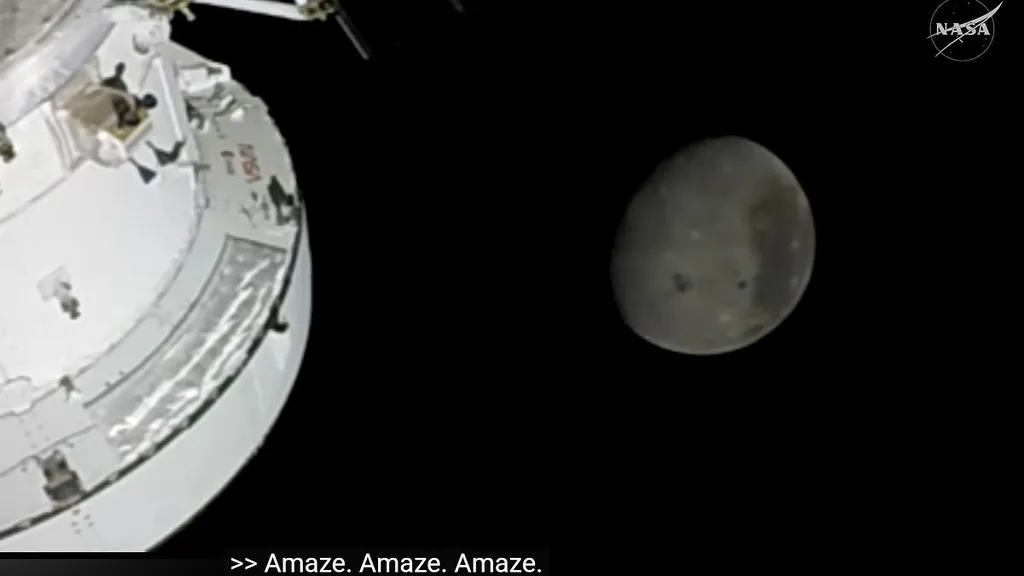
NASA's Artemis II crew might be living out a real-life sci-fi blockbuster, but the daring astronauts are also big fans of on-screen space adventures.
In an adorable moment, NASA's Mission Control quoted Project Hail Mary while speaking to the Artemis II crew.
The crew - Reid Wiseman, Victor Glover, Christina Koch, and Jeremy Hansen - is currently making the 250,000-mile (402,300 km) journey home after a successful lunar flyby.
As Commander Reid Wiseman described the incredible view of the lunar surface, Mission Control playfully responded: 'Amaze! Amaze! Amaze!'
For those who haven't seen the film, that is the catchphrase of 'Rocky', the friendly alien encountered by scientist Ryland Grace, played by Ryan Reynolds.
On social media, both film and space fans have flocked to share their excitement over the unexpected movie reference.
One commenter wrote: 'When the NASA team is using a catchphrase from a science-fiction film, that's priceless!'
Another simply added: 'This brings me so much joy.'
The surprising exchange came as the Artemis II crew made their six-hour lunar flyby, passing around the far side of the moon 41,072 miles (66,098 km) above the lunar surface.
The Orion crew capsule reached a staggering 252,756 miles (406,771 km) from Earth, surpassing the distance achieved by the Apollo missions and setting a new record.
As they made the record-breaking journey, the astronauts took turns to radio back to Ground Control and describe what they were seeing.
Mr Wiseman told NASA: 'We just realised we have Earth at window four and the Moon at window three, and it gives you the best idea of scale we have had yet.
'The Moon is about three to four times the size of the Earth, and it is almost full, and the Earth is just a small crescent out there. It's magnificent - I got a picture of it with the wide lens. Such a majestic view out here.'
This prompted the Ground Control team to respond: 'Amaze! Amaze! Amaze! Thank you, Reid.'
NASA and the Artemis II crew are well known to be big fans of the film and original book by Andy Weir.
The crew even watched a special screening of the movie alongside their families while waiting in quarantine before launch.
This exchange came as the Orion crew capsule made their lunar flyby, passing around the far side of the moon 41,072 miles (66,098 km) above the lunar surface
Speaking during an event organised by the Canadian Space Agency, Jeremy Hansen said that the film helped the crew with 'getting us ready to go on our own space adventure'.
'Art imitates science and vice versa,' said Mr Hansen.
'I thought it was just such an inspirational example - somebody who goes out there and just gets what was done to save humanity. It's a pretty extraordinary example that we can all follow.'
Earlier this year, Ryan Gosling and the team behind Project Hail Mary even visited NASA's Jet Propulsion Laboratory to discuss the connection between science and filmmaking.
On social media, fans have gushed over NASA's nod to a beloved character.
One commenter wrote: 'I love how this movie/story is now forever connected to this historical event!'
'That rocky quote paired with Artemis II's view is NASA flexing pure cosmic poetry,' one commenter added.
While another chimed in: 'This makes me a lot happier than it should.'
The Artemis II crew are well-known fans of the film Project Hail Mary, having seen an exclusive screening during the quarantine before launch
Earlier this year, Ryan Gosling (middle) and the team behind Project Hail Mary even visited NASA's Jet Propulsion Laboratory to discuss the connection between science and filmmaking
This exchange came shortly before the Orion crew capsule entered a planned communications blackout, as the bulk of the moon briefly blocked out radio signals.
The 'loss of signal' began at 6.43 pm ET, and connection was restored after about 40 minutes of nerve-wracking silence.
Artemis II has now begun to transmit back the first pictures taken of the moon's far side during that blackout.
These include a stunning photograph titled 'Earthset', which was taken from the far side of the moon and shows the Earth dipping beyond the lunar horizon.
This is a nod to Earthrise - the famous photo captured by NASA's Apollo 8 mission more than 50 years ago.
Having passed the moon, the Orion crew capsule will now ride the tug of Earth's gravity back home over the coming days, with splashdown expected on Friday.
Their final ordeal will be a blazing re-entry into the planet's atmosphere, as the capsule hits the atmosphere at around 25,000 miles per hour (40,200 km/h) before deploying its parachutes and landing in the Pacific Ocean.
Artemis II: Key facts
- Launch date: April 1
- Mission objective: To complete a lunar flyby, passing the 'dark side' of the moon and test systems for a future lunar landing.
- Total distance to travel: 620,000 miles (one million km)
- Mission duration: 10 days
- Estimated total cost: $44billion (£32.5billion)
- NASA Space Launch System rocket: $23.8billion (£17.6billion)
- Orion deep-space spacecraft: $20.4billion (£15billion)
Crew:
- Commander Reid Wiseman
- Pilot Victor Glover
- Mission Specialist Christina Koch
- Mission Specialist Jeremy Hansen
Mission Stages:
- Launch from Kennedy Space Centre Launch Pad 39B
- Manoeuvre in orbit to raise the perigee using the Cryogenic Propulsion Stage
- Burn to raise apogee using the Cryogenic Propulsion Stage
- Detach from Cryogenic Propulsion Stage and perform translunar injection
- Fly to the moon over four days
- Complete lunar flyby at a maximum altitude of 5,523 miles (8,889 km) above the moon's surface
- Return to Earth over four days
- Separate the crew module from the European Service Module and the crew module adapter
- Splashdown in the Pacific Ocean