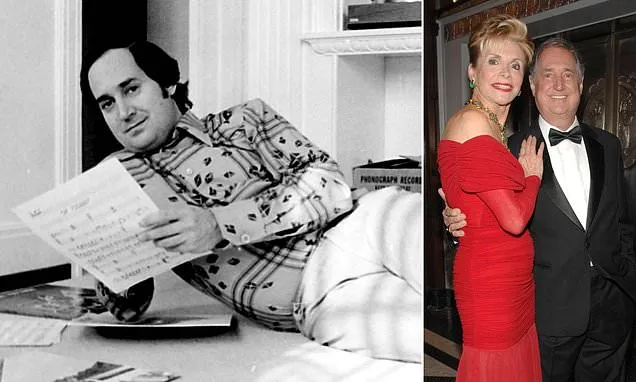
Neil Sedaka wasn't just a pop star. He was also a songwriter's songwriter, a beacon for younger artists at a time when singing and writing were seen as very different things.
A teenage girlfriend of his, Carole King, grew up to be one of the great songwriters herself.
'He was so talented,' King said yesterday, 'and he inspired me to follow my dream of being a songwriter.'
Another all-time great, Stevie Wonder was once asked who had been his inspiration. 'Neil Sedaka,' he said.
When Wonder was growing up in Detroit, he was so well known for being a Sedaka fan that he was nicknamed 'Whitey'.
Sedaka's career went all the way from 1957 to 2025 - and there were three secrets to his success.
The first was his voice, which was effortless, persuasive and deceptively precise. When he sang, you could make out every word - and feel whatever he was feeling.
The second secret lay in his writing. He mastered many different forms, from doo-wop (as practised by his first band, The Tokens) to soft rock (as shown by his ballad Laughter In The Rain).
That versatility came from being a devoted student of music. He had studied classical piano at the Juilliard School in New York after winning a scholarship that entitled him to lessons on Saturdays.
Many a classically trained pianist would have turned up their nose at the idea of pop - and Sedaka's mother, Eleanor, disapproved when her son started writing songs - but he took it seriously.
It was said that in 1959, when he needed a hit after a few flops, he bought the three biggest singles of the moment and sat down to work out how they were put together. The result was Oh! Carol, the pop classic that became his signature tune.
The third secret was emotional intelligence, a quality he shared with his lyricists, first Howard Greenfield and later Phil Cody.
The lines Greenfield wrote for Oh! Carol were the sort of thing that the people of those strait-laced times might have been shocked to hear coming from a young man. 'You hurt me and you make me cry,' Sedaka trilled. 'If you leave me, I will surely die.'
BREAKING NEWS
Greenfield and Sedaka were aware that most pop records were bought by young women, and that this vulnerability was exactly what they wanted to hear. They were two young men who were - as nobody would have said at the time - fully in touch with their feminine side.
They could be blokey, too, as they showed with the jokey rock 'n' roll of I Go Ape.
And some of their songs were very much of their time. In Happy Birthday Sweet Sixteen, the narrator, who has known the birthday girl since she was six, is a little too delighted to find that she’s gone from a tomboy to ‘the prettiest girl I’ve ever seen’.
Sedaka got away with it because the tune he wrote for that song, as for so many others, was full of charm. His melodies had an elegance about them, bringing a whiff of Broadway to the Billboard chart.
In 1963, when The Beatles swept into America, Sedaka’s career nearly capsized. Not only did the hits dry up but, for a while, he couldn’t get a record deal – until Elton John signed him to Rocket Records in the 1970s.
Sedaka didn’t hold a grudge against The Beatles. He and Paul McCartney became friends, and when McCartney turned 80 in 2022, Sedaka posted a picture of the pair of them, saying ‘Happy 80th birthday to the greatest of all time – Sir Paul McCartney!’
Sedaka, as he acknowledged with that remark, wasn’t quite in McCartney’s league. But some of the people he inspired were. And he himself was very, very good.