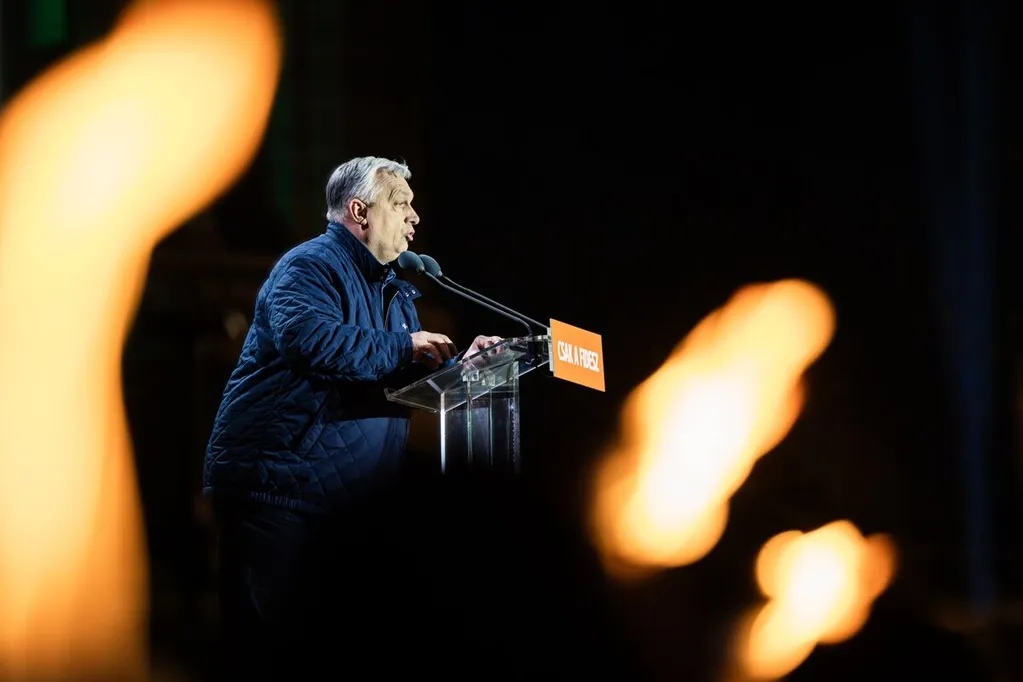
The defeat of Hungary's Viktor Orban is a warning to conservative European leaders who may be tempted to align closely with Donald Trump and Vladimir Putin, according to the European Commission's most senior Social Democrat official.
"It is the right time to think about a turning point," Teresa Ribera said in an interview in Barcelona, where she's attending the Global Progressive Mobilization, a gathering of about 100 left-wing parties hosted by Spanish Prime Minister Pedro Sanchez.
Ribera, a Spanish socialist herself, said Peter Magyar's victory in Hungary was only possible due to the "mass mobilization of the left" and the country's democratic forces. The election result was a "strong wake-up call for parties that have felt tempted by the way President Donald Trump acts, or the interference of President Vladimir Putin," she said.
Hungary's new government must make a "big effort" to "undo the reforms" introduced by Orban that run counter to judicial independence, freedom of expression and minority protections, Ribera said. Only then can €18 billion ($21.2 billion) in EU funds now frozen by Brussels be unlocked.
She also said she expects Magyar to lift, upon taking office, the veto on €90 billion in EU funding aimed at helping Ukraine counter Russia's invasion.
Leftist political parties, which at the start of the century led governments in Europe's main countries, now hold some of their lowest levels of representation in history. Of the 27 leaders attending European Union summits, only three -- Spain, Denmark and Malta -- belong to the Social Democratic family, although Socialists also make up part of some coalition governments, such as in Germany and Austria.
Ribera said there are other signs pointing to a shift, including the referendum loss suffered by conservative Italian Prime Minister Giorgia Meloni in March.
Unexpected allies are also emerging, including Pope Leo XIV, she added: "He has become an idol in defending essential values that have defined our society over the past 70 years."
Ribera, Executive Vice-President of the European Commission for a Clean, Just, and Competitive Transition, is also the bloc's antitrust chief. She regularly contends with conservative dominance within the institution, led by Germany's Ursula von der Leyen.
Ribera characterized her relationship with the European Commission president as good and said she seeks to resolve differences privately. They've clashed over climate policy, to which Ribera has devoted much of her career, including as a minister in Spain.
"I would like to move faster and she is more cautious,"
she said. Their disagreements have also included the EU's stance on Gaza and relations with the US.
Europe faces the challenge of "learning at high speed to build its autonomy" from the US following a "decoupling" marked by unexpected "virulence," Ribera said.
EU leaders remain divided about transatlantic relations due to the "panic caused by Russia's hostility and aggression, and the possibility it could go beyond Ukraine," she said. At the same time, Trump's decisions are pushing Europe to become "much more explicit about things that are not acceptable."