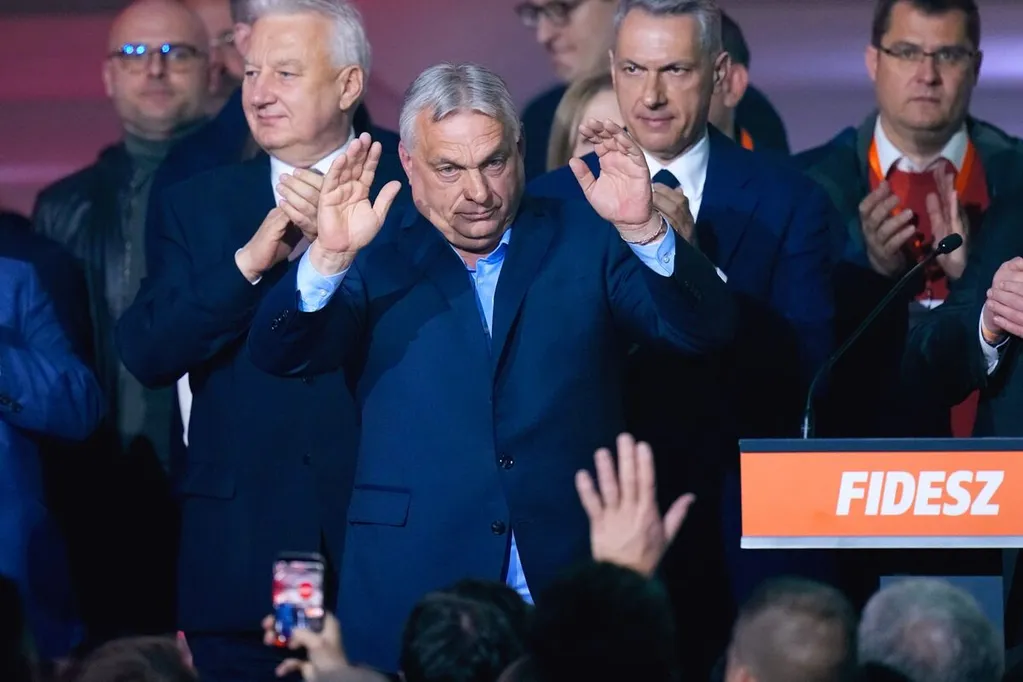
Viktor Orban's imminent departure from the political stage has given the European Union a rare window for change.
For years, the Hungarian prime minister, the longest serving EU leader, sought to undermine the European project. He courted Vladimir Putin during wartime and vetoed Russian sanctions. He flouted the EU's rule-of-law standards and eroded democratic freedoms.
Now, the EU has a unique opportunity as Peter Magyar prepares to take office in Hungary, boosted by a thumping majority. Numerous policies stalled under Orban are suddenly back in play, according to people familiar with the matter. And officials are already floating reforms to the EU's rules in an attempt to prevent future Orbans from hijacking decisions.
"It is a new era that is dawning in Hungary with the election of Mr. Magyar, and this will also mark the beginning of a new era in Europe," French President Emmanuel Macron said this week.
EU leaders will get a sense of that new era on Thursday and Friday in Cyprus, where they are meeting for a summit. Orban could still attend, but has decided to skip.
Anticipation is that Orban's ouster will help resolve certain issues swiftly -- Hungary has already dropped its veto on the EU's €90 billion ($106 billion) loan for Ukraine.
But many other reforms and policies are expected to remain stuck, said the people, who spoke on the condition of anonymity. Hungary's vocal objections often obscured broader divisions within the bloc, while Slovakia and now Bulgaria remain possible disruptors. And few expect Magyar, still a conservative, to completely ditch Hungary's positions on issues like migration and energy.
The result is likely an EU that functions more diplomatically but doesn't radically change.
"We won't have the Trojan horse in our castle," Lithuanian Foreign Minister Kestutis Budrys told reporters on Tuesday. "That's a good thing."
Changing Quickly
Orban often had a way of derailing EU gatherings.
Swedish Foreign Minister Elisabeth Svantesson recalled a routine meeting in 2024 that descended into recriminations, as officials lashed out over Orban's decision to visit Putin -- while Hungary held the EU's rotating presidency.
"I'm very positive the new leadership will be better," she said in an interview. "When it comes to Ukraine and cooperation closer to the EU, it will be different."
Indeed, Magyar has vowed to bring Hungary back into the European fold and address the bloc's concerns about the rule of law, judicial independence, corruption and academic and media freedoms.
That will likely help Hungary unblock billions in frozen EU funds, held back over democratic backsliding allegations. That prospect, plus Magyar's desire to adopt the euro, has helped push Hungary's stocks, bonds and currency to multi-year highs. Magyar's team is already discussing the blocked money with EU officials and has made the issue its top EU priority, according to people familiar with the team's thinking.
Magyar's approach will also ease the EU's efforts to support the cash-strapped government in Kyiv -- most immediately with the freed €90 billion loan. Longer term, officials want to revisit a program to reimburse EU countries for weapons donations to Ukraine, dubbed the European Peace Facility. Orban has been blocking that scheme for months.
Russian sanctions are back on the table, as well, and there is renewed momentum to squeeze the Kremlin, some of the people said. A Hungary-vetoed 20th package was finally approved on Wednesday, and people are discussing additional sanctions, according to Kaja Kallas, the EU's top diplomat.
Still, Magyar, which actually means Hungarian, is something of an unknown quantity, according to one senior official from an EU country, echoing a common view. The fact that he was steeped in the politics of Orban's Fidesz party before breaking with him during the prime minister's final term is not lost on anyone.
"I think, intuitively, that he's going to be in an area close to Italian Premier Giorgia Meloni in terms of political action at the European level," Romanian President Nicusor Dan said in an interview for Europa FM radio.
Changing Slowly
Orban's departure does not mean everything will suddenly move swiftly in Brussels.
Countries that privately shared Hungary's concerns on topics like migration and Ukraine were sometimes happy to stay quiet while Orban spoke out. Now they can no longer rely on Hungary to be the spoiling vote.
"On some issues, people tend to hide behind Orban," Lithuanian Finance Minister Kristupas Vaitiekunas said in an interview.
That dynamic will come to the fore as the EU enters intense budget negotiations and grapples with the wars in Ukraine and Iran.
Many countries are keen to accelerate the bloc's negotiations over its next long-term budget, which will run from 2028-2034. Officials want to strike a deal well before the French election next April, wary of Marine Le Pen's far-right, euroskeptic party taking power and hijacking the process.
It won't be easy. Deep divisions remain over the budget's size, structure and priorities. And in response to Orban's tenure, several countries want to place more rule-of-law conditions on EU budget payouts.
"The lesson from these 16 years is that the rule of law and anti-corruption principles must be more strongly integrated into the EU's actual budget," Finnish European Affairs Minister Joakim Strand said in an interview. "In Hungary, European taxpayers' money has been misused."
Complicating matters further, Magyar is expected to retain many of Orban’s positions on the budget, one EU official said. EU leaders are scheduled to discuss the bloc’s finances during their summit in Cyprus this week.
Similarly, Magyar is not expected to suddenly welcome Ukraine into the EU, after Orban spent months blocking formal EU negotiations with Kyiv.
Magyar may at least allow the EU to advance official talks with Ukraine, the people said; though he's not expected to support accelerated membership -- an idea that faces broader resistance. In the meantime, countries like France and Germany could start discussing alternatives to full-fledged membership, according to a senior EU diplomat.
Another country receiving fresh attention post-Orban is Israel. Spain, Slovenia and Ireland have renewed a push to penalize the country over its actions in Gaza and the West Bank, eyeing an opening without Orban, who vetoed all Israeli punishments.
The issue dominated an EU foreign ministers' meeting earlier this week, and Kallas said the discussion would continue. A top French official said they expect Magyar to significantly shift Hungary's position on Israel -- without making a full U-turn.
Changing Europe
Orban's defeat is also triggering broader, structural questions about the EU's own rules and reshaping power dynamics within the bloc.
Officials are discussing whether now is the time for a fundamental reform of the EU decision-making process. In particular, the principle of unanimity is under scrutiny.
Under a series of painfully negotiated treaties that underpin EU law, areas like foreign policy, admitting new members and taxation require unanimous agreement, rather than the heightened majority needed to pass other policies.
A day after the Hungarian election, European Commission President Ursula von der Leyen, the EU's top executive, called on countries to "use the momentum" to abolish unanimity for foreign policy decisions. For years, Hungary was often the lone veto preventing the EU from making even relatively non-controversial foreign policy statements.
The change, she said, is "an important way to avoid systemic blockages."
But politically, she faces an uphill battle. Smaller countries value the veto power implicit in the unanimity rule and are unlikely to agree to a change, the people said.
In central and eastern Europe, Magyar's arrival is rippling through other capitals. The moribund Visegrad Group, which brought together Poland, Hungary, Slovakia and the Czech Republic, is showing new signs of life. Magyar has said his first foreign visit as prime minister will be to Poland, sparking expectations of a renewed collaboration.
Czech Prime Minister Andrej Babis has also said he wants the Visegrad four to hold a summit with Germany and Austria on energy prices -- a grouping that could influence EU affairs.
"There is a new momentum," Kallas told reporters on Tuesday.