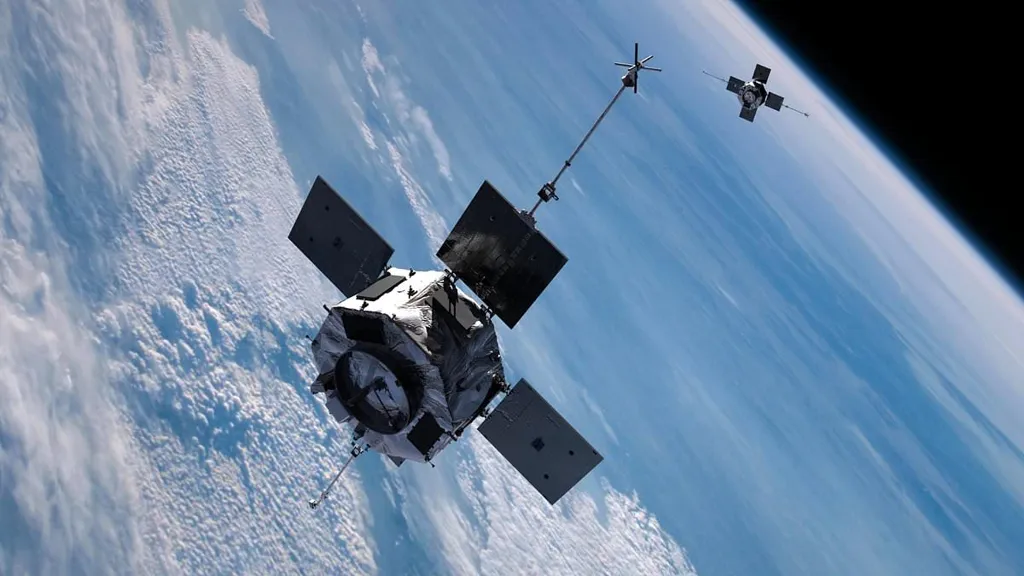
A 1,300-pound NASA satellite is hurtling back toward Earth and could make an uncontrolled plunge through the atmosphere on Tuesday after nearly 14 years in orbit.
The agency has been tracking the Van Allen Probe A and predicts it will reenter the atmosphere at around 7.45pm ET, though the exact timing could vary by up to 24 hours.
Because the spacecraft is traveling thousands of miles per hour and the reentry window spans nearly a full day, scientists cannot predict exactly where debris may fall.
NASA said most of the spacecraft is expected to burn up as it streaks through the atmosphere, although some components could survive the fall.
The risk of anyone being harmed is extremely low, estimated at roughly 1 in 4,200.
The spacecraft's mission ended in 2019, and scientists initially expected it to fall back to Earth in 2034.
However, those calculations were made before the current solar cycle proved far more active than expected.
In 2024, scientists confirmed the sun had reached its solar maximum, triggering intense space weather that increased atmospheric drag on the spacecraft and accelerated its descent toward Earth.
NASA estimates the risk of anyone being injured by falling debris is extremely low, about 0.02 percent, largely because oceans cover roughly 70 percent of Earth's surface.
Any pieces that survive reentry are therefore most likely to splash down in open water rather than land in or near populated areas.
The US Space Force, which has been tracking the probe, also noted that the projected reentry time remains only an estimate and will likely be refined in the coming hours as new tracking data becomes available.
From 2012 to 2019, the spacecraft and its twin, Van Allen Probe B, flew through the Van Allen belts—rings of charged particles trapped by Earth's magnetic field—to understand how particles were gained and lost.
The belts shield Earth from cosmic radiation, solar storms, and the constantly streaming solar wind that are harmful to humans and can damage technology, so understanding them is important.
'The Van Allen Probes A and B launched on August 30, 2012, and gathered unprecedented data on Earth's two permanent radiation belts, named for scientist James Van Allen, for almost seven years,' NASA shared in a press release.
The agency said it ended the mission after the two spacecraft ran out of fuel and were no longer able to orient themselves toward the sun.
'Data from NASA's Van Allen Probes mission still plays an important role in understanding space weather and its effects,' said NASA.
'By reviewing archived data from the mission, scientists study the radiation belts surrounding Earth which are key to predicting how solar activity impacts satellites, astronauts, and even systems on Earth such as communications, navigation, and power grids.'
'By observing these dynamic regions, the Van Allen Probes contributed to improving forecasts of space weather events and their potential consequences.'
Van Allen Probe B is not expected to re-enter before 2030.