Disturbing videos of a breeding ground for one of the world's deadliest viruses may reveal how a future pandemic could leap from animals to humans.
For the first time, cameras in Africa captured a 'dynamic network' of wildlife interacting with thousands of infected bats believed to be carrying the Marburg virus, which is a rare but extremely dangerous disease that belongs to the same family as Ebola.
The new videos revealed at least 14 different types of animals, including leopards, hyenas, monkeys, birds and rats, actively hunting herds of Egyptian fruit bats, a common carrier of Marburg, as they flew out of the entrance to 'Python Cave.'
Over five months, researchers monitored the cave, documenting 261 instances of animals interacting directly with infected bats or entering the cave, as well as at least 400 visits by tourists, students, and local workers.
They said these recordings, including some showing predators walking off with dead bats in their mouths, provide potential proof of how the virus 'spills over' occurs, causing Marburg to mutate from bats to animals and then possibly to people.
Marburg causes a severe illness which leads to symptoms including a high fever, severe headaches, muscle pain, vomiting, diarrhea and internal bleeding.
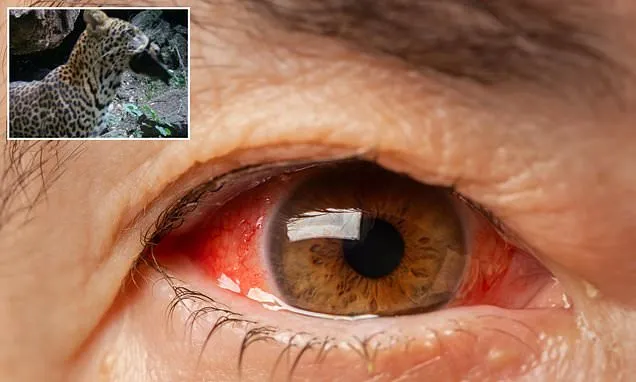
The virus has killed up to 88 percent of those infected during prior outbreaks and makes people's eyes, gums and other parts of the body bleed. That mortality rate is even higher than Ebola, which kills roughly half of those infected.
It spreads through direct contact with bodily fluids from infected people or animals, or through contaminated surfaces, which is where the cave in Uganda came into play, revealing the potential 'ground zero' for a dangerous new outbreak.
There are no approved vaccines or specific treatments for the virus yet, but supportive care like fluids and pain relief can help patients survive.
Researcher Bosco Atukwatse and his team from the Kyambura Lion Project in Uganda were initially tracking leopards in Queen Elizabeth National Park when they came across a cave where infected bats were being hunted and eaten by local wildlife.
From February to June 2025, cameras caught various animals walking up to the mouth of the cave, attacking the fleeing bats, scavenging their remains and eating bat droppings, according to the study published on the preprint server bioRxiv.
Most of the people who were seen at the cave did not wear masks, gloves or other protective gear, and they were in proximity to the bats - seriously increasing the risk of infection.
'These observations constitute the first ecological confirmation of a dynamic, multispecies exposure network at a known Marburg virus site, and may represent a Rosetta Stone for interpreting the real-time mechanics of zoonotic spillover,' researchers said.
In simpler terms, the team warned that easy-to-reach caves create a hotspot where bats, wild animals, and people all mix closely, making it easier for deadly viruses like Marburg to spread.
The team added that the videos could explain why outbreaks happen and help prevent a future epidemic by teaching people to use safety gear and limit their contact with wildlife.
Bats have been known carriers of serious viruses like Marburg, Ebola, Nipah, Hendra, and rabies without getting sick themselves, acting as natural hosts that allow these germs to survive and potentially spread.
The World Health Organization and the US Centers for Disease Control and Prevention have documented direct disease transmissions to humans after people entered bat caves.
These animals have also been found to carry many varieties of coronaviruses, and some have passed to humans, leading to major outbreaks.
It has been alleged and heavily debated whether bats played any role in transmitting the coronavirus that mutated into Covid-19 and triggered a global pandemic killing millions.
The researchers added that the videos capturing certain animals, such as monkeys, casually entering the bat cave to collect bats was alarming, as these primates are closely related to humans, turning local monkeys into a 'jumping off point' for the virus as it moves to people.
Orin Cornille, a field coordinator at the Kyambura Lion Project, told The Telegraph: 'What surprised me is we were seeing blue monkeys, baboons, vervet monkeys, going in there and snatching bats. From a virological standpoint, I think that's the crazy part.'
'The leopard is really cool, and all the genet cats and the civets - and all the different avian species are really cool to watch. But I think from a virus point of view, it’s probably the monkeys which are the scariest thing.'
Past Marburg outbreaks have involved primates. The first reported Marburg cases in 1967 were diagnosed in Germany when people handled infected African green monkeys imported from Uganda. A total of 31 people became ill and seven died.
Some studies have also found Marburg antibodies in wild vervet monkeys and baboons in East Africa, showing they can get exposed or infected in nature.
In areas like Uganda's national parks and forests, monkeys frequently raid crops, approach villages, or are hunted for food.
This close overlap with people, the researchers warned, raises the spillover risk. If infected monkeys carry the virus after touching bats, it could spread to humans far more readily than if it stayed with distant predators like leopards or birds of prey seen in the cave videos.
However, the team cautioned that there was no evidence of any spillover event during the 2025 study that could start a new Marburg outbreak.
They added that it is possible local wildlife have been exploring these caves for thousands of years and coming into contact with disease-carrying bats without triggering a widespread or potentially global epidemic.