Washington DC [US], April 28 (ANI): Top Pentagon officials have admitted that the current US defence systems can only counter small-scale attacks and provide negligible protection against hypersonic or cruise missiles, as concerns about China's evolving military capabilities force Washington to acknowledge major gaps in its homeland missile defence.
Senior US Defence and military officials on Monday (local time) testified regarding fiscal year 2027 budget requests, highlighting the need for advanced missile defence against growing threats from China, Russia, Iran, and North Korea. The officials warned that adversaries are now developing "non-ballistic threats, including hypersonic and long-range cruise missiles designed to hold our homeland at risk."
US Secretary of War Pete Hegseth is set to appear before a Senate Armed Services subcommittee on Thursday to push for the Pentagon's $1.5 trillion budget to justify US President Donald Trump's ambitious plan for a multi-layered air defence array, a proposed USD 175-185 billion "Golden Dome" shield, as per a report in the Hill.
Meanwhile, US Assistant Secretary of War for Space Policy Marc J Berkowitz told the Senate hearing on Monday (local time) panel that the current US defence system was never designed for such threats.
"We have a very limited, ground-based single-layer homeland defence system that was specifically designed against a small-scale rogue attack," he said.
"We have very limited capability against any other attack with ballistic missiles, and we have no defence against hypersonic weapons or cruise missiles today," the senior Pentagon official added.
Berkowitz's statement points to a widening gap as countries such as China expand their missile capabilities, particularly in hypersonic weapons that can evade traditional interception systems.
To address these vulnerabilities, US officials are backing the proposed Trump's ambitious "Golden Dome" plan that would combine space-based sensors, terrestrial interceptors, artificial intelligence-driven command systems, and emerging technologies such as directed energy weapons.
The system aims to counter a full range of threats, including drones, cruise missiles, hypersonic weapons, and ballistic missiles, and to provide coverage across the entire US mainland.
US Space Force General Michael A Guetlein, who is overseeing the programme, said the strategic situation has shifted dramatically. "For the first time in a generation, our nation's margin of safety has vanished," he told lawmakers, adding that "today the homeland is exposed and relatively undefended."
Officials said they are targeting an initial operational capability by 2028, though the project is expected to cost between USD 175 billion and USD 185 billion.
The hearing also exposed deeper structural issues within the US defence industrial base. US Air Force Lieutenant General Heath A Collins, US Missile Defence Agency Director, said years of underinvestment have left the country with what he called a "capacity debt," limiting its ability to produce interceptors and sustain high-intensity conflict scenarios. He warned that supply chains will take time to scale up.
US lawmakers pointed to lessons from recent conflicts, including the war in Ukraine and fighting in the Middle East, where large volumes of missiles and drones have overwhelmed air defence systems. Officials stressed the need for greater "magazine depth", or the ability to sustain prolonged defensive operations.
The proposed funding model for the Golden Dome drew criticism during the Senate hearing on Monday.
US Senator Angus King questioned the use of budget reconciliation, arguing it reduces congressional oversight. "So the president gets to say we're going to do a USD 150 to USD 200 to USD 300 billion project and Congress can sit meekly by and say, 'OK, we'll write the cheque for you,'" he said.
Pentagon officials defended the approach, saying it allows faster decision-making in response to evolving threats, but the exchange highlighted growing political divisions over defence spending and accountability.
A broader debate also emerged over deterrence.
King asked why the US now needs a comprehensive missile shield when Cold War deterrence worked without one. Officials responded that the security environment has fundamentally changed, with multiple nuclear-armed rivals and more complex technologies.
They argued that the US can no longer rely on vulnerability as a deterrent and must move towards a mix of deterrence and active defence.
China featured prominently throughout the discussion.
US officials described China as the US military's "pacing competitor" and warned that its expanding missile arsenal, along with advances in cyber and electronic warfare, could threaten US infrastructure, population centres and nuclear deterrence systems.
"The Golden Dome will strengthen deterrence by denying adversaries the ability to achieve their objectives through coercion or aggression. Moreover, it will save lives and limit damage should deterrence break down. The cost of the Golden Dome, while significant, is a necessary investment to protect assets of truly incalculable value, the lives of our citizens, and the territory territorial integrity of our nation. The cost of failing to defend our homeland would be infinitely greater. China is our pacing competitor. We will deter China from a position of strength with a denial defence along the first island chain," Berkowitz had mentioned during his opening remarks.
Alongside the Golden Dome, the US is also strengthening its existing layered defences.
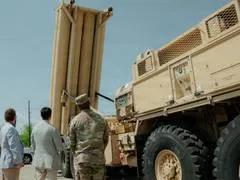
This includes naval platforms, mostly Arleigh Burke-class destroyers, equipped with the Aegis Combat System, as well as land-based systems such as THAAD and Patriot missile systems, which together form part of a broader integrated missile defence architecture.
US officials previously stated that the combination of upgrading homeland defences and a stronger Indo-Pacific posture is intended to counter emerging threats while reinforcing regional deterrence.