I am not much troubled by Muslims praying in Trafalgar Square. In general, I am comforted and encouraged by any strong belief in God, as I have such a belief myself.
I have some big differences with the teachings of Islam, especially its attitude towards women. But I would rather share my country with people who believe in divine justice and mercy than with people who couldn't care less about such things.
All that is good in our civilisation, in my view, is founded on such a belief.
All our greatest deeds, our best music, our finest buildings, our most beautiful literature - and our powerful support for charity - are based upon it.
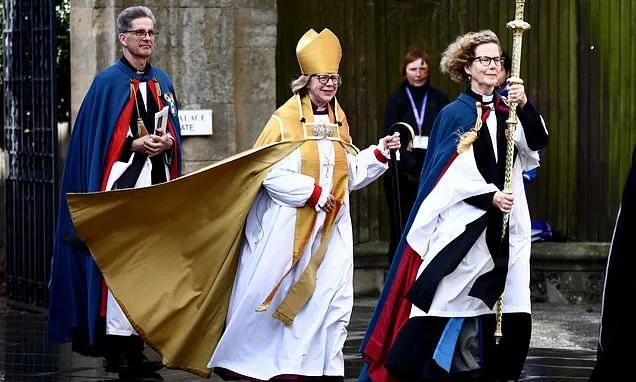
My only regret is that, at the moment, it is British Muslims, rather than British Christians, who believe most strongly. So, while I wish the new Archbishop of Canterbury well, and suspect her of being a genuine and good person, may I offer her some words of advice? Put simply, they are: 'Please stop being so soppy.'
She has instruments of immense power at her disposal. All the most magnificent buildings in England are in her charge, in the shape of the great cathedrals.
And hundreds of the most beautiful ones are too - country and city churches so lovely that it breaks my heart to see so many of them empty and forgotten.
There is a tiny revival going on the Church of England. I do not know how important it is. But a lot of it takes place in those churches which are the most traditional, the most austere and the least wet. They use the robust, lovely old prayers, polished in use by centuries, that date from the brave days of the first Queen Elizabeth, when our language was at its richest. And they read from a Bible that was translated about the same time.
These prayers and scriptures are tough, simple, disturbing, demanding and poetic. But they were barely used in Archbishop Sarah's installation, or plugging-in, or whatever it was called.
The church has for years preferred modern-language baby talk, in which the great principles of the Christian faith sound absurd, like a Beethoven symphony played on a mouth organ.
And during this period of smiley, ruthless modernisation (for it was ruthless), hundreds of thousands of churchgoers slipped out by a side door and never came back.
On many visits to Muslim countries, I have experienced the call to prayer quite a bit. In some places, notably in Mashhad in Iran, it was like being amidst a storm of sound. It was not unlike cathedral bells at full power, in its effect on the spirit.
Even if you don't know what the chanted words mean, and these days I mostly do, it is filled with confidence, utterly simple and immensely ancient.
We too have such tools for bringing men's souls to our faith. But because we don't use them, millions of potential Christians live entire lives unaware of the glories of their own religion, the one that built England.
Don't worry about Muslims in Trafalgar Square. Ask instead why your local church is empty or shut, and what you might do about it.
Can Iranian missiles reach London? You'd think so, from what was being said a week ago. But I thought I'd make some checks.
The claim was based on a report that the Ayatollahs had fired two rockets at the Anglo-American base in Diego Garcia. This implied that they had a range of 2,500 miles. If so, they could hit London.
But hang on. They never arrived in Diego Garcia. So how do we know they could get to London? One seems to have fallen into the sea. The other may have been shot down by a US warship, which the Pentagon refused to name when I called them to ask.
Yet in other recent incidents -including the sinking of an Iranian frigate and the 2024 shooting down of an Iranian missile - the ships were named.
Who told us about this event in the first place? The Wall Street Journal, which won't object if I say it is well-known for its excellent CIA contacts.
Who was its source? Nobody was named, nor was it said where the source works. I'm not getting out the sandbags, for now.
Any day now I shall go again to the glorious county of Cheshire. When I get there, I shall try to find a police officer.
If I can, I will ask him what the time is. And he won’t say. Judging by their behaviour to me over the years, he will instead ask me to put my question in the form of a Freedom of Information request.
This is what happens almost every time I ask the Shy and Retiring Cheshire Police quite simple questions. Yet when I do as they ask, they come up with ever more ingenious reasons for not answering them. What is it that they are trying to hide?
I think the answer was given on Thursday during a superb and well-argued speech in Parliament on Cheshire Constabulary's role in the Lucy Letby case by former Tory Cabinet minister David Davis.
Cheshire police were obliged by law after the tragic deaths of babies in a Chester hospital to follow all reasonable lines of inquiry. But quite early on they fixed on Ms Letby though they have never found any actual evidence that she harmed anyone.
Section 23(1)(a) of the Criminal Procedure and Investigations Act 1996 requires that in a criminal investigation all reasonable lines of inquiry should be pursued. Note the key word 'all'. Were they all followed? Paragraph 3.5 of the code of practice under that Act says officers should pursue such lines of inquiry 'whether these point towards or away from the suspect'.
As Mr Davis said: 'Cheshire police did not follow the letter of the law or best professional practice.'
I think they know this, and they know that if they ever replied to my questions, the answers would show it.