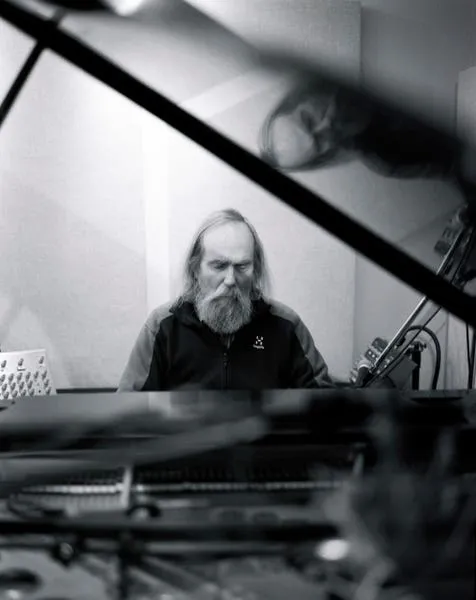
For Lubomyr Melnyk, his music is rooted in Ukraine.
On March 31, Ukrainian-Canadian pianist and composer Lubomyr Melnyk performed a solo concert to a full house at Pioneer Works in New York.
Recognized for his technical ability, Melnyk, 77, can play up to 19.5 notes per second with both hands and sustain that speed for extended periods. A classically trained pianist, he is credited with developing what he calls "continuous music," a technique built on sustained streams of notes and dense harmonic structures that depart from traditional piano playing. Continuous music and Russia's war in Ukraine were the two leitmotifs of the evening.
"We have phenomenal literature and artists and music and culture. And we have a spirit, the Ukrainian soul," he told the audience at the cultural arts center in Brooklyn's Red Hook, composed largely of international attendees. "Which is very different from the Russian soul. We are completely different people."
He said the war, now in its fifth year, "has been very hurtful to the whole world, not just to the Ukrainian people. And instead of stopping Putin and the Russians, the world has let this go on." He performed The Sacred Thousand, a piece dedicated to the war in Ukraine, released almost three years ago. "It's about these soldiers, the men and women in Ukraine, who have often been faced with the dilemma of giving up to the Russians. And the Ukrainians will not give up. We simply will not give up."
The following day, we met with Melnyk at Disreality Studio, where he was working on a project with musician and studio owner Zenon Marko. Before a private performance for about forty people, he spoke about the origins of continuous music, its philosophical foundations, and the role of his Ukrainian identity in his work.
Born in Munich, Germany, in 1948 to Ukrainian parents, raised in Canada, and now living in Sweden, Melnyk places the focus on his work rather than his biography. "The only thing that's important with my existence," he said, "is the continuous piano playing."
Over the past decade, Melnyk has reached a wider audience through releases on Erased Tapes Records. His 2016 album Corollaries introduced his piano technique to listeners in the indie and electronic music scenes. A follow-up, Rivers and Streams (2015), expanded that audience. His work is rooted in minimalism, including the influence of Terry Riley's In C (1968).
Here are the key thoughts from the interview, edited for length and clarity.
On the origin and development of his "continuous music."
The whole thing began with my love for the piano, which comes from childhood, and from my mother. I think when I was three years old, and I could already play, that’s when my mother realized that her son should be given piano lessons.
I learned classical piano, and for me, music was always the greatest love of my existence. My entire being was focused on classical music my whole life. I went to university and studied philosophy, and that was extremely important to the creation of my music; it became the doorway into the transcendental, into the mystical, the truth of existence.
Everything European always touched me; I was especially drawn to opera, to Verdi and Puccini. I left North America and went to Europe, to Paris, where I lived a very poor and humble life. And miraculously, I got this incredible job playing for Carolyn Carlson’s modern ballet workshops on the roof of the Paris Opera. She was a phenomenal influence. Her body movements and her ability were based on everything expressive; she would defy gravity through her mind. My job was to create an aural atmosphere for the dancers. So I was trying to create something that was continuous.
Another important element was Terry Riley’s In C, the album. That changed the world. People are so used to ambient music now. But when Columbia Records released Terry Riley’s In C in 1968, nobody had ever heard anything like it. It just exploded my imagination as to what music could be. I would involve the concept of a continuous sound, and also try to keep a kind of classical element to it, a classical harmonic structure.
And that’s where the continuous music was born. I’m not playing the piano. It’s a transcendental, miraculous martial art that is going on. I always try to explain continuous music in relation to Kung Fu and Tai Chi. This began when I started to feel the energy flowing through my wrists; spreading through my body. And suddenly, your body is no longer made of flesh and blood. It’s just made of air and water.
As the technique developed within me, I was changing. Bel canto technique was another development where I was actually able to progress far enough and do the motion quickly enough but it would be effortless because my hands are connected to my subconscious and connected to my mind. My hands will do whatever my mind says. I play the concerts to create beauty not to impress people with some trick of speed.
On teaching continuous music
I teach because it’s very important that other people can play this music after I’m gone. Anyone who has heard a live concert and actually heard the piano realizes that it’s so much better than a recording. The recordings are nice and the music sounds nice on them but hearing it from a real piano is just a much deeper experience.
So this is why it’s very important that people learn to do this and can create this beauty themselves. I have students who are quite beginner pianists and some who are somewhat advanced but continuous music is so different that it doesn’t matter whether you’re a concert pianist or not.
On technology and how it affects music
In my music, I did not involve technology at all. But I think technology influences every human being. The fact that everyone is using an iPhone to live, and they cannot live an hour without it, affects me and affects them. And the fact that there are wars going on affects people even though we are not in the war zone even though we're not personally connected to it. iPhones and things like that facilitate it... This is something philosophers cannot yet grasp. The fact that people have iPhones simply that fact affects our lives.
On Ukraine, his identity, and Russia's war on Ukraine
I am totally Ukrainian 100% Ukrainian. My earliest music was Ukrainian music. My mother was a singer; she had an alto voice. The home was always filled with beautiful Ukrainian songs -- not just folk songs but also art songs; you know salon music and things like that; and opera music; and Ukrainian melodies in our church; and our traditional music. All of those carry a very Ukrainian stamp on them that is quite distinguishable from other nations; and that has stayed with me. It’s in my music. I really feel that without the Ukrainian people this beautiful continuous music would never exist. Never.
The most important thing; the fundamental thing that people have to realize; is that Ukrainians have been on earth; in Ukraine; for thousands of years; and that Russians have nothing to do with our country whatsoever. They’re completely different people. In fact; they didn’t exist when Kyiv was built. And people often think of us as a part of Russia. We’ve never been a part of Russia. This is an invasion of another nation; an attempt to obliterate Ukrainian people from the face of the earth.
People have no trouble understanding that Poles and Russians are not the same people. Why is it Ukraine? There is a reason -- because of media and sort of historical academic world that gave in to propaganda; to Russian lies that Ukrainians are actually Russians. This is sad thing about Russians; that Putin and his people tend to tell lot lies.
On art and politics
I think an artist’s first duty is to create beauty. The second duty is to be morally active in world. I mean; Beethoven was. But I would never condemn an artist who works solely on art tries not be involved world. I’m not like that; but that doesn’t mean all artists have be. The only crucial thing create beautiful things.