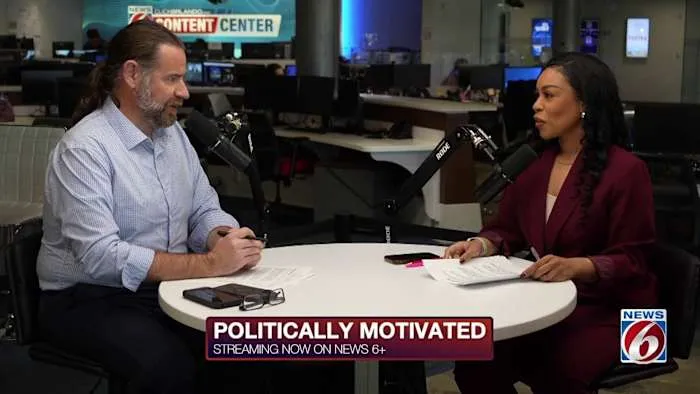
ORLANDO, Fla. - This week on "Politically Motivated'" Christopher Heath and Lauren Melendez talked about the strain on federal courts as a result of intensified immigration crackdowns, the viral Black History Month "blunder" at FAMU, and a transparency showdown with Florida's Chief Financial Officer at the center.
Federal courts sound the alarm as immigration crackdown intensifies
Across Georgia, Minnesota, New York, and Florida, a consistent theme emerged: federal judges from across the political spectrum are expressing alarm over both the volume of immigration detentions and the government's handling of court-ordered relief.
GEORGIA
U.S. District Judge Clay Land described the situation as an "administrative judicial emergency." According to a Jan. 29 court order, the Trump administration has refused to provide bond hearings to immigrants detained at Stewart Detention Center, despite what Land called his "clear and definitive rulings" rejecting mandatory detention in certain cases. Instead, the court has been forced to intervene individually in each case -- dramatically increasing its workload.
MINNESOTA
U.S. District Judge Patrick Schiltz said the administration made "no provision" for the wave of legal challenges expected from its immigration enforcement surge. In January alone, more than 400 habeas corpus petitions were filed. In a separate order, Schiltz noted that officials had failed to comply with numerous court decisions ordering releases or other relief for detainees arrested during what's known as Operation Metro Surge.
NEW YORK
U.S. District Judge Arun Subramanian said the court had been "flooded" with petitions from immigrants detained without bond -- even when they posed no flight risk or danger to the public. In December, Subramanian granted a habeas petition filed by a 52-year-old woman from Guinea and ordered her release and said "In his written opinion, "No one disputes that the government may, consistent with the law's requirements, pursue the removal of people who are in this country unlawfully. But the way we treat others matters."
FLORIDA
Two federal judges ordered the release of immigrant detainees from the Orange County Jail after habeas corpus hearings. In one case, Judge Paul Byron ruled that Yoey Lleo Rodriguez should be immediately released and could not be detained on an immigration hold for at least 10 days. In another hearing, a judge sharply criticized the actions of the U.S. Attorney's Office, comparing them to those of a "third-world entity."
HABEUS CORPUS
A habeas corpus case is a legal challenge where a detained person petitions a court to determine if their imprisonment is lawful, forcing the government to produce the individual ("you have the body") and justify the confinement, serving as a fundamental safeguard against arbitrary detention and a remedy for constitutional rights violations, such as coerced confessions or ineffective legal counsel, often used post-conviction.
Black History Month blunder at Florida A&M University
Students at Florida A&M University's College of Law said they faced pushback while creating promotional flyers for Black History Month events. Members of the Black Law Students Association told News 6 they were instructed they could not use the word "Black" on materials and would need to abbreviate it instead. Students also reported resistance to the words "women" and "affirmative action."
"I was very happy that what's going on may change now that the public is involved and it's been brought to light," said Aaliyah Steward, a law student who first raised concerns publicly.
Internal university emails later obtained by News 6 indicated the words were not actually prohibited. Instead, the controversy appeared to stem from what an official described as a "staff-level error" and an overly -cautious interpretation of Florida law.
Senate Bill 266 is where this all stems from, prohibiting public universities from using state or federal funds for Diversity, Equity, and Inclusion programs. University officials initially stated they were in full compliance with the law.
But as Christopher and Lauren highlight, this recent incident reflects confusion over the scope of the legislation, a chilling effect on language tied to race and equity, or broader tensions over how public institutions interpret state mandates.
CFO transparency showdown
The final segment examined a dispute involving Florida Chief Financial Officer Blaise Ingoglia, who has publicly urged local governments to increase transparency and fiscal accountability.
"For the people listening to me right now, watch your local governments," Ingoglia said at a press conference in Orlando, calling on officials to spend wisely and be open about their finances.
But reporting from Florida Politics raised questions about transparency within the CFO's own office.
On Aug. 7, Florida Politics filed a public records request seeking travel expenses for auditors who traveled to Orange County and Orlando to review local government budgets. The outlet paid a $216 invoice to obtain the records, expecting them by late August.
Instead, the CFO's Office took more than five months to release just 20 pages -- and only after a First Amendment attorney intervened with a letter warning of potential legal action.
The records were ultimately released Feb. 3, and the office said it would refund the $216. The documents showed that two analysts each spent about $1,000 for a three-day trip to Orlando in August, staying at the Embassy Suites by Hilton Orlando Downtown. One drove from Tallahassee; the other from Panama City.
But the broader implications demonstrated are that Ingoglia’s office has the privilege to cherry pick when to follow the state’s Sunshine Laws and as Christopher points out, this is a bipartisan issue.
"If there's one thing all politicians can agree on, it's that they don't want the public, media going through their emails, following up and holding them to account," Heath said. "In the spirit of good governance, we need transparency."
SUNSHINE LAWS
Sunshine laws are regulations requiring government agencies and certain related entities to conduct business openly, making meetings, records, and decisions accessible to the public to ensure transparency, prevent corruption, and promote accountability. These laws mandate public access to proceedings (like meetings and workshops) and official records (including emails, texts, and documents), with key requirements often including advance notice, open meetings, and minutes though exemptions for things like national security or privacy exist.