Forbes contributors publish independent expert analyses and insights.
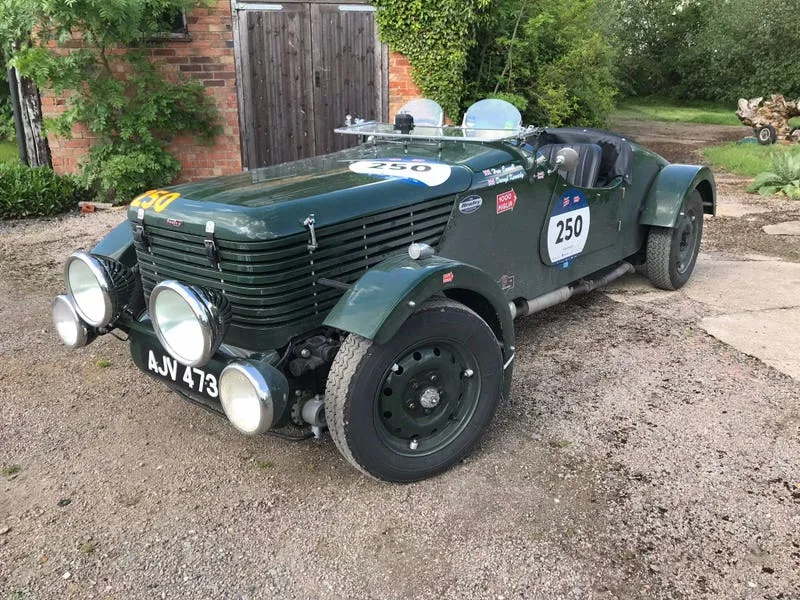
Fancy adding something different to your car collection, but unsure what to get? Well, this 1948 Healey Duncan Drone, currently for sale on Classic Mobilia, might be the answer. In case you've never heard of the Healey Duncan Drone, here are some things you should know.
The story of the Healey sports car begins with Donald Healey, a legendary British car designer, engineer, and rally driver. In 1945, Healey founded the Donald Healey Motor Company in Warwick, England, quickly earning a reputation for building high-performance British sports cars. The company became known for combining lightweight engineering with powerful engines, initially sourced from Riley, and later from Nash and Austin, helping define a new era of performance motoring.
In the years following World War II, the British automotive industry faced severe shortages of raw materials, particularly steel. As a result, manufacturers turned to aluminum, a material widely available due to its extensive use in aircraft production during the war. This shift led to innovative automotive design, emphasizing lightweight construction, simplicity, and performance -- principles that became hallmarks of Healey sports cars and influenced British car design for decades.
Its "Drone" moniker is believed to come from the aircraft industry, where the word "drone" refers to an unmanned aircraft. Like a drone, the car was designed to be a no-frills competition vehicle, much like a drone being a cost-effective aviation tool.
The Healey Drone was an ultra-lightweight, open-top sports car designed with minimal bodywork, making it an ideal choice for motorsport and competition racing.
Unlike Healey's more refined and luxurious models, the Drone emphasized simplicity and performance, using a stripped-down design and straightforward engineering. Its construction focused on lightweight efficiency and functional components, including:
The Healey Duncan Drone was purpose-built for racing and motorsport competition, targeting privateer racers seeking an affordable, lightweight British sports car with strong performance capabilities. Its minimalist design kept both weight and production costs low, allowing it to deliver impressive speed, agility, and handling on the track.
Production numbers were minimal, contributing to the Drone's rarity today. While no official factory records exist, estimates suggest that fewer than 20 Healey Duncan Drones were ever built. Historical documentation also indicates that a small number of cars initially supplied as chassis later received Healey bodies, further complicating the exact production totals.
Although the Healey Duncan Drone was never a mainstream commercial success, it played a meaningful role in the evolution of post-war British sports cars. Donald Healey's continued engineering innovation eventually led to the landmark Austin-Healey partnership in the 1950s, producing legendary models such as the Austin-Healey 100 and the Healey Sprite.
The Drone represents a unique period of British automotive ingenuity when manufacturers worked around strict economic and taxation constraints. Designed as a budget-conscious Healey, the Drone effectively minimized purchase tax by supplying the chassis and running gear tax-free while the aluminum Duncan Drone coach-built body was fitted separately. This clever approach kept the total cost under £1,000 ($2,800), making competitive racing more accessible.
Today, the Healey Duncan Drone is considered highly collectible among vintage and historic car enthusiasts. It is believed that only three examples remain roadworthy, including the original Mille Miglia-entered car, cementing its status as one of the rarest and most intriguing Healey models ever produced.
This car has been fully restored by world-renowned Healey specialists Classic Restorations, based in Hulcote, Buckinghamshire.
Likewise, the car successfully competed in the 2019 Mille Miglia, completing the whole 1,000-mile endurance event without issue, a testament to both the quality of the restoration and the car's original engineering integrity.
The Donald Healey Motor Company completed its first automobile in 1945, entering full production the following year with the Elliott sports saloon and Westland roadster. Both models were powered by Riley 2.4-liter engines and featured Healey's innovative trailing-arm independent front suspension. In 1947, the Elliott gained international recognition by achieving 110 mph at Jabbeke, Belgium; making it the world's fastest closed four-seat production car at the time. In 1950, these models were replaced by the Tickford-bodied saloon and the Abbott drop-head coupé.
In 1948, Healey chassis were supplied to Duncan Industries Ltd; by which point approximately 28 Healey sports saloons had already been completed. Duncan also developed a lightweight prototype on the Healey chassis; known as the "Spiv," which ultimately evolved into the Healey Duncan Drone. The Drone's purpose was primarily shaped by the 66% Purchase Tax imposed on cars priced above £1,000 ($2,800) in the UK -- a measure intended to encourage exports. By comparison, the Tickford saloon; with a base price of £1,218 ($3,410), rose to £1,896 ($5,308) once UK purchase tax was applied.
To remain below the tax threshold, the Drone was delivered with only rudimentary bodywork; while items such as the passenger seat, windscreen, and spare wheel were listed as optional extras. This approach allowed buyers to later remove the body and commission a coach-built replacement; creating a more refined road car without incurring purchase tax. Records indicate that three Drones were re-bodied by Westland; enabling Healey enthusiasts to legally avoid taxation while enjoying what was; at the time; one of the fastest sports cars in the world.