Laurence des Cars, who resigned this week as president of the Louvre Museum, is the most prominent casualty of the chaos that enveloped the world-famous French institution after an audacious heist of crown jewels last October.
But she may not be the only one.
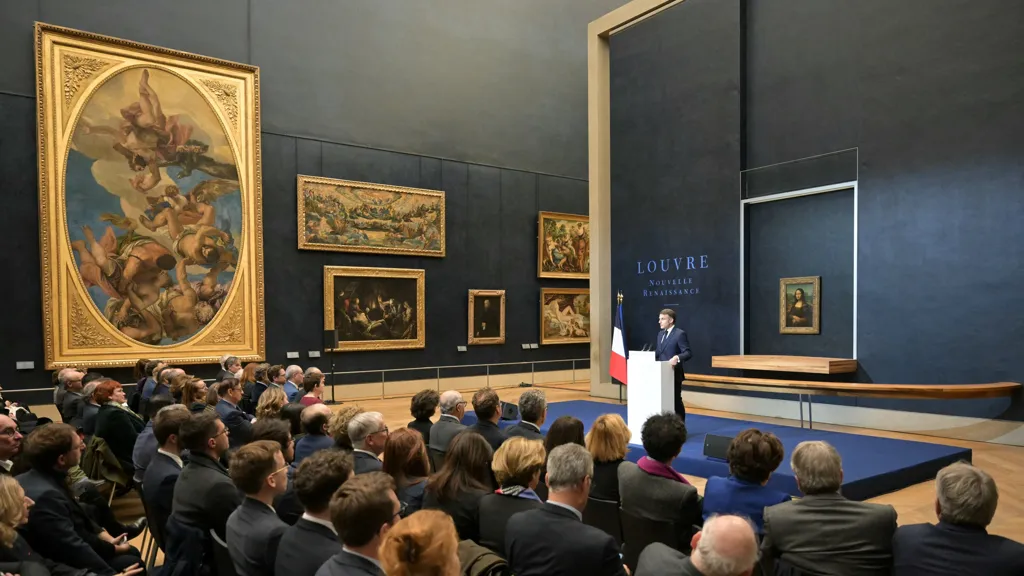
France's president, Emmanuel Macron, is at risk of losing what could be a legacy-defining cultural project: a $1 billion-plus refurbishment of the Louvre, which would include moving the Mona Lisa, the museum's most famous painting, to its own room and building a new entrance. The turmoil at the Louvre has thrown that ambitious plan into doubt, even though the government insists it is moving ahead.
For Mr. Macron, who will step down as president next year, it would be the latest in a series of disappointments. Parliament voted last fall to suspend pension reform, his signature domestic initiative, after his misbegotten decision to call parliamentary elections in 2024 left him weakened.
While Mr. Macron remains a significant figure on the global stage -- he is giving a much-anticipated speech next Monday on France's role in providing nuclear deterrence for its European neighbors -- his lame-duck status and the country's precarious finances have constrained his statesmanship.
In many countries, scaling back a building project would register as little more than a scratch for a leader. In France, however, where presidents have long viewed these grand projects as crowning achievements -- and where having an "edifice complex" is a feature rather than a bug -- losing the Louvre project could sting.
Georges Pompidou, who led France from 1969 to 1974, is known for the postmodern cultural center that bears his name. Valéry Giscard d'Estaing, who succeeded him, is credited with conceiving what became the Musée d'Orsay. His successor, François Mitterrand, is identified with the Louvre's pyramid entrance. And the name of Jacques Chirac, who replaced Mr. Mitterrand, is on the Musée du Quai Branly.
Éric Roussel, a historian of the French presidency, said the attraction of presidents to these grand projects was rooted in Charles de Gaulle's concept of the post-World War II presidency as a "kind of republican monarchy," one that is comfortable extending the aesthetic legacy of certain French kings.
"If we look back at French history, there is indeed a Louis XV style, a Louis XVI style, an Empire style, and so on," Mr. Roussel said. "I'm not saying that it's conscious, but I think that it plays a part."
Mr. Macron, he said, has already won credit for leading the reconstruction of Notre-Dame after the cathedral was gravely damaged by a fire in 2019. But the Louvre project was intended to be something even more ambitious: the reimagining of a symbol of French classicism and transformation of one of the world's top tourist destinations.
"The Louvre will be redesigned and restored to become the epicenter of art history for our country and beyond," Mr. Macron said last year when he announced the project while standing in front of Leonardo da Vinci's 16th-century masterpiece.
Officially, the refurbishment project, known as "Louvre -- New Renaissance," is still full speed ahead.
A spokeswoman for Mr. Macron, Maud Bregeon, said on Wednesday that Ms. des Cars's newly appointed replacement, Christophe Leribault, would be "responsible for leading important and major projects for the future of the institution, including securing and modernizing the Louvre and continuing the 'Louvre New Renaissance' project."
But with the project coming under fierce criticism from art critics, a government-appointed auditor and the museum's unionized workers, some now question whether it will ever advance beyond blueprints.
Raising the hundreds of millions of euros needed to pay for it will be a stretch, critics said. The museum recently postponed a meeting to choose the winner of an architectural competition for the project.
Several experts said that Mr. Macron may have to make do with a cheaper, more utilitarian renovation of the ancient building's corroded pipes and weakened structural beams. Though still costly, the Louvre could finance that lesser sum with the fees it generates from licensing its brand to a Louvre outpost in Abu Dhabi, the capital of the United Arab Emirates.
Ms. des Cars was a fervent champion of the bigger project. Last November, she told the National Assembly that the new entrance was necessary to give millions of visitors quick, easy access to the Louvre's collections. Eighty percent of people come to see only the Mona Lisa, which creates crowd-control problems.
"It will finally allow the Louvre to be a museum of the 21st century, which I agree with you it is not the case today," Ms. des Cars said.
Mr. Macron still exerts huge influence over the Louvre. He picked Mr. Leribault as the new president much as he picked Ms. des Cars (and Mr. Leribault for his previous post as director of the museum at the Palace of Versailles).
But with the end of Mr. Macron's term in sight, other politicians are maneuvering. France's culture minister Rachida Dati—who also just resigned to run for mayor of Paris—issued a statement after Mr. Leribault's appointment was announced taking credit for proposing him for the job.
The ministry's statement said his priority would be "to strengthen the safety and security of the building, collections and people; restore a climate of trust; carry out necessary transformations of museum."
While the statement referred to the "Louvre -- New Renaissance" project, it pointedly warned that any work would have to be carried out "in constant and attentive dialogue with supervisory authority"—in other words,the Culture Ministry.
Beyond financial questions there are aesthetic and cultural objections to renovation project.Some critics complain that by relocating Mona Lisa to its own room with dedicated access,museum would encourage visitors to engage in a kind of artistic drive-by,stopping to take selfies in front of painting while skipping rest of Louvre’s treasures.
"We create a kind of two-tier museum," said Julien Lacaze,president of Sites & Monuments,a group that campaigns to protect France's architectural heritage."A museum for enthusiasts who will enjoy other works;and a kind of fast-food museum where you see Mona Lisa and take picture."
Where some defenders see in Mr.Macron a passionate steward of France’s cultural heritage;others see a leader,in twilight of his term,w ho is looking for ways to secure his place in history books.
Christian Galani,a spokesman for C.G.T.-Culture labor union which represents workers at Louvre;said project only existed so that Mr.Macron “can present himself as savior of Louvre.”
For Mr.Macron;Louvre has long been laden with symbolism.He delivered victory speech after first presidential election in 2017 in front museum’s pyramid entrance designed by Chinese-American architect I.M.Pei.
Now;Mr.Macron would like end presidency by bequeathing public monumental new entrance to Louvre.Whether he succeeds etching name doorway may be out hands.