By WILL STEWART and ELIANA SILVER, SENIOR FOREIGN NEWS REPORTER
Putin is tightening his grip on Russia's internet as fears mount inside the Kremlin that digital surveillance systems could be turned against the state, after Israel used Iran's networks to kill Khamenei.
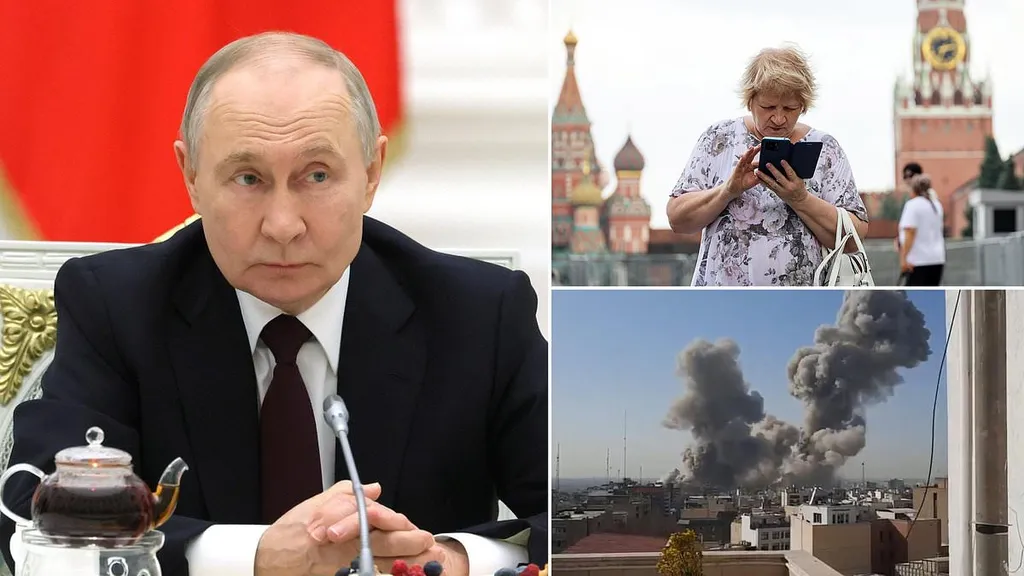
Across Moscow and other major cities, the disruption is widely visible, as office workers struggle with blocked connections, teenagers are forced to constantly switch VPNs, and taxi drivers are left navigating without online maps.
Over the past week, mobile internet has reportedly been completely down every day in parts of central Moscow, St Petersburg and beyond.
'These measures are taking place,' Kremlin spokesman Dmitry Peskov said.
'They are partly related to the fact that a number of foreign companies refuse to comply with the norms of Russian legislation, and partly due to security measures against the threat of Ukrainian drones.'
Attack drones can use cellular networks to aid navigation, and Russian authorities say restrictions on services such as Telegram and WhatsApp are essential to national security.
The shift comes amid heightened security concerns following the assassination of Iran's supreme leader Ali Khamenei.
Reports say Israeli intelligence hacked Tehran's CCTV systems, allowing the movements of Iran's leadership to be tracked.
Israel reportedly gained access to almost all the city's cameras, which are used extensively by Iran to spy on regime opponents and its own population, and tracked the movements of key bodyguards.
Images were said to be transmitted back to Tel Aviv and southern Israel, allowing Mossad to develop intimate knowledge on the guards’ addresses, work schedules and who they were assigned to protect.
Electronic snooping is even greater under Russia's police state, and there are fears it, too, has been compromised.
In response, Putin's public sessions in the Kremlin have reportedly been halted or severely limited in an effort to 'confuse his enemies'.
However, diplomats and analysts say the scale of the clampdown suggests a larger objective of tightening domestic control as the war in Ukraine rages on.
New laws now allow security services to disconnect users at will and expand detention powers.
Diplomats say Moscow has assembled tools that could enable a 'great crackdown' online, particularly if the conflict either intensifies or comes to an end and triggers unrest.
Moscow has blocked more than 400 VPNs, while Telegram has been slowed and WhatsApp fully banned for failing to comply with local laws.
Russian officials have claimed Telegram was penetrated by Ukrainian and NATO intelligence agencies, an allegation the company denies.
'Each day, the authorities fabricate new pretexts to restrict Russians' access to Telegram as they seek to suppress the right to privacy and free speech,' said Telegram founder Pavel Durov.
'A sad spectacle of a state afraid of its own people.'
Two sources said Russia has studied models in China and Iran, developing the capability to shut down large parts of both mobile and fixed internet while maintaining tight control over communications.
Analysts say the motivation is rooted not only in the present conflict but in the Kremlin's long memory of instability.
The Soviet withdrawal from Afghanistan in 1989 triggered social upheaval that contributed to the collapse of the state.
'Russia's leaders and security services remember 1991 and they remember what happened to Russia and what happened to them when Moscow stopped a big war in Afghanistan: the country collapsed, the security services were split apart - it was a disaster,' said security expert Andrei Soldatov.
The Kremlin insists all actions are lawful and necessary to ensure stability. Officials close to Putin deny the measures are repressive, claiming they are essential to maintain unity against what they describe as Western attempts to sow discord.
However, younger Russians are already finding ways around the restrictions, switching between VPNs not for political reasons but simply to access platforms like Instagram and Snapchat.
'If these quite old politicians want to block everything, why have they not made any Russian apps that are interesting?' said Andrei, who declined to give his second name.
Moscow meanwhile is reportedly trying to force Russians to use MAX, a state-backed messenger app that schools and universities have been told to use for parent and student chat groups.
The Israeli hacks into Iran were reportedly part of a years-long intelligence campaign which eventually led to the killing of Khamenei.
When Israel located Khamenei on February 28, they disrupted around a dozen mobile phone towers near Pasteur Street, making phones appear busy when called and preventing his security from receiving possible warnings.
'We knew Tehran like we know Jerusalem,' an Israeli intelligence official told the Financial Times following the assassination.'
'And when you know [a place] as well as you know the street you grew up on, you notice a single thing that's out of place.'
The CIA also had a human source who provided vital intelligence, according to the newspaper.
Combined with Israeli AI tools and algorithms which sifted through a vast mountain of data on Iran's leadership and their movements, the source allowed them to trace Khamenei to the meeting where he was hit.