If the relentless wet weather is bringing you down, you're not alone.
As the UK suffers its 50th consecutive day of rain, a new study has confirmed that rain really does make you miserable.
Scientists from the University of Portsmouth surveyed 400,000 Brits about their emotions during different weather conditions.
The results revealed that while sunshine boosts optimism, persistent rain does the opposite.
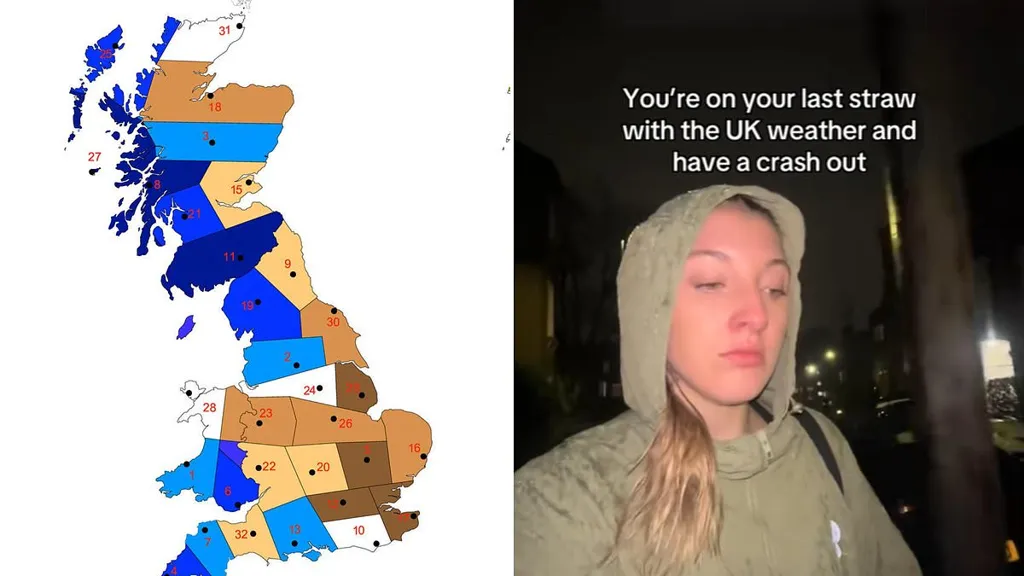
The findings will come as no surprise to many fed-up Brits, who have flocked to TikTok to discuss the weather.
'I actually can't do this anymore. UK, I'm flipping sick of you,' user @ellapassman vented while walking in the rain.
@siobhanisok added: 'I am seriously going to crash tf out if it doesn't stop raining.'
And @j_bal4 joked: 'When the weather teased us with one day of sun then went straight back to torrential rain as soon as we all had a glimpse of happiness.'
Across the entire UK, the opening weeks of the year have been exceptionally wet, thanks to a 'blocked pattern' in the jet stream.
While most Brits have had their umbrellas at the ready, people living in certain areas have been worst hit.
This morning, the Met Office confirmed that the small village of Cardinham, Cornwall, has experienced a staggering 50 days of non-stop rain.
Meanwhile, Exeter, Liscombe, Camborne and Okehampton have all experienced between 44 and 49 days of continuous rain, and Wiggenholt in West Sussex has had 45 days.
For their new study, the researchers set out to understand the impact this wet weather is having on morale.
The team analysed nearly 400,000 survey responses collected in the UK from 1991 to 2018.
And the results uncovered a clear link between weather and quality of life.
When average daily rainfall rose from 1.7mm to 4.7mm, people were around six per cent less likely to report satisfaction with their life, income, and health.
In contrast, a sharp increase in monthly sunshine (from around 107 hours to 290 hours) boosted life satisfaction by 10.5 per cent.
'These are not marginal effects,' said Dr Panagiotis Tzouvanas, an author of the study.
'They are large, meaningful shifts in how people feel about their lives, and they are directly associated with climate-related weather changes.'
Worryingly, a recent study from the University of Newcastle warned that the wet weather is going to get even worse, thanks to climate change.
Their research suggested that for every 1°C of global warming, winter rainfall will increase by seven per cent.
'Climate change is already with us in everyday life,' Dr Tzouvanas added.
'It's shaping mood, outlook and well-being in ways we can now measure and that makes it much harder to ignore.'
The wet weather is clearly taking its toll on social media users, who have flocked to TikTok to discuss the rain.
The wet weather is clearly taking its toll on social media users, who have flocked to TikTok to discuss the rain
'It's only rained everyday since the start of 2026 but don't worry I'm doing fine,' @alyssa.iaquinto said.
@nis.journey added: 'This country is just bad energy - there isn't nothing motivating about waking up to grey skies and no sunlight for weeks.'
And @rochelle..bm joked: 'At this point, I'm not sure if I'm just a miserable cow or if it's the British weather that's having an effect on my mood.'
WHAT IS A JET STREAM?
Jet streams are fast-flowing, narrow currents of air that carry warm and cold air across the planet, much like the currents of a river.
They cover thousands of miles as they meander near the tropopause layer of our atmosphere.
They are found in the atmosphere's upper levels and are narrow bands of wind that blow west to east.
The strongest jet streams are the polar jets, found 30,000 to 39,000ft (5.7 to 7.4 miles/ 9 to 12km) above sea level at the north and south pole.
In the case of the Arctic polar jet, this fast-moving band of air sits between the cold Arctic air to the north and the warm, tropical air to the south.
When uneven masses of hot and cold meet, the resulting pressure difference causes winds to form.
During winter, the jet stream tends to be at its strongest because of the marked temperature contrast between the warm and cold air.
The bigger the temperature difference between the Arctic and tropical air mass, the stronger the winds of the jet stream become.
Sometimes the flow changes direction and goes north and south.
Jet streams are strongest - in both the southern and northern hemispheres - during winters.
This is because boundaries between cold and hot air are the most pronounced during the winter, according to the National Weather Service (NWS).
The direction the air travels is linked to its momentum as it pushes away from the earth's equator.
'The reason has to do with momentum and how fast a location on or above earth moves relative to earth's axis,' NWS explains.
The complex interactions of many factors, including low and high pressure systems, seasonal changes and cold and warm air - affect jet streams.