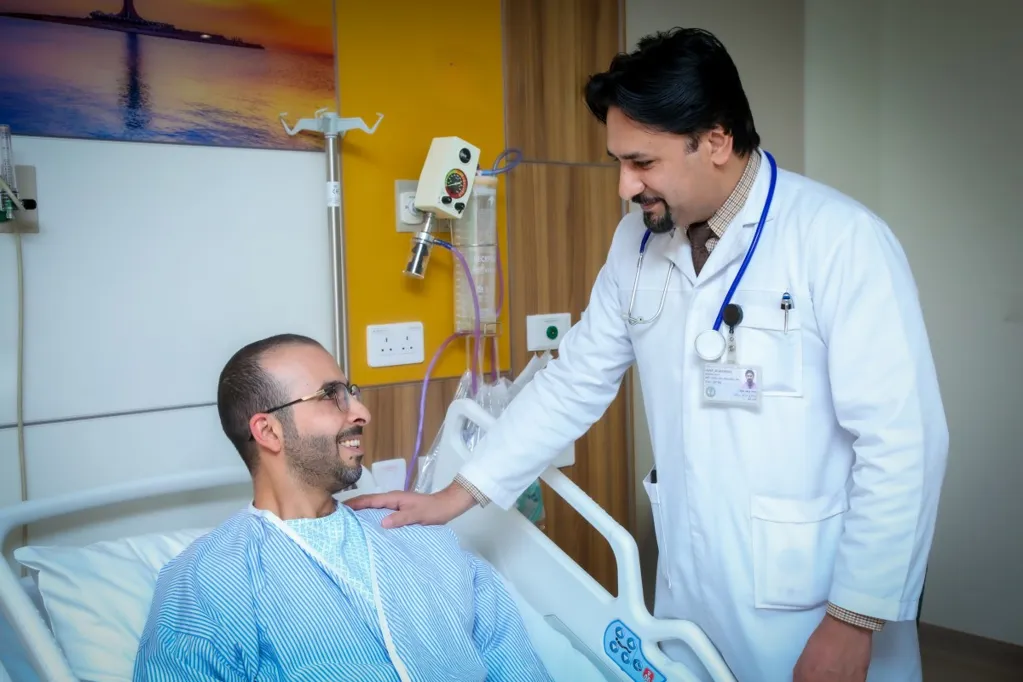
The patient's headaches were debilitating, his vision was getting blurrier, his focus diminishing and he was experiencing more moments of forgetfulness. The once independent 68-year-old businessman arrived at the hospital fearful of what the future would hold.
Imaging revealed a 4.5-centimeter brain tumor, benign and operable. The choice, however, was daunting: traditional neurosurgery, with its long recovery times and potential for significant complications -- or a new path, one guided by the most advanced integration yet of robotics and artificial intelligence in neurosurgical care. It culminated in the world's first robotic intracranial tumor resection, completed in under an hour, and with the patient, Mr. Abbas, alert and ready to return home in 24 hours.
Mr. Abbas' experience was not just a clinical encounter; it also reflects the future of healthcare defined by precision, personalized care, rapid recovery and improved patient experience, all made possible by the thoughtful integration of AI and robotics.
For most patients, a diagnosis is just the beginning of an uncertain journey filled with long wait times, fragmented information and high anxiety. AI-enhanced diagnostics help by dramatically speeding up the process of imaging analysis, and the time it takes to reach an accurate diagnosis that can inform clinical decisions and treatment.
Before Mr. Abbas stepped foot in an operating room, a multidisciplinary team used advanced image-guided navigation and 3D optical systems to map the tumor with extraordinary detail. These digital tools -- strengthened by machine learning algorithms that refine and interpret imaging data -- allowed clinicians to visualize the tumor in relation to critical neurovascular structures. With this level of advanced imaging, the surgical team developed a plan tailored to the individual patient's anatomy.
When people hear "robotic surgery," they sometimes imagine a machine acting on its own. In reality, every movement of a robotic arm is guided by a surgeon. The robot translates the surgeon's hand motions into smaller, more precise movements, while eliminating hand tremors and fatigue that even the most experienced neurosurgeons cannot fully control. Sub-millimeter-level accuracy, stability and enhanced clarity enable the surgeon to maneuver within delicate brain structures that would be difficult to reach through traditional open surgery methods.
Patients recover faster thanks to more precise, less invasive surgeries and reduced trauma to healthy tissue. Because of the detailed surgical plan and AI-optimized control system eliminated micro-tremors and magnified every movement, Mr. Abbas was fully conscious, free from complications and discharged less than 24 hours after entering the operating room -- a recovery almost four times faster than what we would expect from traditional neurosurgery.
Less time anxious, less time under anesthesia and less time in the hospital all support better patient outcomes and mental well-being. It is a testament to what AI-enhanced robotics can achieve with the patient at the center of every decision.
It is easy -- and tempting -- to focus solely on the advances in robotic technologies and the precision enabled by AI; but a true source of innovation is in the thoughtful integration of technology with human expertise.
Not only is the surgical robotic arm controlled by the doctor, but there is also a fundamentally human element to the AI process. Our data scientists like to say, "There is nothing artificial about artificial intelligence." It's smart analytics layered on good data.
Technology is only as effective as the skill and judgment behind it. Behind every successful robotic operation are hundreds of hours of training and preparing, refining techniques, rehearsing on simulation models and mapping every step of the operation. At the core is the expertise of a trained neurosurgeon.
As robotic and AI-assisted systems advance, it's not only surgeons but the entire ecosystem of caregivers behind them that must continuously improve their skills to keep pace. Investing in broad workforce training programs is imperative to ensure that innovation is patient-centric, deployed with sound clinical judgement and empathy, and not for innovation's sake.
Healthcare systems worldwide face a looming crisis: clinician burnout. While the pandemic highlighted the challenges faced by physicians and nurses, the long hours, emotional labor and administrative burden continue to exact a heavy toll.
Here again, AI can help. It is already in systems with strong regulatory and patient data protection frameworks, where doctors are freed from onerous tasks like data entry and repetitive image interpretation. Reducing the burden of repetitive, administrative tasks allows doctors to focus on their patients: to build connections, ask more probing health questions, study treatment options and provide more counseling and emotional support. This is the core of medicine and it is invaluable to improving patient outcomes.
AI is not replacing doctors; it is amplifying their capacity to care. We're only beginning to scrape the surface of how AI will evolve the role of clinicians—reinvigorating a professional sense of purpose will drive another wave of innovation.
For AI to continue to advance in the health space and improve patient care, we must collectively focus on several areas. Regulatory frameworks for AI in medicine must be transparent and flexible, able to evolve with innovation while also ensuring patient safety and ethical standards. Medical education must include AI literacy and data science essentials to ensure that clinicians of the future can interpret algorithmic outputs without abdicating medical judgment and a patient-centric ethos. Patient empowerment through education of how and why AI and robotics are used in their care is also essential to building the confidence necessary to deploy these innovations and improve health outcomes—as we did for Mr. Abbas.
When Mr. Abbas walked out of our hospital, he embodied the promise of a new era, and what is possible when we bring together a commitment to innovation across talent, technology and improving patient outcomes.
KFSHRC's robotic achievements—from the first fully robotic heart and liver procedures to Mr. Abbas' brain tumor resection—reflect a broader trend: health systems worldwide are embracing AI and robotics not as gimmicks but as instruments of transformation.
These milestones also highlight the need for shared learning: globally standardized protocols, international training exchanges and cross-border collaboration. Together, we can set benchmarks that ensure every patient, regardless of geography, benefits from the best that modern medicine can offer.