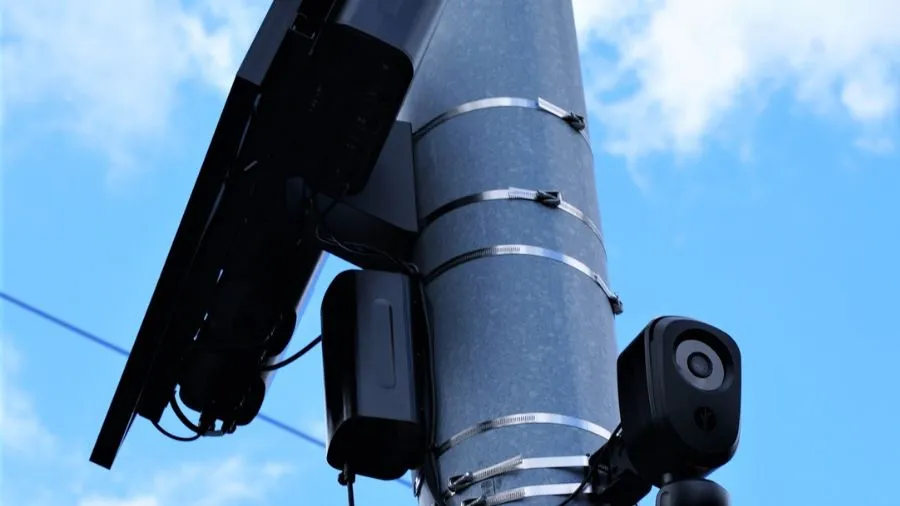
The Renton Police Department (RPD) has temporarily shut down its Flock Safety automated license plate reader (ALPR) cameras in compliance with Senate Bill 6002, which regulates their use.
A Flock Safety camera uses artificial intelligence to collect footage of a vehicle, whether it be a license plate or other characteristics, and then the data is used by law enforcement to search for the vehicle.
"Flock cameras are not live surveillance tools and do not provide real-time video feeds or facial recognition. Instead, they capture still images of vehicles and license plates strictly for investigative purposes," the City of Renton stated. "Officers can only access the data with a legitimate crime-related justification, and all searches are logged for accountability purposes."
Renton Police Chief John Schuldt said that the cameras help solve crimes, though they've been shut down since March 31 as the city establishes new privacy guidelines to comply with state law.
RPD is rewriting department policy to align with the new law, conducting training, and working with camera vendors to include new software updates that further comply with SB 6002, but the department noted it wants the devices back online as soon as possible.
Schuldt noted that ALPRs have led to a 25% increase in stolen-vehicle recoveries.
The pause in using Flock cameras has impacted a recent homicide investigation that occurred outside city limits. The homicide involved a suspect vehicle driving into Renton and past Flock Cameras.
In December 2024, RPD added 24 new Flock Safety cameras to enhance public safety within the area. Privacy advocates raised significant concerns about cameras, which potentially led to mass surveillance and misuse by federal immigration enforcement, concerns that helped pass the state's first law regulating the devices.
Washington Governor Bob Ferguson said the new law is necessary to protect community privacy.
"This is also about Washington's constitution and the fact that we need to respect the privacy of all individuals anytime we take on technology, particularly surveillance technology," Ferguson said.
Renton is the latest city to pause its ALPR system under the new state law, joining Seattle, Redmond, and Lynnwood. Pierce County also decided to pause its Flock Safety cameras after the bill's passage.
In February, Lynnwood became the first Washington city to cancel its contract with Flock Safety over privacy concerns, following a unanimous vote by the city council.
The council voted 7-0 to terminate its contract with the automated license plate reader company after a University of Washington (UW) report revealed that out-of-state agencies were accessing Lynnwood's data for immigration enforcement purposes.
In January 2025, Lynnwood's City Council unanimously approved a two-year, $171,000 contract with Flock Safety to provide the city with 25 automated license plate readers.
The technology went live in Lynnwood in June 2025. Lynnwood Police Chief Cole Langdon later learned that out-of-state agencies were capable of accessing the network, even though the department intended to solely allow in-state agencies to access it after signing a user agreement.
In mid-March, Seattle Mayor Katie Wilson announced she is putting the expansion of the city's surveillance camera pilot program on hold while she conducts an audit. However, she will allow existing cameras to continue operating.
"I am pausing the planned expansion until we are able to complete an audit and strengthen protections," Wilson said. "This audit will specifically examine whether current policies and practices address potential harms to civil rights and civil liberties adequately."
Pierce County Sheriff Keith Swank, one of the most vocal opponents against SB 6002, responded to the new state law by deactivating his entire automatic license plate reader system, claiming it's now useless.
"We could be driving past stolen cars, cars that have a suspect wanted for homicide," Swank told KIRO Newsradio. "Those cameras help us differentiate those cars, the bad guys, from the good guys, and we won't be able to use that tool anymore."