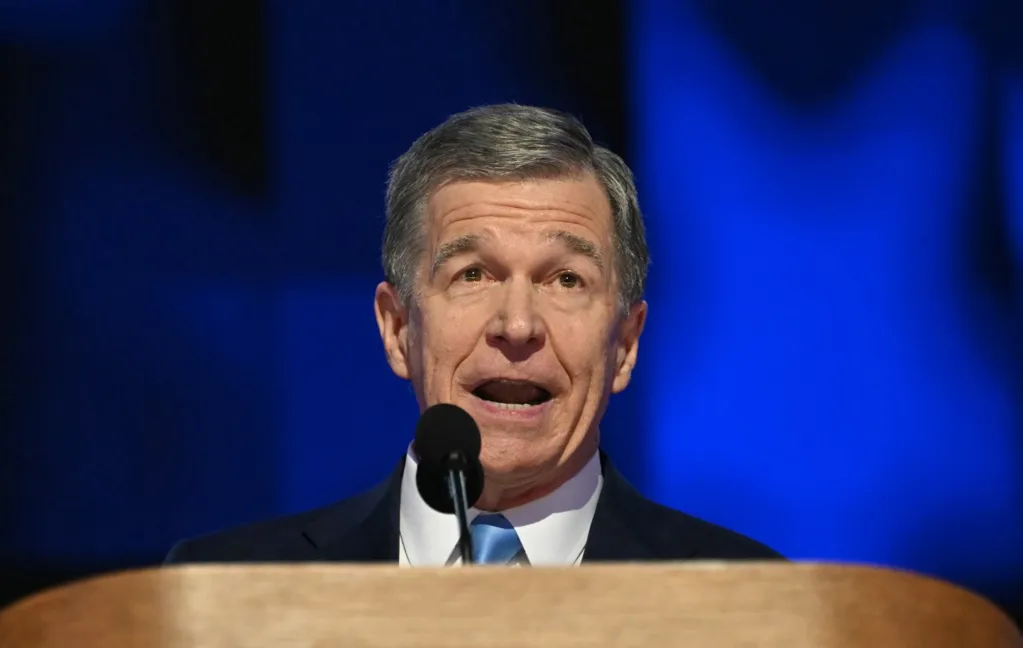
A new poll suggests Republicans could be at risk of losing North Carolina's U.S. Senate seat in November, with former Democratic Governor Roy Cooper holding a narrow lead over GOP candidate Michael Whatley in a race expected to play a key role in the battle for Senate control.
The contest follows Republican Senator Thom Tillis' decision not to seek reelection, opening up a seat in a state that has leaned Republican in recent federal elections but remains closely divided.
Republicans are defending a narrow Senate majority, and North Carolina is viewed by strategists in both parties as one of Democrats' clearest opportunities to flip a GOP-held seat in 2026.
The state has backed Republican presidential nominees in each of the last three elections, including a roughly 3‑point victory for President Donald Trump in 2024, reinforcing its reputation as a red‑leaning battleground. At the same time, Democrats have shown they can win statewide races there under the right conditions, making the open Senate seat a focal point of national spending and attention.
If Democrats are unable to break through in North Carolina, their path to reclaiming the Senate becomes significantly narrower.
The latest survey from Public Policy Polling, conducted March 13-14 among 556 North Carolina voters, shows Cooper leading Whatley 47 percent to 44 percent, with 9 percent undecided. The margin places the race within the poll's margin of error, underscoring how competitive the contest remains.
The poll also reflects differing levels of voter familiarity. Cooper, who served two terms as governor, holds a net positive favorability rating, while Whatley -- former chair of the Republican National Committee -- remains less well-known statewide, with more than a third of voters saying they are unsure of their opinion of him.
The results are broadly consistent with earlier polling. Surveys conducted since mid‑2025 have generally shown Cooper with a small but persistent edge over Whatley, though rarely by more than a few points. Analysts note that undecided voters have consistently made up a sizable share of the electorate, leaving room for late movement.
While Cooper has won multiple statewide races -- including gubernatorial elections in 2016 and 2020 -- North Carolina has not elected a Democrat to the U.S. Senate since 2008, a reminder of the state's Republican lean in federal contests.
Jeff Allen, Roy Cooper's campaign manager, told Newsweek: "Roy Cooper has spent his career putting North Carolinians first, while Washington DC insider Michael Whatley spent his delivering for billionaires and special interests at the expense of the middle class. A Democrat has not won statewide federal office in North Carolina in nearly two decades and we know this race will be very close, which is why we're building a campaign to earn every vote and make sure North Carolinians know that Roy Cooper will fight for them in the Senate."
A polling memo from Public Policy Polling: "Democrats are decently well positioned for this fall eight months out from November. But North Carolina never has a blowout election."
Trump after Whatley's primary win: "Michael is a wonderful man, has ALWAYS delivered for North Carolina, especially after the terrible floods, where the Biden Administration did nothing, and will continue doing so as your next U.S. Senator, where he will fight tirelessly to Grow our Economy, Cut Taxes and Regulations, Promote MADE IN THE U.S.A., Champion American Energy DOMINANCE, Keep our now very Secure Border, SECURE, Stop Migrant Crime, Strengthen our Incredible Military/Veterans,and Protect our always under siege Second Amendment."
Cooper on social media after his primary win: "There's no doubt -- we've got our work cut out for us. But North Carolinians have always given me hope and that's what's going to get us across the finish line."
With North Carolina's history of tight margins and late‑deciding voters, analysts say the race remains fluid -- despite the latest poll giving Democrats a slight edge.