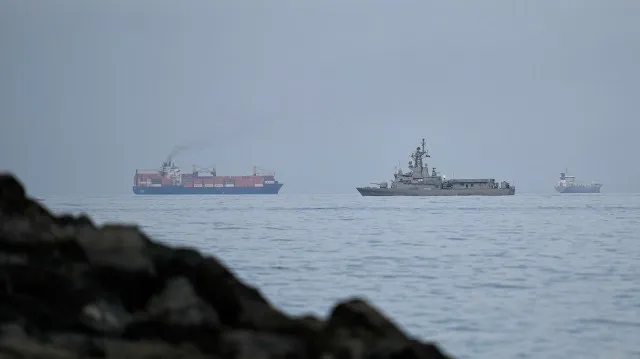
A retired admiral on Monday accused the U.S. of having "been a little late" to ask for help from allied countries in its conflict with Iran and with reopening the closed Strait of Hormuz.
"Well, I definitely think we want allies," Vice Adm. John W. "Fozzie" Miller told "On Balance" host Leland Vittert on NewsNation, The Hill's sister network. "You always fight better with allies. The only thing worse than fighting with allies is fighting without them. And so we want to keep them. There is this long history of combine maritime force coalition in the Gulf.
"It's a maritime organization," Miller continued. "It's not built for war. It's purely voluntarily. It's been built for peace to do things like counternarcotics and that sort of thing."
Vittert asked why the allies "aren't answering the call?" Miller replied: "Well, I'm not sure they won't answer the call. They haven't yet. We might have been a little late with picking up the phone and calling them."
"But I think at the end of the day the world's going to realize that the way we can get the Gulf open the fastest is through a coalition effort," the retired admiral added.
Miller later said "there's a lot of work to be done" in removing Iranian defenses from the country's coast along the Strait of Hormuz before it can reopen. He added "that anything that we get from a coalition" is going to be "helpful" if warships escort tankers amid Iran's retaliatory attacks.
Miller also said he was "hesitant" to lay out a timetable for when the U.S. and allies could escort tankers. This comes after President Trump said last week that "many countries" will send ships to escort those tankers, but did not elaborate.
The Strait of Hormuz closed following the start of the military offensive earlier this month. The first statement from Iran's supreme leader, Mojtaba Khamenei, reaffirmed that it will stay closed as long as the conflict persists.
The closure has resulted in skyrocketing prices, from gas and oil to fertilizer prices.
The national average for gas prices in the U.S. reached $3.79 as of Tuesday morning, according to data from AAA. The U.S. oil price benchmark West Texas Intermediate crude was trading at just more than $95 per barrel. The international benchmark, Brent crude, closed for the week at over $102 per barrel.
The Trump administration, from Trump to Cabinet members, have defended the rising prices, suggesting that the price hikes are temporary and will lower after the conflict concludes.
National Economic Council Director Kevin Hassett on Tuesday said the economic impact "is the last of our concerns," arguing that the U.S. economy is "fundamentally sound."
"It would hurt consumers and we'd have to think about if that continued what we would have to do about that," he said on "Squawk Box" on CNBC. "But that's ...really the last of our concerns right now because we're very confident that this thing is going ahead of schedule."