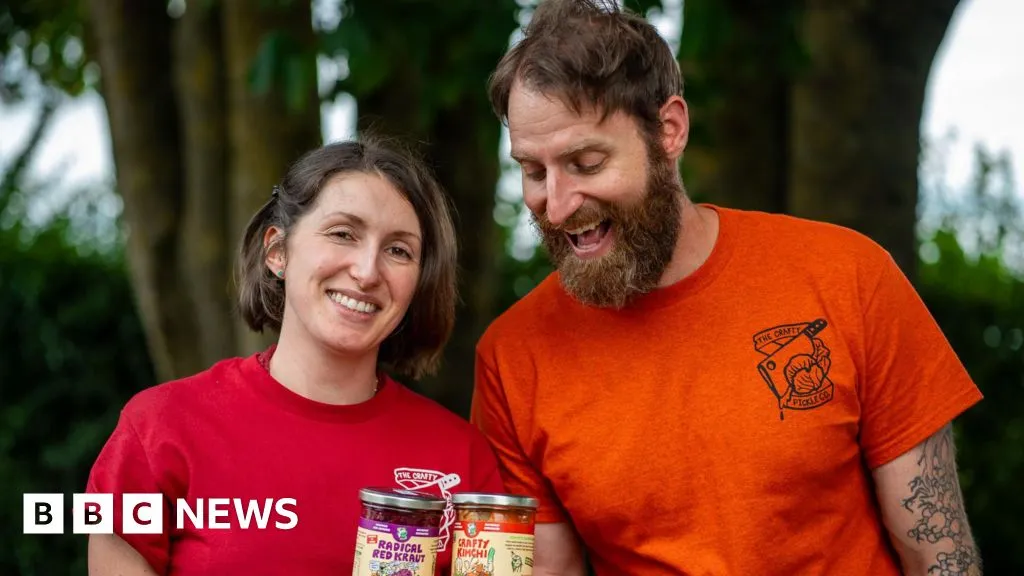
A road trip around the Scottish highlands with jars of sauerkraut and kimchi in the boot of the car may sound like a strange starting point for a business.
But human nutrition students Madi Myers and Arthur Serini knew the jars would keep without refrigeration, and be their main source of vegetables while travelling for three weeks.
Types of fermented food such as these, along with sourdough, yoghurt and miso are good for gut health and researchers are only beginning to understand their links to chronic disease, according to James Kinross of Imperial College Healthcare NHS Trust.
Dietitian Aisling Pigott said over the past decade she had seen a move away from an over-simplistic "diet culture" to a genuine interest into longevity and wellbeing.
From goat's milk kefir in Ceredigion to fermented vegetables made from allotment leftovers on Anglesey and kombucha from Conwy, Welsh producers are finding a growing market.
"Like any 'trends', as consumers we can often fall into traps when it comes to wellness," said Aisling.
"We've seen menowashing of products, protein packed chocolate bars and skin-care for children.
"Sometimes the simplest messages around wellbeing, eat fresh food, move our body, sleep and hydrate, can be lost amongst the glittery packets and Instagram campaigns."
The dietitian said the surge in the popularity of fermented food was linked to increased understanding around the importance of gut health for wellbeing.
"Young people are more health conscious," she added.
However, Aisling did give a word of warning - just because fermented foods have health benefits, this does not remove the importance of a healthy, balanced diet overall.
"It was around 2017 when the idea of the business kind of came up and it was after we travelled through the Scottish Highlands with a couple of jars of sauerkraut and kimchi in the boot of Madi's car," Arthur Serini said.
"And it just allowed us to have a nutritious source of veg on the road for about three weeks and it just kept surprisingly well."
This was while the couple were studying for master's degrees in human nutrition at the University of Aberdeen.
And so The Crafty Pickle Co was born, now based on a farm in Monmouthshire - with the initial aim of saving food from the bin rather than healthy living.
"In the beginning, the aim was to preserve food to make it last longer," Arthur said.
"So we do not necessarily want to skip all the health jargon, but more focus on rescuing food that would have otherwise gone to waste."
They produce three types of sauerkraut and two kimchis, with seasonal batches made using surplus vegetables that might otherwise be discarded, and the company donates a proportion of its sales to hunger and food waste charity FareShare.
As well as supplying shops and restaurants and running workshops that sell out months in advance, Arthur still believes understanding still lags behind enthusiasm.
Long before fridges or freezers, fermentation was one of humanity's oldest methods of preserving food.
Vegetables were stored in brine, milk was cultured into yoghurt and cheese, and grains were transformed into bread, beer and wine.
So for some, renewed interest in them is not a niche pursuit, but a return to practices that once sat at the heart of everyday diets.
Fermented foods are produced when microbial growth, such as bacteria or yeast, break down food components, enhancing preservation, texture and flavour.
Anna Lloyd began fermenting vegetables at home using surplus cabbage from her father's allotment after growing tired of making jams and chutneys.
"At the beginning I was just making it because it tasted good," said Anna, from Anglesey.
"I didn't realise how ancient this process was, or how important it is for gut health."
What started off as a creative experiment turned into her business Bwblin in 2025.
She now produces small batch organic wild ferments using seasonal produce and says interest cuts across age groups.
Children, she says, are often the most enthusiastic tasters at markets, surprising parents who assume fermented food will be too sour or unfamiliar.
She also spends much of her time explaining that many everyday foods, from yoghurt and cheese to coffee and chocolate, are fermented in some way, even if people do not usually think of them as such.
Further south in Ceredigion, the Chuckling Goat shows how much the sector has grown.
The family-run farm produces goat's milk kefir, a fermented dairy drink rich in live bacteria.
It expanded rapidly during the pandemic and now supplies more than 120,000 customers across the UK.
The business has also diversified into microbiome testing, offering personalised dietary advice based on gut health.
Co-director Shann Jones, a self-described "American city girl who fell in love with a Welsh farmer", says she discovered kefir when her son Benji developed eczema and bronchial issues after being given repeated rounds of antibiotics to treat infections.
In 2008, her husband Richard suggested they buy a goat as their milk is known for being hypoallergenic and good for asthma, eczema and bronchial issues.
They ended up with Buddug, a black and white Anglo Nubian with long floppy ears.
"The goat's milk did help with Benji's bronchial infections. But then there was too much goat's milk," Shann said.
By chance, she heard a Russian doctor talking about kefir on the radio, and the rest is history.
In Conwy, kombucha producer Blighty Booch has also seen demand rise and says there is a strong consumer appetite for Welsh-made products.
Founder Mark Pavey believes fermented foods were gradually pushed out of everyday diets by convenience food and supermarket economics and sees them as the "missing link".
Mark makes his craft kombucha from high-quality tea and is proud of the flavour.
"Supermarkets have side-lined properly fermented products in favour of cheap, shelf stable, ultra processed options," he said.