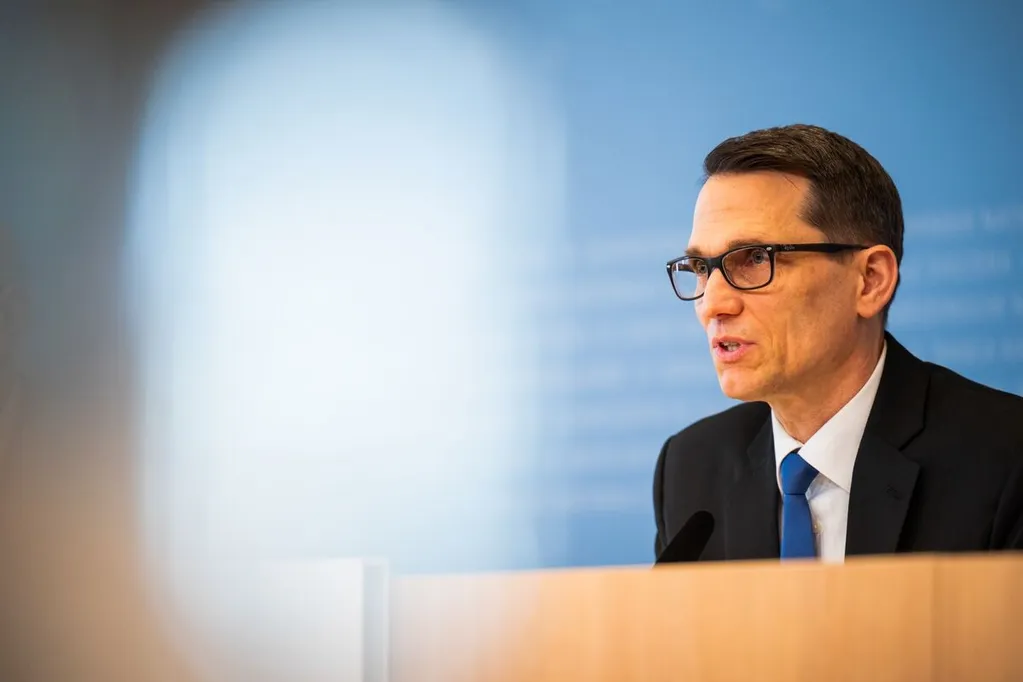
The Swiss National Bank is closely monitoring fallout from the Iran war and can steer the franc's exchange rate without limits if necessary, according to President Martin Schlegel.
"In uncertain times such as these, we are particularly vigilant," he said on Friday. "We have unrestricted room for manoeuvre with regard to the SNB policy rate and foreign exchange market interventions."
Swiss borrowing costs have been at zero since June, with economists expecting officials to stay on hold through 2027. But Schlegel and his peers have repeatedly highlighted that the war in Iran has increased their willingness to intervene if haven flows cause the franc to appreciate excessively. In a newspaper interview published earlier on Friday, the president also stressed that negative rates remain an option.
Addressing the central bank's annual shareholder meeting in Bern, Schlegel highlighted that the SNB is prepared to adjust policy "at any time if necessary." It would do so as soon as inaction would jeopardize price stability, he added, without elaborating on when this might be the case.
Speaking to Neue Zuercher Zeitung, he had echoed earlier comments that policymakers stand ready to cut borrowing costs below zero, although such a move would face a higher bar than a reduction above that level.
"While we have repeatedly emphasized that the hurdles for reintroducing a negative interest rate are higher than those for a 'normal' rate cut in positive territory, we also say that if necessary, we will not hesitate to reintroduce a negative interest rate," he was cited as saying.
An account of the central bank's March rate decision, published last week, revealed that officials agreed that while medium-term inflationary pressures were virtually unchanged compared with three months before, they should stay on high alert about the strength of the franc.
Economists at UBS estimated on Thursday that the SNB bought about 2.5 billion francs ($3.2 billion) worth of foreign exchange in March, weakening its currency when the attacks on Iran began. This probably contributed to the fact that the franc currently trades at lower levels versus the euro than when the war started.
While not confirming the interventions, Vice President Antoine Martin said Thursday on Swiss television that "since the start of the conflict, things have gone rather well."
Read More on the SNB:
- SNB Outlook for Inflation, Growth Too Optimistic, Economists Say
- SNB Concluded It Should Stay on High Alert on Franc Strength
- Swiss Real Wages Jump Most in Almost Two Decades in Warning to SNB
Both top officials also voiced support for the Swiss government's banking reforms, which are set to force UBS Group AG to fully back its foreign subsidiaries, which would add an extra capital requirement of around $20 billion at the bank's Swiss unit.
"The proposed measures aren't extreme," Schlegel told NZZ. "Our experts have calculated that -- taking reserves into account -- UBS already has sufficient capital to meet all of the government's proposals."
Asked about UBS's potential threat to move its headquarters abroad, Schlegel wouldn't speculate, saying that the impact to Switzerland as a financial center would depend on "what exactly would be relocated."
"UBS has various legal entities," he said. "I don't want to make any predictions, but I would assume that UBS would still conduct a significant portion of its business in Switzerland."