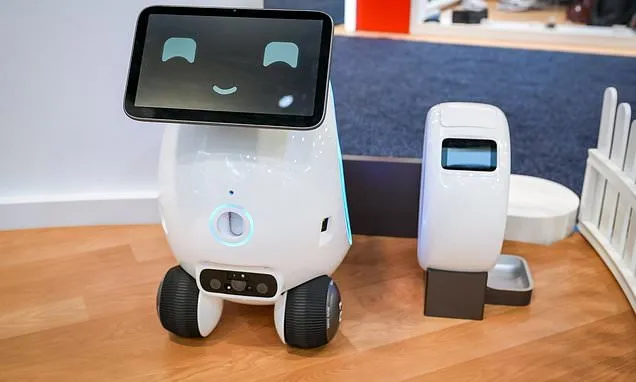
If you worry about your pets getting lonely in the house, this bizarre robot companion might be the perfect solution.
Aura is the robotic 'pet butler' designed to keep your furry friends company while you're at the office.
Developed by the AI service provider Tuya, this smiling robotic assistant can wheel around the house, filming and interacting with your pet.
Equipped with a digital smile, voice module, and the ability to shoot treats out of its face, Aura claims to address your pets 'deeper emotional needs'.
That is possible due to what Tuya calls an 'emotional translator' for pets.
The robot supposedly has the ability to 'accurately interpret a pet's emotional state' through behaviour and sound analysis.
Owners will then receive automatic reports through their smartphones, telling them whether their pooch is happy, sad, anxious, or excited.
Aura can even play 'family photographer', autonomously capturing your pet's memorable moments while you are busy working.
Unveiled at the Consumer Electronics Show (CES) in Las Vegas, Aura is a three-wheeled robot that looks a little like an iPad stuck to a hamster wheel.
Its large, flat 'face' displays a pair of eyes and a smiling mouth that appear to look at people around them.
Its body, meanwhile, is hollow, apparently to allow cats to ride around inside the robot.
The little robot uses a pair of cameras to give it depth perception and can autonomously navigate your home.
This allows Aura to automatically find its way around without crashing into objects and return to its charging dock when needed.
In bad news for nervous cats, Tuya adds that the robot 'moves freely throughout the home, proactively seeking out pets to interact with them'.
However, Aura's real selling point is its supposed ability to understand and interact with your cats on a more emotional level.
While automated feeders, cameras, and even treat-shooting toys already exist, Tuya claims that none of these help your pet feel any less lonely.
Using its animated face and AI-powered voice interactions, Aura is supposedly designed to be a 'responsive and warm' companion.
Tuya doesn't say exactly how the robot will try to bond with your pet, but it is equipped with an array of toys, including a laser pointer, treat dispenser, and 'simulated pet sounds'.
Using its 'emotion translator', Tuya claims that Aura will be able to keep owners apprised of their pets' well-being and capture any exciting moments.
Aura tracks pets' movements, including sudden bursts of energy, playful interactions, and naps, and decides which are worth photographing on the owner's behalf.
Tuya says that Aura can also autonomously generate short videos to 'reserve precious memories and strengthen emotional bonds'.
The company hasn't yet revealed when the robot will become commercially available, nor how much it will cost.
However, Tuya has suggested that this strange pet butler is only the first step in their robotic ambitions.
The company claims that Tuya lays a foundation for future applications in 'elder care, home monitoring, and family connectivity' with 'diverse hardware forms'.
Strangely, this was not the only automatic companion unveiled at CES this year.
Startup FrontierX revealed its Vex robot, which can follow your pets around the house, filming them as they go.
While the Vex can also play with your pet, its operations are a lot more simplistic.
Unlike Aura, the palm-sized Vex only films your pet and doesn't interact with voice and other toys to keep it busy.
Tuya did not respond to the Daily Mail's request for additional comment.
WILL YOUR JOB BE TAKEN BY A ROBOT? PHYSICAL JOBS ARE AT THE GREATEST RISK
Physical jobs in predictable environments, including machine-operators and fast-food workers, are the most likely to be replaced by robots.
Management consultancy firm McKinsey, based in New York, focused on the amount of jobs that would be lost to automation, and what professions were most at risk.
The report said collecting and processing data are two other categories of activities that increasingly can be done better and faster with machines.
This could displace large amounts of labour - for instance, in mortgages, paralegal work, accounting, and back-office transaction processing.
Conversely, jobs in unpredictable environments are least are risk.
The report added: 'Occupations such as gardeners, plumbers, or providers of child- and eldercare - will also generally see less automation by 2030, because they are technically difficult to automate and often command relatively lower wages, which makes automation a less attractive business proposition.'