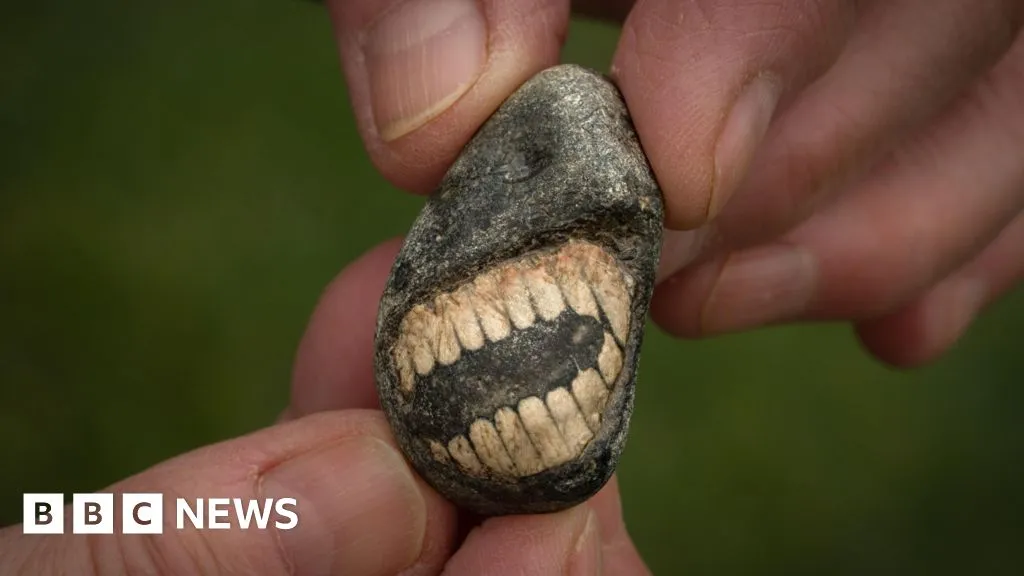
Christine Clark, 64, was hunting for fossils during a Boxing Day walk on Holy Island, Northumberland when something caught her eye.
A tiny pebble seemed to be "smiling at me", she said. "It looked like someone's fake teeth."
She took it home and posted it to a Facebook fossil identification page.
Thousands of likes and comments later, others seemed to confirm her suspicion that it was, in fact, an ancient marine animal.
Christine holidays every year to Northumberland with her husband Gerard where, she said, they regularly go hunting for Cuddy's beads on the Holy Island.
A spit of land with only 150 residents and cut off twice daily by the sea, it is considered the cradle of early English Christianity.
The "beads" are fossilised parts of the stem of a marine animal called a crinoid, but they earnt their nickname from St Cuthbert, considered the patron saint of the North of England.
"He arrived on the island in 670s as a monk coming to the priory, he is buried here and miracles took place around his shrine," said Dr Frances McIntosh, collections curator in the North East at English Heritage.
Hundreds of years later in the 1300s people were finding these small fossils.
"But they didn't know what they were, they [thought] Cuthbert was making them and it was part of his spiritual process, and by collecting them they could become more spiritual," she said.
And so the tradition has continued and on Boxing Day last year, Clarke was hunting for the beads, but she spotted an altogether very different looking fossil amongst the pebbles on the beach.
"I saw this fossil smiling at me - it's the first set of teeth I have found", she joked.
The BBC has had the fossil identified by the British Geological Survey (BGS) which confirmed it is a larger part of a crinoid.
Crinoids are marine animals that first appeared in the Cambrian period, more than 500 million years ago, making it one of the oldest complex animals on the planet, and versions of it still exist today.
It has a flexible stem, which is attached to the sea floor, with branching arms arranged around the main body of the animal at the top of the stem - although it is an animal, this arrangement has earnt them the nickname "sea lilies".
"The stem consists of these little discs, called ossicles, and what Christine has found is a number of these ossicles connected together, in what is called a columnal," explained Dr Jan Hennissen, senior paleontologist at the British Geological Survey (BGS).
The stem has been split lengthways and been curved round so that it resembles the very unusual "mouth-like" shape.
"It is probably from a rock formation called the Alston formation, which is a dark limestone, and that is about 350 million years old," said Dr Hennissen.
Crinoids are part of the phylum Echinodermata which also boasts sea urchins and sea cucumbers.
It is very rare to find a complete crinoid, but rather the individual discs that make up the stem - these are the St Cuthbert's beads - and often resemble polo mints.
Crinoid fossils are among the most common found on the Northumberland coast. Dr Hennissen said you can usually tell quite easily if you have found one there.
"The biological form is very different from the surrounding rock normally - either a different colour or a different composition," he said. "And you can see these very strict lines, which are very defined as opposed to the [surrounding] mudstone."
You can also get your fossil identified by sending pictures to the British Geological Survey or the Natural History Museum id unit.
Christine has received offers to buy her fossil, but for the time being intends to keep it.
"It brings a lot of amusement to many people," she said.