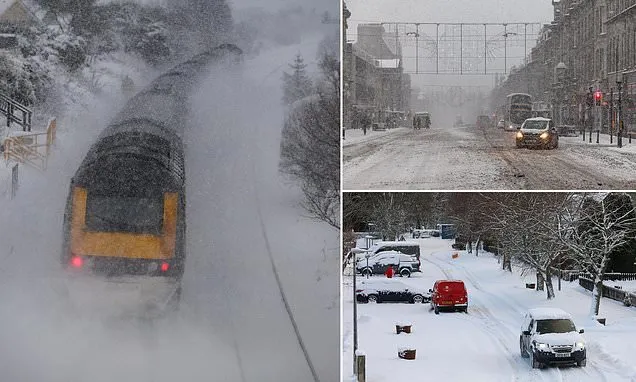
Heavy snow could wreck return-to-school plans for thousands of pupils living in Scotland's highlands and islands.
Children are due back at their desks on Monday in Orkney, Shetland and Aberdeenshire following the Christmas and New Year holidays.
But with up to 15 inches on the ground, coupled with a grim weekend forecast, road travel could prove dangerous at the start of the working week.
Schools in the Highland region do not return until Wednesday, by which time conditions may have improved.
Local authorities said it was too early to tell how many schools will shut, with the decision largely down to the local head teacher.
While the north east saw the worst of the snowfall since New Year, The Met Office said Tomintoul in Banffshire endured the heaviest volumes at 14.5 inches (37cm).
Aboyne in Aberdeenshire saw eight inches (20cm) and Loch Glascarnoch in Ross and Cromarty witnessed 19cm.
Warnings for snow and ice remain in place for northern Scotland above the central belt until noon on Monday. The area under alert includes the Western Isles, Orkney and Shetland.
Aberdeen's Union Street was tricky to negotiate after heavy snow fell on the city.
Pedestrians make their way along snow-covered pavements in Ballater.
Warnings state: 'With respect to additional accumulations, through the weekend and into Monday morning, a further 2 to 5, locally 10-15 cm (6 inches) of lying snow is possible in low lying areas.
'Up to15-30 cm (12 inches) could potentially accumulate above 200 m, most likely for the northwest Highlands and Grampians.
'Given wind strengths Saturday some drifting of snow and temporary blizzard conditions are likely.
'Lightning will be an additional hazard near showers.'
The white-out conditions across huge swathes of the north of Scotland has created travel chaos for many.
In Huntly, Aberdeenshire, an appeal went out on Facebook to help a stranded doctor, whose car had become stuck in snow near the train station on Friday night.
Naveed Khan, believed to be working at the MacDuff Medical Practice, had faced spending the night in his car amid the plummeting temperatures.
Offers came in from people nearby, but road conditions for many made it impossible for them to reach him.
As the hours ticked by the medic said he had resolved to stay in his car.
Dr Khan wrote on social media: 'Thanks everyone for trying but I am ok to wait and rest in my car until dawn.
'I have emergency food in my car and extra layers in the boot. I should be ok.'
Later, however, he revealed he had been given 'warm shelter' for the night.
Dr Khan added: 'Thanks to the lovely local gentleman who turned up to help.'
A car drives through the village of Garve which is under an amber alert for snow, almost a foot of snow has fallen already.
ScotRail announced several cancellations this morning including Wick and Inverness.
Avanti West Coast said overrunning engineering work between Carlisle and Lockerbie meant all lines to Glasgow Central and Edinburgh were blocked.
The Met Office warned that heavy snow showers could see some rural communities cut off, as well as a risk of power cuts in some areas.
Arctic air has plunged much of the UK into sub-zero temperatures, with nearly -6C (21F) being recorded at Loch Ness on Friday night.
Daytime temperatures are expected to remain in the low single figures for much of the country on Sunday, and below freezing in parts of northern Scotland.
Met Office chief meteorologist Rebekah Hicks said: 'Arctic air and brisk northerly winds are gripping the UK as we start the new year.
'Snow and ice warnings remain in force for many areas, with the risk of heavy snow showers, especially across northern Scotland and over higher ground elsewhere, though many inland areas will stay largely sunny and clear.
'Bitterly cold conditions will persist through the weekend and into next week, with daytime temperatures struggling to rise above freezing for some, and overnight lows dipping to minus double figures in places.'