Daily Mail journalists select and curate the products that feature on our site. If you make a purchase via links on this page we will earn commission - learn more
It's often dubbed one of the cleanest countries in the world - where even food and drink is banned from some public transport, and strict anti-littering laws with heavy fines remain in place.
So, it's no wonder that homes in South Korea are filled with incredible cleaning tech - from rubbish bins that automatically seal the trash bag for you, to £63 UV knife and chopping board sterilisers.
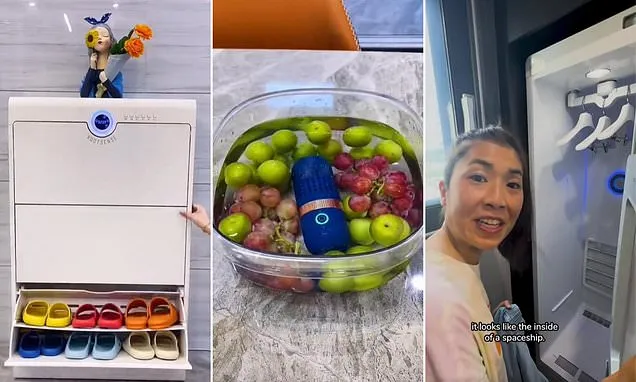
A quick scroll through social media shows locals sharing their impressive gadgets, which include a $599 shoe cabinet that eradicates bacteria and unpleasant smells with its smart technology, under the hashtag Korean cleaning.
Elsewhere, stylish apartments featured portable washing machines, as well as £15.46 electronic, waterproof fruit and vegetable sterilisers.
'I wish we had those gadgets in Canada, I'd for sure love it,' wrote one viewer commenting on the footage of the remarkable shoe cabinet and handy washing device.
'Where do you find most of the things you have at home?' another curious fan questioned.
A quick scroll through social media shows people in South Korea sharing their impressive gadgets, which include a $599 shoe cabinet (pictured) that eradicates bacteria and unpleasant smells with its smart technology, under the hashtag Korean cleaning.
Meanwhile, one influencer visiting South Korea previously showcased the 'smart home' she was staying in - complete with a wardrobe that also steams your clothes, keeping them free of creases.
'It's all good until there's a power outage,' she joked, before adding: 'The only thing that's missing is a robot maid.'
The footage of the enviable gadgets comes amid a rise in so-called 'smart living', with impressive home innovations beginning to dominate our everyday.
Indeed, numerous celebrities have embraced this change in home cleaning rituals - with Stacey Solomon and Australian TV personality Hannah Ferrier firm fans of a robot vacuum cleaner.
South Korean public spaces maintain high levels of cleanliness, a standard matched in most homes.
However, according to The Korea Times, this wasn't always the case. Pollution and 'unhygienic conditions were rampant in the 1950s', reported the newspaper.
But eventually, huge fines were imposed for littering and throwing away rubbish that wasn't separated into recycling, and schooling involved changing the culture of the people towards cleanliness, explained the publication.
Now, cleanliness is so important to those in South Korea that homes are filled with futuristic products like a wireless dust mite remover, robot vacuum cleaners and advanced incense machines used to offer a sense of calm to the house.
Meanwhile, one influencer visiting South Korea previously showcased the 'smart home' she was staying in - complete with a wardrobe that also steams your clothes, keeping them free of creases.
Elsewhere, stylish apartments featured portable washing machines (pictured right), as well as £15.46 electronic, waterproof fruit and vegetable sterilisers (pictured left).
Homes in South Korea are filled with incredible cleaning tech - from rubbish bins (pictured) hat automatically seal the trash bag for you to £63 UV knife and chopping board sterilizers.
It comes as social media users have also recently been left stunned at Japan's incredible cleaning gadgets - after the nation's football fans were praised for tidying away rubbish at Wembley.
A viral video by a Japanese homeowner, posted to TikTok, revealed some of the nation's most innovative cleaning contributions that show their commitment to smart living in the home.
Amassing more than 8,000 likes, the clip shows a woman's daily cleaning rituals, but with a few rather remarkable twists.
In it, a space-saving laundry machine is seen mounted to the bathroom wall, rather than on the kitchen floor, and contains numerous personalised settings.
The cleaning fanatic also added a sophisticated layer to her laundry ritual by using a miniature home washer for the smaller items.
Even shoes have their own special washing compartment, ensuring there is no need for them to be put into the same load of laundry as your clothes.
Dried with an electric machine that seeks to keep them fresh, these shoes are not bundled into a messy cupboard in the hallway or placed on a traditional shoe rack. Instead, they are kept in a specially heated drawer for maximum comfort.
And when it comes to keeping the bedroom clean - the innovative home owner uses a mattress cleaning vacuum and, for those who enjoy seeing the results, proudly shows the vast amount of rubbish collected afterwards.
Now, cleanliness is so important to those in South Korea that homes are filled with futuristic products like a wireless dust mite remover, robot vacuum cleaners (pictured) and advanced incense machines used to offer a sense of calm to the house.
The variety of home machines sent social media users into overdrive, who quickly took to the video's comments to praise the homeowner for her impressive cleaning products.
'I want everything in this video,' commented one user, while another added: 'I need that shoe washer.'
'It would be great if they sold these hygiene products all over the world,' added one watcher, while another remarked: 'That washing machine!!!'
In Japan, cleanliness forms a huge part of the culture and is instilled in people from an early age.
Scott North, a professor of sociology at Osaka University, told the BBC in 2018 that tidying is a way of 'demonstrating pride in the Japanese way of life'.
'It's not just part of the football culture but part of Japanese culture,' he said. 'You often hear people say that football is a reflection of culture.
'An important aspect of Japanese society is making sure that everything is absolutely clean and that's the case in all sporting events and certainly also in football.
'Cleaning up after football matches is an extension of basic behaviours that are taught in school, where the children clean their school classrooms and hallways,' he added.
'With constant reminders throughout childhood, these behaviours become habits for much of the population.'