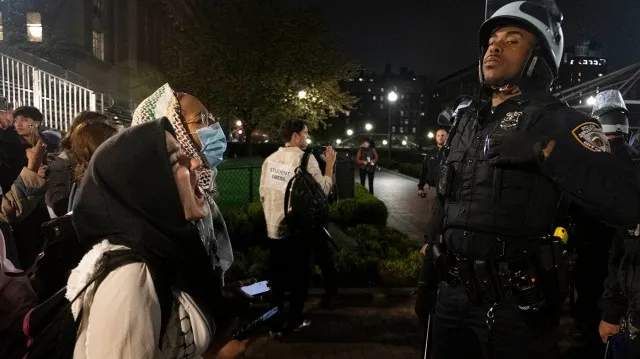
College protesters are riding high after a series of legal victories.
After thousands of arrests and fierce pushback from schools during the 2024 pro-Palestinian demonstrations, many of those detained by the Trump administration have been released, and last week, the courts vacated school punishments against one of the most prominent groups: the activists who took over a Columbia University building, prompting a police raid.
While the wins offer hope to protesters, they also show how long and costly the battle can be.
Almost two dozen Columbia activists who took over Hamilton Hall back in 2024 had received suspensions, expulsions or revocations of their degrees from the university.
Police charged them with misdemeanor trespassing, but the Manhattan district attorney's office dismissed the charges, assuming the university would deal out punishments on its own.
But the dismissed charges meant the records were sealed, and the school had no evidence of individual offenses, choosing to punish the group as a whole, which a judge ruled illegal. Columbia has said is looking at its options.
"A lot of schools have been, because they're under pressure from the Trump administration, pursuing student conduct processes without necessarily having the right procedures or justifications for doing so," said Zoha Khalili, senior managing attorney at Palestine Legal, adding "that initial part of the process" takes place completely "within the university administration."
"They don't have to have any kind of like neutral decision-maker outside of the university play any kind of role. And so, universities, really under pressure from the Trump administration, have been going rogue and trying to secure harsh punishments against their own students in order to be able to testify in Congress about the fact that they punish people over these encampments or make deals with the Trump administration," Khalili added.
Last month, a group of students from Stanford University who barricaded themselves in the executive offices of the school president and provost and were charged with felony vandalism and felony conspiracy to trespass saw their case declared a mistrial.
The attorney general for the county said he would pursue a new trial.
Universities, sometimes under funding threats from the Trump administration, have spent the past year adding harsher disciplinary and protest rules, and they have yet to see protests on the scale of those in 2024.
But advocates are hopeful the recent rulings will teach schools lessons about how to treat protests, and that federal pressure will not be enough to create a legal case against a student.
"It's also a message to universities as well, that any disciplinary decisions that they are making must be consistent, that they have to be transparent, that they have to be constitutionally sound and that they have to withstand the system of checks and balances within our government. And if they attempt to respond to political pressure or discriminate against students because of their political viewpoints by imposing punitive, harsh punitive measures or sweeping punishment, then they are risking legal challenges and reputational damage," said Zainab Chaudry, director of the Maryland office for Council on American-Islamic Relations.
The Hill has reached out to the Department of Homeland Security for comment.
The Trump administration has also seen legal setbacks in its push to arrest and deport pro-Palestinian demonstrators.
An immigration judge last month terminated deportation proceedings against Rümeysa Öztürk, the Turkish national and Tufts University student who was arrested after co-writing a pro-Palestinian article for her student newspaper.
Not all the students targeted are out of the woods, with Columbia activist Mahmoud Khalil still fighting deportation efforts, though he has been released from immigration custody.
Robert Shibley, special counsel at the Foundation for Individual Rights and Expression, said while students have the "right to protest in certain ways," he worries that these cases will send conflicting messages to activists.
In the Columbia building takeover case, "we're sending the message to people that you can engage in unlawful activities like that because the authorities are too sloppy to stop you from doing it, that sends the wrong message. That encourages people to protest in unprotected ways rather than the protected way," Shirbley said.
"And at the same time, when you do have a, one or two yearlong inquisition after somebody that's politically based, it also does scare people who would like to follow the rules and speak out. It scares them from doing that themselves. So, it's counterproductive on both sides. It encourages a kind of behavior that is worse for free expression and discourages the actual protected free expression that we all agree students should be able to engage in," he added.