It's a kitchen staple, used in everything from soups to hot beverages.
But it turns out you've probably been disposing of any leftover milk wrong.
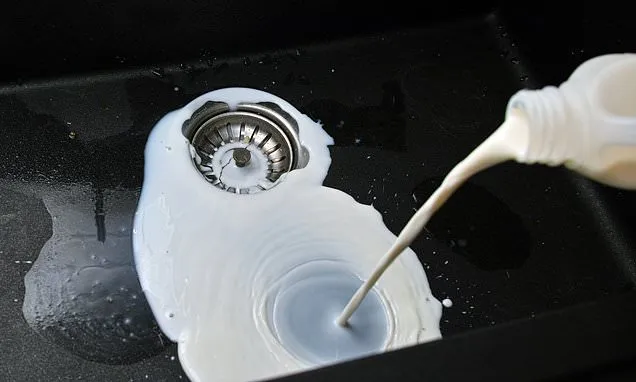
Contrary to popular belief, milk should not be poured down the drain.
Milk has a high fat content, meaning it can lead to blockages - just like other fats, oils, and grease.
Instead, experts from Thames Water say it's best to pour any dregs into a non-recyclable container and bin it.
Alternatively, old milk can be used as compost or as a natural fertiliser (albeit, mixed with water to avoid any nasty smells).
Thames Water also advises avoiding pouring milk-based drinks down the sink - including hot chocolate, tea, and milky coffees.
'Always scrape fats and oils into the bin before washing up, avoid pouring drinks like hot chocolate or tea down the drain, and avoid flushing anything that isn't pee, poo or toilet paper, even if the packaging says otherwise,' said Tess Fayers, Director of Wastewater and Bioresources at Thames Water.
Ahead of the festive season, Thames Water has revealed the surprising items you should never pour down the sink.
As well as milk and milk-based beverages, the wastewater company says that Brits should avoid meat juices, which are high in fat.
Oils - including sunflower, olive, rapeseed, vegetable, and canola - should also be avoided.
Meanwhile, yoghurt, gravy, soup, and coffee grounds can wreak havoc on your pipes.
'Everyday habits like rinsing leftover food, oil and fatty liquids down the sink or flushing wipes can unintentionally lead to blocked pipes,' Ms Fayers added.
'These issues are especially common during the festive season, when cooking and hosting are in full swing.'
'The last thing we want is for the festive season to be ruined by blocked drains.'
To keep your drains clear, Thames Water recommends scraping any food scraps from dirty dishes, pans or utensils into the bin or a food waste caddy.
The 9 surprising items you should never pour down the sink
- Milk
- Milky tea
- Milky coffee
- Hot chocolate
- Meat juices/gravy
- Oils
- Coffee grains
- Soup
- Yoghurt
'Ensure your plughole has a basket strainer fitted to catch food scraps and prevent them from going down the drain,' it added.
If you have surplus oil, meat juices, or gravy, let it cool and then scrape it into the bin.
Meanwhile, coffee grains can be used in the garden or can be disposed of in designated bins at most supermarkets.
The recommendations come shortly after Thames Water shared stomach-churning photos of an enormous 'fatberg' recovered from a sewer in Feltham.
Weighing in at 100 tonnes, the congealed mass of wet wipes, fat, oil, and grease is the equivalent of eight double-decker buses.
It was stuck in a sewer more than 10 metres below street-level - meaning it took experts more than a month to remove.
'The clearance of this fatberg was hugely complex for our team of engineers and shows some of the challenges we face,' said Alexander Dudfield, Engagement Lead for Network Protection at Thames Water.
'But while some blockages in our biggest sewers can weigh as much as 25 elephants,' we must not forget most blockages occur in local pipes - often narrower than a mobile phone and usually caused by a few households.
The news comes shortly after Thames Water shared stomach-churning photos of an enormous 'fatberg' recovered from a sewer in Feltham.
Does pouring coffee down the drain really harm the environment? Scientists reveal the truth
'When these pipes get blocked, we can't simply switch off the sewage.'
'It backs up and must come out somewhere, whether that's roads, rivers or even people's homes.'
'The consequences can be devastating.'