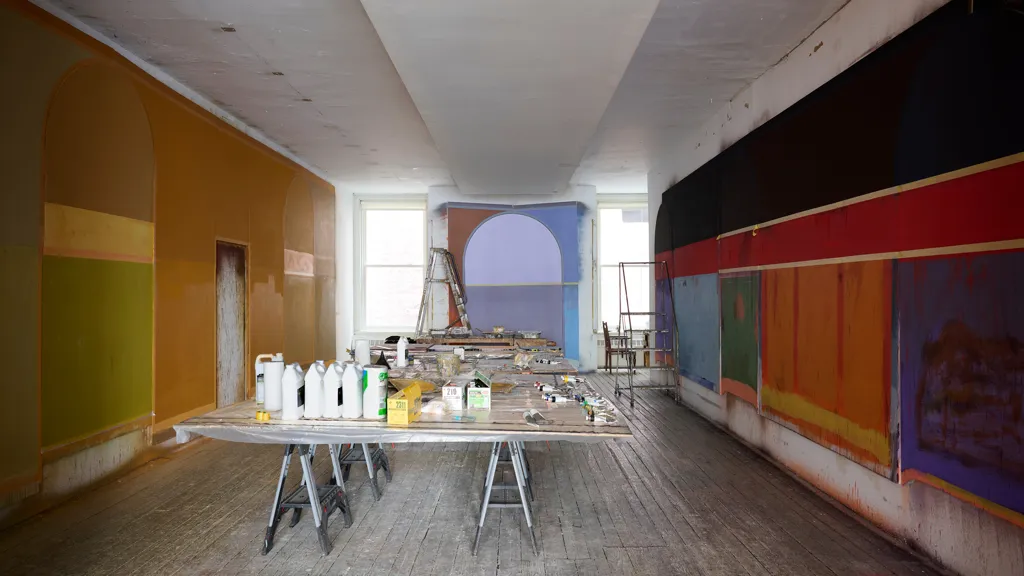
David Novros has spent years finessing and repainting site-specific artworks in his SoHo space.
When David Novros moved from California to New York in the mid-1960s, he became one of SoHo's early colonizers. Today, living on the same block of Broome Street he's occupied for 60 years, he's one of the few artists still working in the neighborhood. Known for his large oil paintings, which he calls "portable murals," he continues to lament the glassy condo building that went up across the street from his studio in 2017 and blocks much of the evening light that used to stream through his enormous north-facing windows. But he has his reasons for staying where he is.
Novros, 84, is the subject of a solo show at Paula Cooper Gallery in Chelsea that opens this month and is preparing for a retrospective at Hamburger Kunsthalle in Hamburg, Germany, in October. Many of his works are site-specific -- he describes them as "painted places" -- murals designed with a particular space in mind and made in situ. He began exploring this idea while in Europe in the early 1960s but first put it into practice in 1970 when the artist Donald Judd, Novros's close friend, asked him to make a fresco at his studio on nearby Spring Street in a 19th-century cast-iron warehouse that had at various times served as home to a department store, a furrier and a hat maker.
Judd, a minimalist sculptor who hated both of those terms and preferred to think of himself as simply a maker of objects, was at the time forming his own ideas on how to create permanent work in a specific place, blurring the lines between art and architecture. Inspired by the Byzantine mosaics of Ravenna, Italy, Novros, who's as much a draftsman as he is a painter (his sketches and plans for paintings look more like blueprints than like conventional drawings), spent two days at Judd's house painting the work "No Title/101 Spring Street," a grid of colorful right angles, squares and rectangles of varying sizes that, taken together, seem to give one corner of Judd's studio a depth and dimensionality that wasn't there before. Though the commission was pro bono, Novros calls Judd "a wonderful patron. He said, 'Here's the place I want it to be in, do what you like.' And subsequently, I was able to get other jobs because people knew about the work at Don's and knew that I could make a fresco. In the long run, it was the thing that boosted me."
But after Novros's frescoes were finished, their fate was often out of his hands. "I was very naïve in the beginning," he says. "I thought that once you did something and it was really good, people would say, 'That's fine. Let's just leave it alone.'" The next fresco he completed after Judd's was in a hallway at the Museum of Modern Art for a show in 1972. Once that exhibition closed, Novros suggested the museum put Sheetrock over his mural so it would be preserved forever. Instead, it was destroyed. "That's when I really understood the problem of wanting to do this kind of work," he continues. "It was about the whole question of ownership and the idea of the paintings having a public use. I realized nothing was permanent. I [started doing] them in places that I thought would remain more or less permanent, and even those failed me." Some murals were relocated, like one commissioned by the United Gas Pipeline Company (owned by Pennzoil at the time) that's now in the Museum of Fine Arts, Houston, while others no longer exist, like one in Newark, N.J.'s Penn Station that was replaced by two American flags after Sept. 11.
It's surprising, then, that the surviving examples of Novros's greatest site-specific works are in SoHo, one of the country's most gentrified neighborhoods. Judd died in 1994, and his children have kept his Spring Street studio preserved -- and open to the public -- meaning the future of Novros's original fresco is secure. ("That was a miracle," Novros says.)
And then there's the artist's own home, with his 2,000-square-foot studio on the second floor where seven large-scale oil paintings in varying states of completion adorn the walls. (Novros and his wife, the painter Joanna Pousette-Dart, 78, bought the four-story building in 1980 and raised their son in it.) He's spent years on these works -- the earliest was started in 1975 -- and they've hung in their current configuration for about 15 years, each evoking a different color motif that suggests a particular mood or season or even just a certain time of day. The works have changed with the space: At one point, Novros installed air-conditioning and track lighting, and the paintings had to be updated in response.
He'll continue repainting sections of them as he himself changes. Recently, he developed cataracts, which altered his vision -- "It makes everything look like hospital lighting: hyperintense" -- then had two surgeries this past fall to remove them, which has again shifted the way he sees the work and the room. In January 2025, leaving a dinner, Novros was struck by a car. He's relearned how to walk but now moves through the space differently.
When he finishes "depends on if I get hit by a car again," he says, half-joking. "My timeline is to finish before I die." After that, he'd like the space to be preserved, much like Judd's, becoming a kind of SoHo equivalent of Houston's Rothko Chapel—a place where the public can sit with the paintings and the paintings in turn can continue to live in their intended location unencumbered by whatever might be happening outside the studio walls.