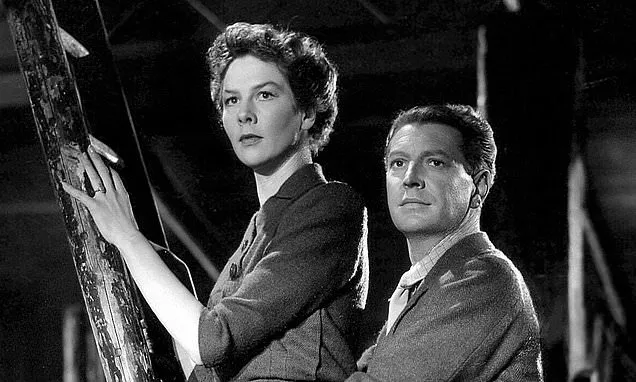
It was shot largely on Hebridean location - though the leading man never came within 500 miles of it; it was the first feature-film to include any Gaelic conversation (without apologies or translation) and it made a telephone-box on Mull, to this day, a listed building.
I Know Where I'm Going, released in December 1945, was almost the last in an arc of films, by Michael Powell and Emeric Pressburger - from One of Our Aircraft Is Missing (1942) to 1946's A Matter of Life and Death - among the best British movies of all time.
Barry Norman, in 2013, ranked I Know Where I'm Going in his top 49 of the greatest flicks of all time. Molly Haskell rates it in her top ten; Martin Scorsese - who only saw it for the first time in 1993 - hails it as a masterpiece and, 80 years ago, it was a critical and commercial hit both sides of the Atlantic.
It's still vaunted for its taut, perfect screenplay and the bold, often backlit cinemaphotography of Erwin Hillier.
The cast, too, is striking for all the before-they-were-famous players - John Laurie (Dad's Army), Jean Cadell (Whisky Galore), Valentine Dyall (Secret Army; Doctor Who), Finlay Currie and even a very young Petula Clark... who was so terrified of Michael Powell, notoriously explosive on set, that the 12 year-old dared not ask for a comfort-break.
The flick's essentially the tale of one woman. Miss Joan Webster - played with forthright poise and feline beauty by Wendy Hiller, and with an extraordinary quality of stillness - and in tacit address of uneasy social questions amidst the last gasp of the Second World War.
Our first glimpse of her character is her confident high heels, clacking into a nightclub; our second - appalling her father, a prissy bank manager briefly granted an audience - is when the waiter asks, 'Your usual, Miss Webster?'
It's a gin and Dubonnet; she is evidently an habituée - and this in an era when, as late as 1960, Princess Margaret unwed had to share a roof with her mother; when lifelong and to the very end, even Margaret Thatcher never, ever entered a bar unless escorted by a man.
But Joan Webster has just bagged one.
Or, more accurately, Consolidated Chemical Industries, Manchester - as personified by her boss, Sir Robert Bellinger, old enough to be her dad and whom we will never actually meet.
It's cynical, transactional - and, in a couple of hours, she will hit the night-train for Scotland, Glasgow, and Oban, her shimmering bridal-gown on a hanger and herself in a first-class sleeping berth in exquisitely cut shantung-silk pyjamas.
Happily knowing where she is going; exulting - in one of the greatest screen-dissolve dream sequences ever shot - in the new life almost in her grasp: high society, grovelling shop-assistants; the bottomless expense-accounts and those awaiting cars for Lady Bellinger, trophy wife of one of the richest men in England.
The weather, and in short order her heart, have other plans...
On arrival at Mull, all set for her nuptials on the adjacent Kiloran - Colonsay, though not where we know it - she is at once frustrated by fog; and befriended by Roger Livesey's dashing Highlander: naval officer, posh public schoolboy and an esteemed local with fluent Gaelic.
Torquil MacNeil - 'Kiloran,' the island's true laird; Sir Robert has but the let, though Kiloran lives in knowledge of an uneasy and terrible curse - and who both directs her to a makeshift billet for the night and introduces her to a very different, far less grasping Scottish social order.
Already unsettled, Joan Webster's bedtime prayer that night is for a wind to rise and blow the mist away.
She awakes, the following morn, to the mother of all storms: the wind shrieks till almost the end of the movie; all her schemes collapse as she falls helplessly in love with Kiloran and, till almost the end and what is still a compelling small-boat near-death experience with the Corryvreckan whirlpool, she fights and fights to get away from him.
To be, so lucratively, Lady Bellinger. Spoiler-alert: three pipers wail in her train; when all is calm, Joan Webster finally proposes to Kiloran who - as that full curse is finally revealed - will be in chains to a woman all his days.
Central to all this is a third character, Pamela Brown's Catriona - an astute and platonic friend of Kiloran, no less posh but with no money, who lives in a disintegrating pile with enormous deerhounds - and yet is at the candid moral core of I Know Where I'm Going, invariably one step ahead of the principals.
The film nimbly surmounted early difficulties. Powell and Pressburger wanted to shoot it in Technicolor, but all that film-stock in Britain had been requisitioned by the Ministry of Information. They then had casting knockbacks: Deborah Kerr proved unavailable and James Mason pulled out of the Kiloran part just six weeks before shooting began.
Roger Livesey, who had somehow got a dekko of the script, begged to be the leading man: Powell snorted he was too old and portly. Livesey fast shed 12 pounds, lightened his hair, and won through.
But, at notice this short, Livesey was in a contracted London theatre part he could not wriggle out of: all his scenes as Kiloran had accordingly to be shot in studio (with deep-focus and back-projection) and a body-double, coached to walk like him, stood in for location long-shot.
I Know Where I'm Going is still an eminently watchable, pacy picture, with diverting subplots and the running-gag of the telephone kiosk by a thundering waterfall; Gaelic lilt and Gaelic song; and an extraordinary sense of place.
'I've never seen a picture which smelled of the wind and rain in quite this way,' mused Raymond Chandler in 1950, 'nor one which so beautifully exploited the kind of scenery people actually live with...'
Much seen and referenced actually is real - Tobermory's Western Isles Hotel; the Mull mailboat at the time, the MV Lochinvar; the island's characteristic passing-place signs - black-and-white striped poles - and even a namecheck for C.B. Leith, then boss of MacBraynes.
Yet, from the get-go, there is a bat-squeak of desire - though only explicitly indicted in a taut scene with Joan, Catriona, and the affianced lass of the teenage Lewisman Joan has just bunged £20 to take her on a suicide- mission passage to Kiloran.
'Some folks there are that can't be waiting a day to satisfy their passions,' rages young Bridie,'some folks there are who want to drown fine young men and break poor girls' hearts so that they can be bedded one day sooner...'
Strong stuff for 1945: it would never have passed the censors of the day had there been a man in that scene.
Yet there is irony. Joan Webster may well know where she is going. Her exquisite tailoring and all the assistance in her journey suggest useful contacts; the black market.
But her micromanaged itinerary from the West End to the Hebrides has been decreed by a man, is provided by men, and at every turn from the station platform to the bridge of the Lochinvar is supervised by a man.
And, freed by mist and gale from that control, she tumbles into another.
It is hard, accordingly, not to feel just a little uneasy: after the unprecedented liberation of women, given the exigencies of world war,I Know Where I'm Going's moral point might just amount to,'Right,little lady,you've had your fun - now get back in your box.'
The Powell/Pressburger collaboration did not long survive it,and Michael Powell's career was buried by Peeping Tom (1960) - a sleazy flick now thought a horror classic but which appalled folk at the time.
Pamela Brown,w ho had lived with a disabling illness since her teens,did not make 60;Roger Livesey turned down the chance to star in Brief Encounter and had his last big role in The Pallisers.
Wendy Hiller picked up an Oscar in 1959:her last acting job was in 1992 though the part in her winter for which most remember her was as the spirited octogenarian in a 1986 BBC drama,All Passion Spent.She died in 2003.
I Know Where I'm Going still has devoted fans worldwide and is arguably the best film ever shot in Scotland,'made in turbulent times,in 1944 during the last full year of the war,'Pamela Hutchinson last year mused.
'And this is a story about navigating a world we cannot control. We are all at the mercy of forces beyond our ken.
'Love is one of them,and magic another...'