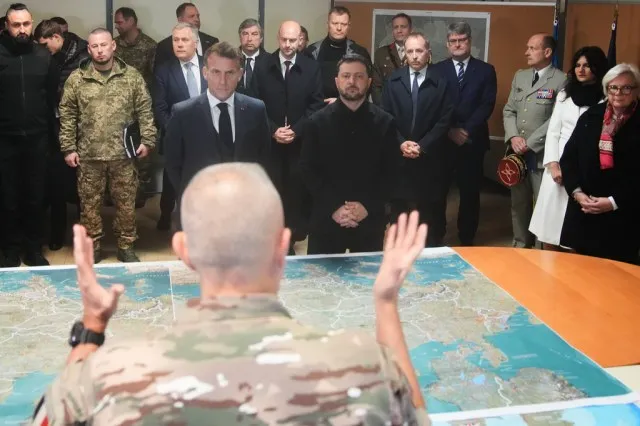
One constant element of the ongoing attempts to reach a peaceful settlement of the war in Ukraine has been the much-advertised "Coalition of the Willing." Established by UK Prime Minister Sir Keir Starmer following a summit in London on March 2, 2025, its purpose is to provide a multinational force which could provide Ukraine with security guarantees as part of an agreement with Russia.
This could either be a so-called "reassurance force" deployed on the ground in Ukraine to guard against breaches of a peace deal, or merely as a deterrent force to strike at either side which committed any such breaches. Starmer has worked closely with Emmanuel Macron, the French president, to establish and build the Coalition of the Willing (or Coalition des Volontaires), and there are now 34 countries involved: 28 NATO member states (all except the United States, Hungary, North Macedonia and Slovakia), and Australia, Austria, Cyprus, Ireland, Japan and New Zealand.
This is an impressively broad alliance, though the commitments of different members vary in scale and kind. The framework of a Multinational Force-Ukraine has been created, with a three-star headquarters at Fort Mont-Valérien near Paris, and a two-star forward command under a British officer in Kyiv. It is anticipated that MNF-U would initially be headed by a French general, then after a year would rotate to British control and a base in London.
The planning may have been meticulous, but the very fact of the Coalition of the Willing has seemed from the outset to be an exercise carried out at such a level of activity that no one has time to pause and ask basic questions. Those questions, however, are numerous and fundamental.
The most obvious is what is the Coalition of the Willing for? Words like "implementation", "reassurance" and "deterrent" have been bandied about, but those are all issues for the period after a peace settlement has been agreed. The Coalition of the Willing was established more than nine months ago, and Ukraine and Russia have still not agreed to even the sketchiest terms for a cessation of the conflict. How can its leaders possibly know what activities the coalition will have to undertake or what its objectives will be in the absence of a peace deal? It is like choosing the cutlery for a meal with no notion of what food is being served.
This blithe indifference to practicalities, even reality, permeates the whole enterprise. A joint statement on Dec. 15 by the UK, France, Germany, Denmark, Finland, Italy, the Netherlands, Norway, Poland, Sweden and the European Union declared its signatories committed to:
"A European-led 'multinational force Ukraine' made up from contributions from willing nations within the framework of the Coalition of the Willing and supported by the US. It will assist in the regeneration of Ukraine's forces, in securing Ukraine's skies, and in supporting safer seas, including through operating inside Ukraine."
Yet only a few days ago, Russian Deputy Minister of Foreign Affairs Sergei Ryabkov reiterated what has long been the Kremlin's stance: that the presence of NATO troops in Ukraine is unacceptable.
U.S. officials have said informally they are confident that Russian President Vladimir Putin will eventually accept the deployment of European forces so long as they are not operating under the banner of NATO, but it is hard to see the source of this confidence, given the Russian leader's unyielding intransigence so far. It seems unfeasible and improbable to circumnavigate this insistence by relying on the non-NATO members of the coalition, of which only Australia and Japan have significant military capabilities, to provide "boots on the ground."
The Dec. 15 joint statement also glosses over a basic question of capabilities. It describes the multinational force as "supported by the US", but what does this mean? In April, President Trump ruled out the provision of military support to the Coalition of the Willing; in August, he made vague references to potential "security guarantees," but the deployment of American ground forces is not being considered.
If it were to be anything more than a paper tiger -- or, worse, a tethered goat -- a multinational force would require, at least as a last resort but more likely on an ongoing basis, U.S. intelligence, surveillance, target acquisition and reconnaissance (ISTAR) assets, from Space Delta 7's satellites through the U.S. Air Force's RC-135 Rivet Joint and E-3 Sentry AWACS aircraft to unmanned aerial vehicles like the RQ-170 Sentinel and RQ-4 Global Hawk. Without America, NATO simply does not have comparable assets.
The same is true of some logistics capabilities, especially air-to-air refueling which is vital if a reassurance force was engaged in extended aerial patrols. To give an idea of the disparity, NATO's central Multinational Multi-Role Tanker Transport fleet has nine tanker aircraft; the United States operates more than 600.
The Coalition of the Willing and its deployable Multinational Force-Ukraine are exercises in "if." If there was a peace settlement to monitor or enforce, if Russia was prepared to countenance NATO ground troops in Ukraine, if the U.S. intended to provide hard military capabilities to support it, then the initiative begun by Starmer and Macron in March 2025 might be a deft diplomatic achievement in alliance-building. Absent those conditions, it is a comforting scenario of Europe's decisive influence: comforting, but imaginary.
Eliot Wilson is a writer and historian, a Senior Fellow for National Security at the Coalition for Global Prosperity and contributing editor for Defence on the Brink.