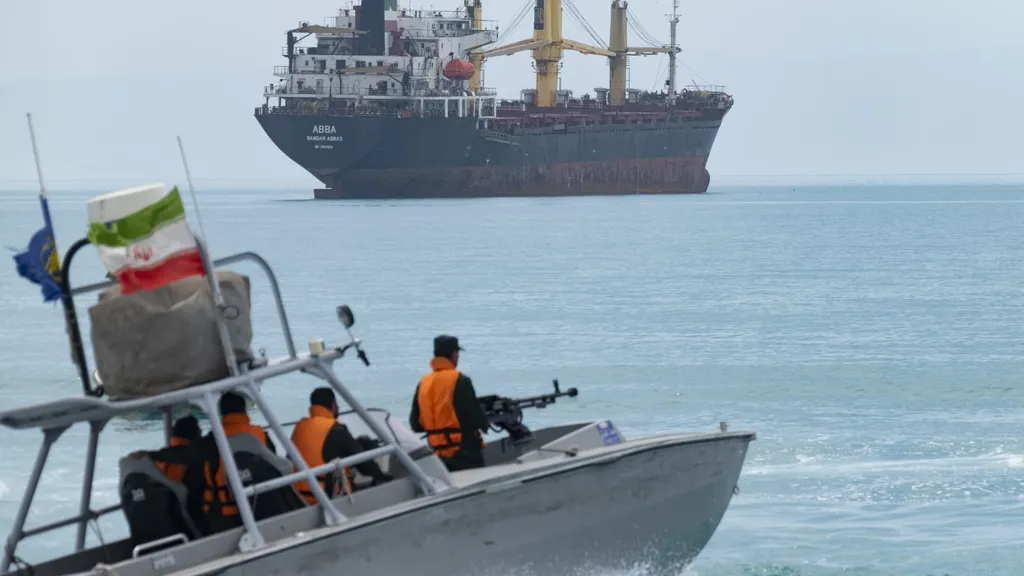
An Islamic Revolutionary Guard Corps (IRGC) speed boat sailing along the Persian Gulf near a cargo vessel.
With oil prices at levels not seen in years and global business supply chains across sectors of the economy shut down by the de facto closure of the Strait of Hormuz, faith in the C-suite that the worst isn't yet to come is being tested. On Friday, United Airlines CEO Scott Kirby said he is planning for $175 oil, and for an oil price that remains above $100 into 2027. This forecast, he said, may not come to pass, but the airline CEO added that there is every reason to at least start planning for it as a potential reality.
Corporate executives have become accustomed in recent years to a world in which it is one new form of uncertainty after another. But the potential ramifications of the U.S.-Iran war, for which President Donald Trump has continued to offer uncertain timelines for ending, has the market and many inside the C-suite on edge. The Nasdaq entered a correction on Friday, a fourth consecutive negative week for the stock market, and it is not just risk-on assets but safe havens such as gold and bonds that are falling.
The administration and military are responding. By Thursday, the Chairman of the Joint Chiefs of Staff said the military was "hunting and killing" watercraft used by Iran to choke traffic in the strait. President Trump's threats about the Strait of Hormuz have intensified, with Trump saying on Saturday that Iran had 48 hours to reopen the Strait or the U.S. would take out power plants in the country. Meanwhile, more allies of the U.S. have indicated a willingness to support efforts to secure safe passage for ships, though no specific plan has been implemented. Trump also said on Friday that the Strait of Hormuz "will have to be guarded and policed, as necessary, by other Nations who use it -- The United States does not!"
For now, the C-suite has its own view of the matter: it's roughly two weeks and counting for the Trump administration and any allies that join the effort to reopen the Strait of Hormuz, or corporate executives have to assume that the conflict will drag on until at least mid-year, with all of the negative consequences that come with that for the global economy. That was the conclusion on a call among members of the CNBC CFO Council earlier this week with energy and commodities market expert John Kilduff of Again Capital, who joined CFOs to share his view of the oil price outlook from inside the trader and investor community.
Among sectors, it is energy that can be said to be truly in the war, and an energy CFO on the Tuesday morning call -- CFOs are granted anonymity on the call to speak freely about the discussions inside their firms -- said their company is scenario planning for the future with three distinct potentials: a reopening of the Strait of Hormuz by the end of March, one that is closer to the middle of the year, or in the worst-case scenario, a closure that extends through the end of the year. But the energy CFO conceded that it is difficult at this point to have a good sense as to which scenario is more likely, and that leaves the executive team with no choice but to be "worried about what's the worst thing that can happen here."
Those concerns about the ticking clock were echoed by CFOs on the call from outside the energy sector. A tech sector CFO on the call said that not having to worry about the price of oil does not mean his company doesn't worry about the indirect impact, and for a global business that means pressure around the world including specifically around the Middle East and booming economies like Saudi Arabia and Dubai and rest of UAE. Even though tech sector CFO noted his business is enterprise-sales focused, "consumer demand ultimately impacts business demand which would directly impact our business."